


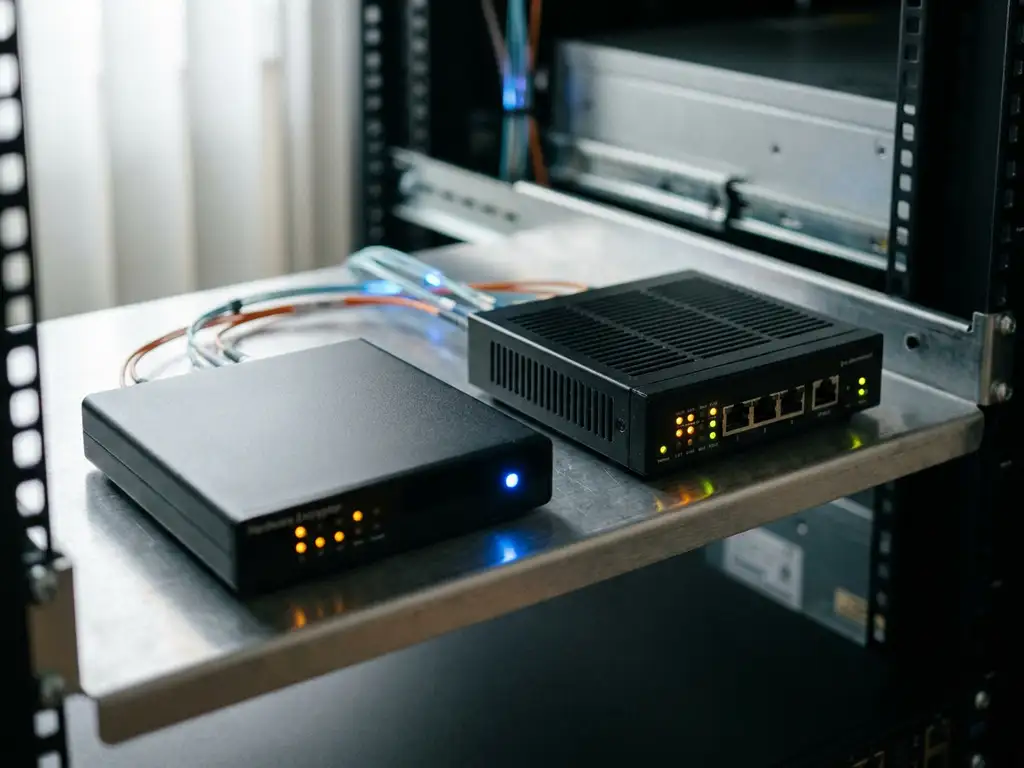
A hardware encryptor and a firewall both protect your network, but they do so in fundamentally different ways. A firewall filters traffic based on rules and blocks unwanted connections. A hardware encryptor encrypts the entire data stream at the level of the physical connection, ensuring that intercepted data remains unreadable. Both solutions complement each other and are in many cases both necessary for comprehensive network security.
What does a hardware encryptor protect that a firewall does not?
A hardware encryptor protects the confidentiality of data in transit across the network, even after that data has already been permitted through the firewall. A firewall determines which traffic is allowed to pass, but encrypts nothing. If an attacker taps the physical connection or intercepts data between two locations, all unencrypted information is simply readable. A hardware encryptor makes that impossible.
The difference lies in the security principle. A firewall operates on the basis of access control: it keeps unauthorized connections out. A hardware encryptor operates on the basis of confidentiality: it ensures that data is unreadable to anyone who is not authorized to access it, even if they have physical access to the connection.
This makes hardware encryption indispensable in scenarios where data is transmitted over external or public networks, such as connections between data centers, office locations, or critical infrastructure points. A firewall offers no protection against physical eavesdropping or man in the middle attacks at layer 1 or layer 2 of the OSI model. Exploring the full range of security solutions available can help you understand where hardware encryption fits within a broader defense strategy.
How does layer 1 and layer 2 encryption work in practice?
Layer 1 and layer 2 encryption encrypt data at the deepest level of the network, before higher level protocols such as IP or TCP come into play. At layer 1, the physical signal itself is encrypted; at layer 2, the Ethernet frame is encrypted before it travels over the connection. The result is that the entire data stream is unreadable to outsiders, regardless of the content or protocol used.
Layer 1 encryption: securing the physical signal
With layer 1 encryption, the optical or electrical signal itself is encrypted. This occurs directly on the physical connection, for example on a fiber optic link. Because the encryption takes place before any protocol processing, there is no way to intercept the data without the key. This level of security is particularly relevant for fiber optic connections in critical environments, and is closely related to the capabilities found in optical networking products designed for high security deployments.
Layer 2 encryption: security at the Ethernet level
Layer 2 encryption operates at the level of Ethernet frames. This is the most common form of hardware encryption for WAN connections and point to point connections between locations. The encryption is completely transparent to higher network layers, meaning that existing network equipment and applications continue to function without any modifications. The latency added by hardware encryption is minimal, making it suitable for latency sensitive applications.
Ready for the next step?
Explore our solutions or get in touch with one of our experts directly.
When do you need both a hardware encryptor and a firewall?
You need both when your network requires both access control and data confidentiality in transit. In practice, this applies to virtually any organization that transmits sensitive information over connections outside its own physical control. The firewall guards the boundaries of your network; the hardware encryptor protects the data that crosses those boundaries.
Consider an organization with multiple locations communicating via a leased fiber optic network. The firewall filters unwanted traffic and protects against external attacks. But the connection between locations runs over infrastructure that is not entirely under the organization’s own control. That is where a hardware encryptor ensures that any intercepted data is worthless to an attacker.
Both solutions are complementary, not interchangeable. A firewall is not a substitute for encryption, and encryption is not a substitute for access control. Organizations that believe a firewall is sufficient are leaving a significant attack surface unprotected.
Which organizations need a hardware encryptor?
Organizations that transmit sensitive or confidential data over external networks need a hardware encryptor. This is especially true for sectors where data breaches have direct operational, legal, or security consequences such as healthcare institutions, government organizations, financial institutions, data centers, and critical infrastructure operators.
In healthcare, patient data is exchanged between hospitals, laboratories, and general practitioners. In transportation and the maritime sector, operational systems are managed via networks that span large distances. In critical infrastructure such as energy and water management, the integrity of communications is a matter of safety. What all these environments have in common is that the consequences of a data breach or interception extend well beyond financial damage alone.
Organizations subject to strict compliance requirements such as NIS2 or sector specific regulations may also be required to apply encryption at the network level. A sound security policy always combines multiple layers of protection in such cases. Managed security services can play an important role here, ensuring that encryption policies are consistently enforced and kept up to date.
What is the difference between software encryption and a hardware encryptor?
Software encryption encrypts data at the application or operating system level, whereas a hardware encryptor performs encryption in a dedicated physical device at the network level. The practical difference lies in performance, reliability, and attack surface. Hardware encryption is faster, more consistent, and less vulnerable to software based attacks.
With software encryption, the encryption process runs on a server or endpoint. This means the system itself must be compromised in order to undermine the encryption. A hardware encryptor has its own processor and memory dedicated to cryptographic operations. The keys never leave the device, which drastically reduces the attack surface.
In addition, software encryption typically operates at layer 3 or higher, which means that metadata such as IP addresses, routing information, and connection patterns may still be visible. Hardware encryption at layer 1 or layer 2 conceals this information as well, providing far more complete protection against traffic analysis.
How do you choose the right encryption solution for your network?
The right encryption solution is chosen based on four factors: the sensitivity of the data you transmit, the network topology, the required performance, and the compliance obligations that apply to your organization. There is no universal solution; the choice depends on your specific situation.
Start by identifying which connections fall outside your direct physical control. Those are the connections where encryption makes the greatest difference. Next, determine which OSI layer is most appropriate: layer 1 for maximum transparency and protection of the signal itself, layer 2 for flexible deployment on Ethernet connections. Then consider bandwidth requirements and whether the encryption may affect latency sensitive applications.
You should also account for future threats. Quantum computing poses a real long term risk to current encryption standards. Solutions that support quantum resistant algorithms offer a longer lifespan and also protect against future attacks in which currently intercepted data is decrypted at a later date.
How we help with encryption and network security
We help organizations select, implement, and manage the right combination of encryption and network security. Not an off the shelf solution, but an approach tailored to your network environment, your data, and your risk profile. You can find an overview of all available networking solutions to see how encryption fits within a complete network security architecture.
- Advice on layer 1 and layer 2 encryption, aligned with your network topology and compliance requirements
- Vendor independent selection from proven encryption solutions from partners such as Cisco, Nokia, and Huawei
- Integration of encryption into existing network architecture without impact on performance
- Support throughout the full lifecycle, from design to ongoing management
- Future proof solutions that also protect against quantum threats
Want to know which encryption solution is right for your situation? Get in touch and we’ll work together to address the security challenges in your network.
Ready for the next step?
Explore our solutions or get in touch with one of our experts directly.