


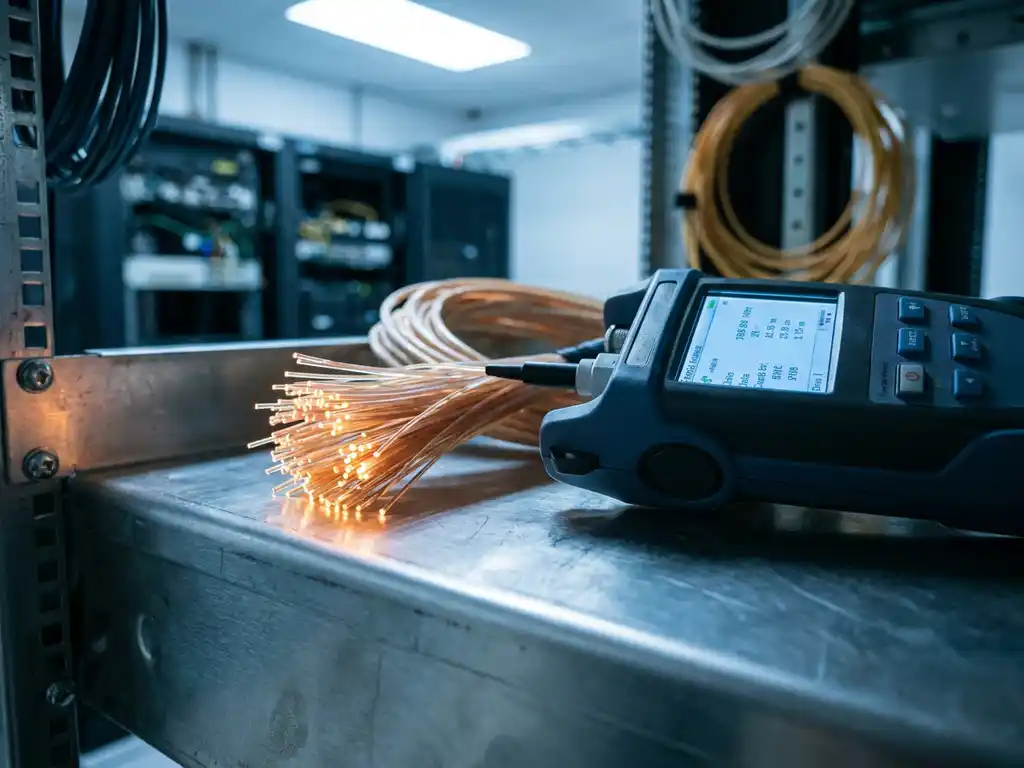
ALM, or Automatic Laser Management, is a technology within fiber optic monitoring that automatically supervises and manages laser transmission in an optical network. The system detects interruptions in the fiber optic connection and immediately shuts down the laser to prevent further damage or hazardous situations. Once the connection is restored, the laser is automatically switched back on. In this article, we answer the most frequently asked questions about ALM fiber optic monitoring: how it works, what it delivers, and when you need it.
How does ALM work in an optical network?
ALM works by continuously measuring the outgoing and incoming optical power on a fiber optic connection. As soon as the system detects a significant drop in the received signal indicating a cable break or severe degradation it automatically shuts down the laser. This protects both the equipment and the personnel working near the fiber. Once the fault has been resolved, ALM recognizes this and switches the laser back on.
The mechanism is based on a feedback loop between the transmitting and receiving ends of an optical connection. The equipment continuously measures parameters such as received power and signal integrity. If a measurement deviates from the configured threshold values, the system responds within milliseconds. This makes ALM fundamentally different from passive monitoring: the system intervenes actively, not just after the fact.
An important characteristic of modern ALM implementations is that they do not require active equipment at remote locations. The intelligence resides in the central network equipment, which greatly simplifies management and minimizes the risk of failures caused by external hardware. This is part of a broader set of networking solutions designed to keep optical infrastructure reliable and manageable.
What are the benefits of ALM in fiber optic monitoring?
The benefits of ALM in fiber optic monitoring are direct and measurable. The system significantly reduces recovery time during outages, prevents unnecessary damage to equipment, and increases safety around fiber optic installations. Because issues are automatically detected and the laser is immediately shut down, technicians do not need to intervene manually before the situation is safe.
Specifically, ALM delivers the following benefits:
- Faster fault detection: the system responds to anomalies within milliseconds, long before an administrator receives a notification.
- Less damage to optical components: automatically shutting down the laser protects transceivers and other vulnerable components.
- Greater safety: eye safety is a genuine concern in fiber optic installations; ALM prevents an active laser from continuing to emit unattended in the event of a cable break.
- Proactive signal monitoring: ALM measures physical parameters such as received power and optical reflections, making degradation visible before performance issues arise.
- Low operational overhead: thanks to self-calibration, regular manual maintenance is not required.
For organizations that depend on continuous network availability such as hospitals, data centers, or transport networks this is not a luxury but a fundamental requirement. A network that monitors itself and responds without human intervention reduces the burden on IT teams and significantly shortens downtime. Managed services can further extend this capability by providing round-the-clock oversight and expert intervention when it matters most.
Ready for the next step?
Explore our solutions or get in touch with one of our experts directly.
What is the difference between ALM and OTDR monitoring?
The core difference between ALM and OTDR monitoring is that ALM is an active, real-time safety mechanism that manages the laser based on signal measurements, while OTDR is a diagnostic instrument that maps the physical condition of a fiber optic cable. ALM responds automatically to faults; OTDR is used to identify the location and nature of a fault.
An OTDR, or Optical Time-Domain Reflectometer, sends a light pulse into the fiber and analyzes the reflected signal to determine the exact location of a break, bend, or connection loss. This is a valuable technique during installation and maintenance, but it is not a continuous monitoring system. OTDR measurements are typically performed manually or at scheduled intervals.
ALM, by contrast, operates continuously and autonomously. It does not compare historical signal profiles but responds directly to deviations in the live network. The two techniques complement each other: ALM provides immediate response and protection, while real-time fiber optic monitoring and diagnostic tools such as OTDR help locate and resolve the root cause of a fault.
In which network environments is ALM essential?
ALM is essential in network environments where high availability and safety are non-negotiable. This includes critical infrastructure, healthcare networks, transport networks, and data centers, as well as environments where technicians regularly work on active fiber optic connections. In all of these situations, ALM provides the automatic protection that manual monitoring cannot guarantee.
Specific environments where ALM is particularly valuable:
- Healthcare and hospitals: networks connecting medical equipment cannot afford unexpected downtime; ALM detects issues before they impact business-critical systems.
- Transport networks: in rail, highway, and port environments, fiber optic connections are often laid over long distances and are difficult to inspect; automated monitoring is therefore indispensable.
- Data centers and DCI connections: high data density and continuous operation make rapid fault detection and automatic recovery a necessity.
- Passive access networks (PON): ALM is straightforward to configure for passive monitoring of access services without requiring active equipment at remote locations.
- Critical infrastructure: energy companies, water management authorities, and government networks operate connections that must be available 24/7, where security incidents can have immediate consequences.
In environments where the security of data transmitted over the fiber is also a concern, it is worthwhile to combine ALM with additional security solutions at the network level.
How is ALM configured in network equipment?
ALM is configured through the management interface of the optical network equipment, where threshold values are set for the minimum received power and the maximum allowable signal deviation. Once a measurement falls outside these limits, the system automatically shuts down the laser. Configuration is typically a one-time process and requires no regular maintenance afterward, thanks to self-calibration.
In practice, the configuration steps include:
- Inventory of connections: identify which fiber optic links require monitoring and determine the expected signal levels based on cable length and the number of connectors.
- Setting threshold values: configure the minimum and maximum power values within which the network operates normally. Deviations outside these limits trigger ALM.
- Integration with the monitoring system: ensure that ALM events are forwarded to a central monitoring and network management platform so that administrators are notified immediately.
- Testing the automatic response: simulate a connection interruption to verify that the laser shuts down correctly and restarts after the fault is resolved.
- Documentation and management: record the configuration and schedule periodic reviews to confirm that the settings still match the current network topology.
Modern optical equipment often supports ALM as a standard feature, but activation and fine-tuning require technical knowledge of the specific network environment. An incorrect threshold value can result in false shutdowns or, conversely, in genuine faults going undetected. Explore our range of optical products to find equipment that supports robust ALM functionality out of the box.
How we help with ALM fiber optic monitoring
We implement and manage ALM solutions as part of our broader approach to fiber optic monitoring and proactive uptime management. In doing so, we combine technical depth with a practical approach that aligns with your specific network environment and business objectives.
What we concretely offer:
- Comprehensive network analysis to determine where ALM will have the greatest impact on your infrastructure
- Configuration and commissioning of ALM on existing or new optical equipment
- Integration with real-time monitoring platforms for immediate alerts and clear reporting
- Implementation of redundant connections and failover systems for maximum availability
- 24/7 monitoring and proactive maintenance of the entire network infrastructure
- Tailored maintenance contracts, so you always have the right support at the right time
With more than 20 years of experience in fiber optic communications and optical network infrastructure, we translate complex monitoring challenges into practical, future-proof solutions. Want to find out how ALM can make your network more stable and secure? Contact us for a no-obligation consultation.
Ready for the next step?
Explore our solutions or get in touch with one of our experts directly.