


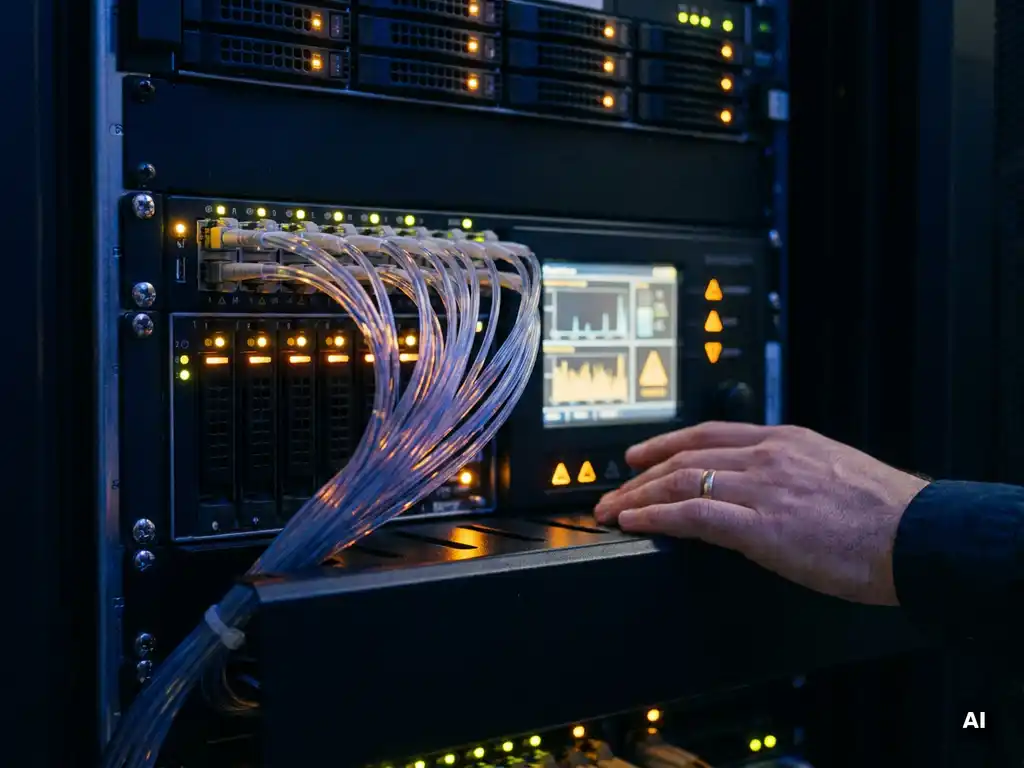
An organization needs realtime optical monitoring as soon as a failure in the fiber optic network causes direct operational or financial damage. The more critical the processes running on the network, the greater the need to detect problems before they escalate into outages. In this article, we answer the most frequently asked questions about when and why realtime monitoring of your optical infrastructure becomes indispensable.
What are the consequences of an outage without realtime monitoring?
Without realtime optical monitoring, you only discover a failure when users or systems report it. By that time, the outage has already impacted business processes, customers, or safety. The damage is then not only technical, but also operational and reputational.
In practice, this means your network management team operates reactively. A fiber optic connection can gradually degrade due to physical damage, temperature fluctuations, or connector contamination, without anyone noticing. Only when the connection fails completely does the search for the cause begin. That takes time, and time is costly in business-critical environments.
Think of a hospital where medical equipment communicates via the network, or a data center where downtime directly leads to contractual penalties. In such situations, the question is not whether you need realtime monitoring, but why you haven’t started yet.
Which organizations benefit most from optical monitoring?
Organizations with business-critical networks, high availability requirements, or sensitive data benefit most from realtime fiber optic monitoring. This is especially true for sectors where network outages directly affect safety, continuity, or compliance.
The following types of organizations face the greatest risk from unmonitored network loss:
- Hospitals and healthcare institutions where networks support medical systems, patient records, and monitoring equipment
- Data centers and cloud providers with strict SLA obligations for uptime
- Transport and logistics where realtime data transmission is essential for planning and safety
- Critical infrastructure such as energy networks, water management, and government facilities
- Educational institutions with large, distributed networks across multiple campuses
- Maritime organizations where connectivity in remote locations is difficult to restore
Common characteristic: in all these organizations, manual or periodic inspection is too slow to prevent damage.
How does realtime monitoring of an optical network work?
Realtime optical network monitoring works by continuously performing measurements on the fiber optic connections in your network. Specialized equipment analyzes signal strength, attenuation, and error patterns and compares these against established thresholds. When deviations occur, the system immediately generates an alert.
The core of the system consists of optical taps or inline measurement equipment that monitors the light signal without interrupting the data stream. The measurement data is forwarded to a central management platform where network administrators have a complete overview of the status of every connection.
Modern monitoring and network management solutions offer not only live insight, but also historical data. This allows you to identify trends, such as a slowly increasing attenuation on a specific segment, and intervene proactively before a connection actually fails. That is the difference between reactive recovery and proactive management.
What is the difference between passive and active optical monitoring?
Passive optical monitoring measures the signal without actively intervening in the network. Active monitoring sends its own test signals through the network to measure quality and availability. Both methods have their own applications, and the choice depends on your network topology and availability requirements.
Passive monitoring
With passive monitoring, the existing light signal is tapped and analyzed. The network is unaware of this. This approach is suitable for environments where the signal must not be disturbed, such as with encryption layers or sensitive transmissions. The drawback is that passive monitoring only works when an active signal is already present. A connection without data traffic is not monitored.
Active monitoring
Active monitoring sends its own test pulses through the fiber, also known as OTDR measurements (Optical Time Domain Reflectometry). This allows you not only to measure signal quality, but also to determine the exact location of a break or attenuation. This is particularly valuable for long routes or complex network topologies, as it drastically reduces the time needed for fault detection.
In most professional environments, a combination of both methods is applied for maximum coverage.
When is periodic measurement no longer sufficient?
Periodic measurement is no longer sufficient when the time between two measurements exceeds the maximum acceptable downtime of your network. If an outage occurs between two measurement moments and goes unnoticed, your organization sustains unnecessary damage for an extended period.
In addition, there are situations where the nature of the problems makes periodic measurement structurally inadequate:
- Intermittent faults that only occur under certain conditions and are not visible during a scheduled measurement
- Gradual signal degradation that flies under the radar between measurement moments until it is too late
- Physical threats such as excavation work near fiber optic cables, where you want to know immediately if something goes wrong
- Compliance requirements that mandate demonstrable, continuous monitoring
If your network falls into one of these categories, switching to realtime monitoring is not a luxury, but an operational necessity.
What signals indicate that your network is ready for realtime monitoring?
Your network is ready for realtime optical monitoring when the operational risks of unmonitored outages outweigh the investment in a monitoring solution. There are concrete signals that indicate the time has come to make the move.
Watch for the following indicators:
- Increasing outages that you only discover through user complaints rather than through your own systems
- Growing network with more connections, greater distances, or more dependent systems than before
- New compliance requirements from regulations or customer contracts that require demonstrable availability
- Expansion into critical applications such as video surveillance, medical equipment, or industrial control systems
- Rising recovery costs due to prolonged outages or expensive emergency repairs
- Security as a priority where physical attacks on the fiber optic network pose a real risk
Do you recognize several of these signals? Then it is wise to look into a structured approach for your optical network infrastructure. We help organizations assess their current situation and design a monitoring solution that fits their specific environment and risk profile. From advice to implementation and management, we remain involved throughout the entire lifecycle of your network.