


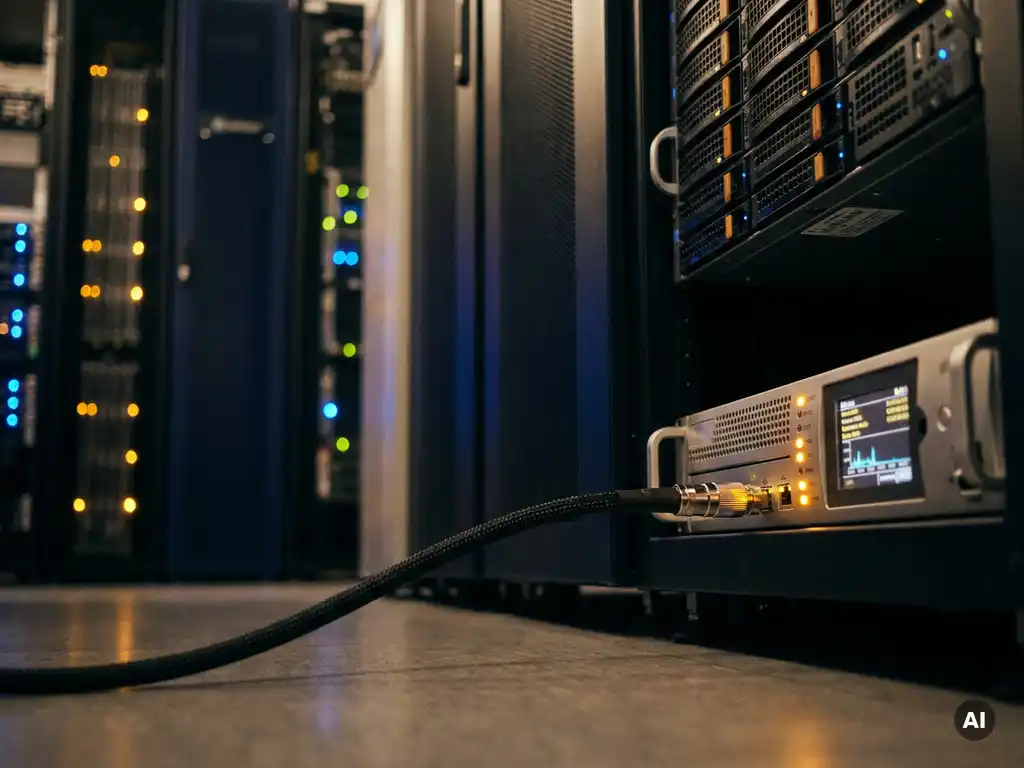
A corporate network needs layer 1 encryption when the data traveling across it is so sensitive that even a physical attack on the cable or fiber is unacceptable. Think of organizations in critical infrastructure, defense, financial services, or healthcare, where a data breach not only causes reputational damage but also has legal or security consequences. In this article, we answer the most frequently asked questions about layer 1 encryption, so you can determine whether it is the right choice for your network.
What threats does layer 1 encryption neutralize?
Layer 1 encryption protects against attacks on the physical transmission layer of your network. This means that intercepting signals on fiber or copper, also known as “fiber tapping” or “line tapping,” yields no usable data. Even if an attacker gains physical access to the cable, they see only encrypted noise traffic.
The threats that layer 1 encryption specifically neutralizes include:
- Fiber tapping: tapping light signals on fiber without breaking the connection
- Man-in-the-middle attacks at the physical level: placing an eavesdropping device in the cable route
- Insider threats via physical access: employees or contractors who have access to the infrastructure
- Attacks on leased lines or dark fiber: where you depend on the physical security of an external provider
What makes layer 1 encryption unique is that it encrypts the data before it leaves the network device. There is no software vulnerability or configuration error that can bypass the encryption, because the security takes place entirely at the hardware level.
How does layer 1 encryption differ from IPsec and TLS?
The key difference is where in the network chain the encryption takes place. IPsec operates at layer 3 (network layer) and TLS at layers 4–7 (transport and application layer). Layer 1 encryption encrypts at the physical transmission level, making all data, including headers and protocol information, completely unreadable to an attacker.
This has practical implications:
- Latency: Layer 1 encryption adds virtually no delay, because it operates at the hardware level. IPsec and TLS require software overhead and can introduce noticeable latency, which is problematic for time-sensitive applications.
- Metadata protection: IPsec and TLS encrypt the payload, but often leave metadata such as IP addresses and packet sizes visible. Layer 1 encryption also conceals this information.
- Attack surface: Higher layers depend on software, configurations, and certificates. All of these elements can contain vulnerabilities. Layer 1 has no software stack that can be attacked.
- Transparency: Layer 1 encryption is protocol-agnostic. It does not matter which protocol runs over it — everything is protected without modifying the applications.
In short: IPsec and TLS protect the content of communications. Layer 1 encryption protects the communication itself, at the most fundamental level. The two approaches are not mutually exclusive and are often combined in environments with high security requirements.
In which sectors is layer 1 encryption mandatory or strongly recommended?
Layer 1 encryption is mandatory or strongly recommended in sectors where laws and regulations impose strict requirements on the protection of data in transit, or where a data breach creates direct security risks. In 2026, this applies to a growing number of organizations due to tightened European regulations such as NIS2 and the increasing threat of quantum computers.
Sectors where layer 1 security is particularly relevant:
- Government and defense: state secrets and classified communications require the highest levels of protection
- Healthcare: patient data is subject to strict privacy legislation and must not be interceptable
- Financial services: transaction data and customer information are targets for targeted attacks
- Critical infrastructure: energy, water, and transport, where network disruption or data theft has societal consequences
- Data centers and cloud providers: transporting data from multiple customers over shared infrastructure
- Education and research: institutions with valuable intellectual property on shared networks
Want to know how sensitive data can be protected within your sector? The specific requirements vary by market and by the type of data you process.
When is layer 1 encryption the better choice over higher layers?
Layer 1 encryption is the better choice when you are dealing with high data volumes, low latency requirements, or when you want to decouple security from the application layer. It is also the designated solution when you are transporting data over infrastructure that you do not fully manage yourself, such as leased lines or dark fiber.
Specific situations in which layer 1 encryption is preferred:
- You are transporting large volumes of data via WDM or fiber over long distances
- Latency is critical, for example in financial trading systems or real-time industrial control
- You want no dependency on software configurations or certificate management for your basic security
- Quantum threats are a factor, as layer 1 encryption can be combined with quantum-resistant security
- Your network processes multiple protocols simultaneously and you want a uniform security layer
Is latency not an issue and does it involve smaller data streams between specific applications? Then IPsec or TLS may be sufficient. But as soon as the physical infrastructure itself becomes an attack vector, layer 1 offers a level of protection that higher layers simply cannot provide.
What are the requirements for implementing layer 1 encryption?
Implementing layer 1 encryption requires specialized hardware, compatible network infrastructure, and a clear key management process. It is not a software update, but a modification at the level of the physical network layer. Proper preparation prevents compatibility issues and ensures seamless integration.
The key requirements are:
- Dedicated encryption hardware: specialized equipment that performs the encryption at the hardware level, coupled to the transmission equipment
- Compatible transmission infrastructure: the encryption must be compatible with the fiber or WDM system in use
- Key management: a robust system for generating, distributing, and rotating encryption keys
- Redundancy: for business-critical connections, the encryption layer must also support failover
- Certification: depending on the sector, specific certifications may be required, such as FIPS 140-2 or Common Criteria
Implementation requires technical knowledge of both the physical network layer and the security requirements of your organization. An incorrect configuration can undermine security or disrupt the connection. View our encryption solutions for an overview of the available hardware and approaches.
What questions should an organization ask before purchasing?
Before investing in layer 1 encryption, it is essential to thoroughly map out the security need, the technical environment, and the operational impact. Asking the right questions prevents you from investing in a solution that does not align with your infrastructure or your threat profile.
Ask yourself and your vendor these questions:
- What is our threat profile? Are we a target for targeted physical attacks, or is this about compliance requirements?
- Over what infrastructure do we transport data? Own fiber, leased lines, or dark fiber?
- What are our latency requirements? Are there applications that are sensitive to additional delay?
- What certifications are required? Think of sector-specific standards or government standards.
- How do we manage encryption keys? Do we have the internal expertise or do we need support?
- How does this integrate with our existing security architecture? Does it work together with higher encryption layers?
- What is the management model after implementation? Who monitors, maintains, and updates the encryption hardware?
The answers to these questions determine which solution fits best. A good vendor not only helps you with the purchase, but also thinks along with you about the design, implementation, and long-term management. Would you like to discuss the security architecture of your network? We are happy to think along with you about an approach that fits your situation and risk profile. View our security solutions or get in touch directly.