


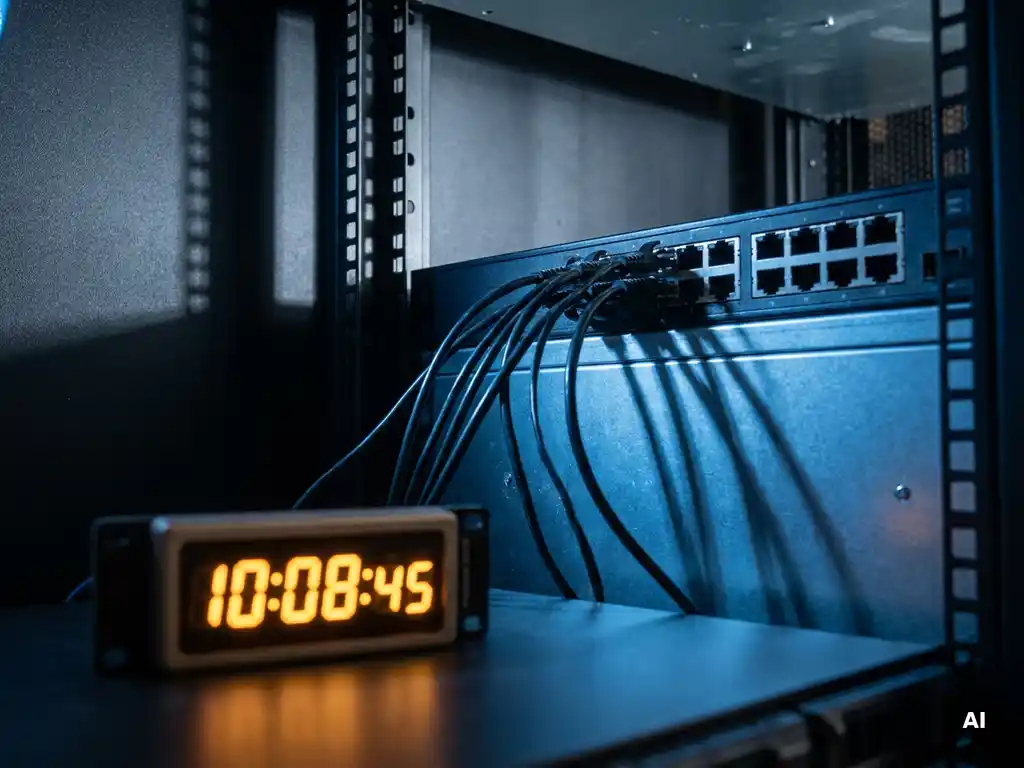
You need redundant time sources as soon as a failure in your time synchronization has direct consequences for the availability, security, or performance of your network. This applies in particular to organizations in sectors such as transport, healthcare, data centers, and critical infrastructure, where even small timing deviations carry significant operational risks. In this article, we answer the most frequently asked questions about timing redundancy, from the consequences of an outage to the choice between NTP and PTP.
What happens when a time source fails in a network?
When a time source fails in a network, devices lose their common time reference. This causes clocks to drift apart, resulting in errors in logs, authentication processes, encryption, and data transfer. In networks without redundant time sources, a single failure can trigger a domino effect that impacts the entire infrastructure.
In practice, a time failure manifests in various ways. Security certificates become invalid because the timestamp is no longer correct. Database transactions fall out of sync, which can lead to data loss or corruption. In distributed systems such as financial platforms or telecom networks, packets may be processed in the wrong order, with direct consequences for service delivery.
The longer a network operates without reliable time synchronization, the greater the drift becomes. Some systems have built-in holdover mechanisms that can operate without an external source for a period of time, but these are finite. Without a well-thought-out network architecture with multiple time sources, recovery after an outage is also time-consuming and error-prone.
Which sectors and applications require redundant time synchronization?
Sectors that work with business-critical processes, real-time communication, or strict regulations almost always require redundant time synchronization. This applies in particular to transport and logistics, healthcare, data centers, financial institutions, telecom, and critical infrastructure such as energy and water networks.
In the healthcare sector, medical devices and patient records must be precisely synchronized. A deviating timestamp in an electronic patient record can lead to medical errors or issues during audits. In the transport sector, precision timing and coordination between systems are essential for safe operations, whether it concerns rail management, aviation navigation, or maritime communication.
Data centers are another clear example. Here, distributed applications run that depend on accurate timestamps for transaction processing, replication, and fault detection. Even a deviation of a few milliseconds can cause inconsistent data across multiple nodes. In industrial environments with automated production processes, timing redundancy is also not a luxury but a requirement.
What is the difference between NTP and PTP redundancy?
NTP redundancy and PTP redundancy differ primarily in accuracy and scope of application. NTP provides synchronization at the millisecond level and is suitable for general IT environments. PTP (Precision Time Protocol) achieves accuracies down to the microsecond and is designed for environments where high precision is essential, such as telecom, energy, and financial trading.
NTP redundancy
With NTP redundancy, you configure multiple NTP servers as time sources, so that clients automatically switch over when a server becomes unreachable. This is relatively straightforward to set up and sufficient for most enterprise IT environments. However, accuracy is limited, especially over WAN connections where network latencies vary.
PTP redundancy
PTP redundancy is more complex and requires specialized hardware that supports the protocol, such as boundary clocks and transparent clocks. Multiple grandmaster clocks can be deployed so that networks seamlessly switch to a secondary source upon failure of a primary source. This is essential for applications where microsecond-level timing is required, such as 5G networks, financial exchanges, and energy networks with precision protection.
The choice between NTP and PTP depends on the accuracy requirements of your applications. For many organizations, a combination of both makes sense: NTP for general IT systems and PTP for time-critical infrastructure.
When is a GNSS backup necessary as a time source?
A GNSS backup is necessary when your network depends on an external time signal via satellite systems such as GPS, and an interruption of that signal has direct consequences for the operation of your infrastructure. This is particularly relevant for organizations that use PTP grandmaster clocks that receive their primary time signal from GNSS.
GNSS signals can be disrupted by atmospheric conditions, spoofing, jamming, or simply a poor antenna position. In environments such as tunnels, ports, industrial sites, or urban areas with dense construction, reception of GNSS signals is not always guaranteed. A GNSS backup ensures that your system falls back to an alternative time source in the event of signal loss, such as an atomic clock or another GNSS receiver at a different location.
For sectors such as telecom, rail, and energy, where network synchronization is legally or operationally mandated, a GNSS backup is not an optional addition. It is a fundamental part of a robust timing architecture. Real-time monitoring of your infrastructure also helps to detect signal disruptions at an early stage, so you can intervene in time.
How do you determine how many redundant time sources you need?
The number of redundant time sources you need depends on your availability requirements, the criticality of your processes, and the risks you want to mitigate. As a rule of thumb: the higher the impact of a time failure, the more layers of redundancy you need to build in.
Start with a risk analysis. Ask yourself: what are the consequences if my primary time source fails? If the answer is that processes immediately come to a halt or data is lost, then at least one secondary time source is required. If business-critical or safety-relevant systems are involved, a third source is recommended as a tiebreaker and additional safeguard.
In practice, many professional networks use a three-tier architecture: a primary GNSS-fed grandmaster clock, a secondary grandmaster as a backup, and a holdover mechanism in the equipment itself for brief interruptions. The longer the required holdover time, the more accurate the internal oscillator must be. This has direct implications for hardware selection and therefore for costs.
If you want to make the right assessment for your situation, it is advisable to discuss this together with a specialist. We help you map out the risks and design a timing architecture that fits your infrastructure and requirements.
What signals indicate that your current time synchronization is insufficient?
Insufficient time synchronization manifests itself in recognizable symptoms that disrupt your network and applications. The most common signals are inconsistent logs, failed authentications, issues with security certificates, and unexplained errors in distributed systems or databases.
Concrete warning signals include:
- Timestamps in log files that do not match between different systems or servers
- Certificate errors caused by time differences between client and server
- Authentication issues with protocols such as Kerberos, which depend on accurate time synchronization
- Irregularities in database replication or conflicts in distributed transactions
- Alert notifications in your network management system about clock deviations or lost NTP or PTP connections
- Performance issues in time-critical applications that cannot be explained by other causes
Many of these problems are initially not recognized as timing issues, which complicates diagnosis. Proactive monitoring of your network is therefore essential. With the right tools, you can see time deviations before they lead to outages, and you can intervene before the impact becomes noticeable to users or processes.
If you notice one or more of these signals in your network, the time has come to seriously evaluate your time synchronization architecture. A well-configured system with redundant time sources not only prevents outages, it also gives you the assurance that your infrastructure continues to operate reliably and securely, even when something unexpected occurs.
Ready for the next step?
View our solutions or get in touch directly with one of our experts.