


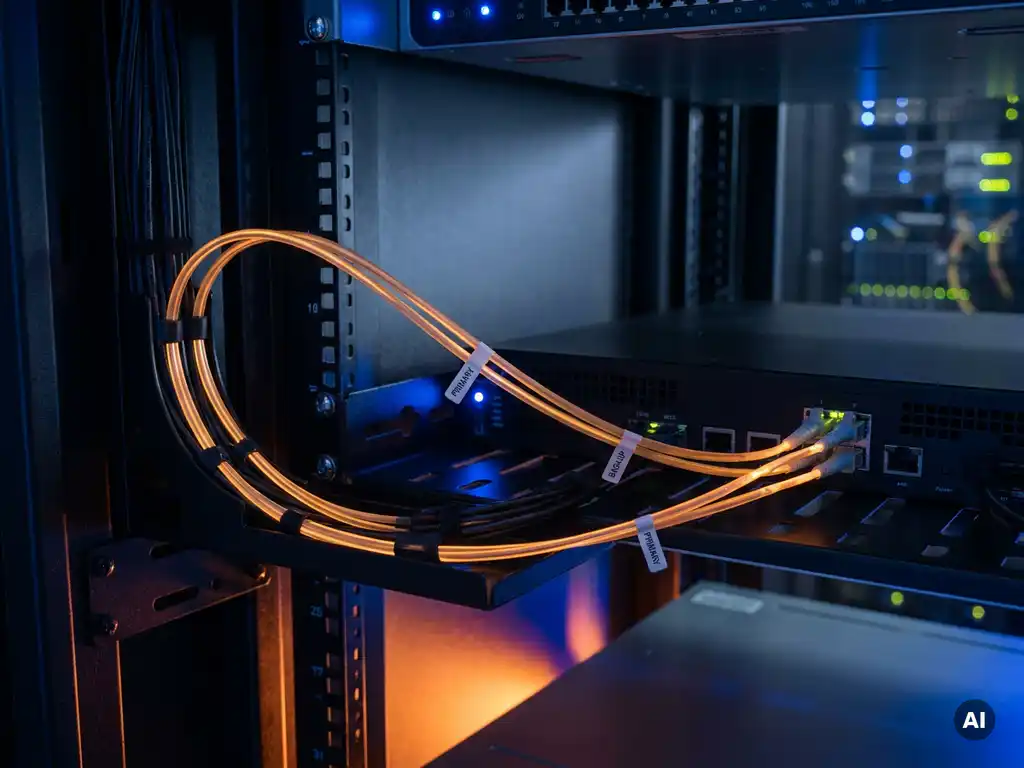
If your primary and backup connection follow the same physical route, you essentially have no real redundancy. In the event of excavation work, cable breaks, or a failure along that route, both connections go down simultaneously. True network redundancy requires not just two logical connections, but also two completely separate physical paths. For healthcare organizations in particular, this distinction is critical: a shared route failure can interrupt access to electronic patient records, medication data, alarm systems, and clinical communication all at once. Below, we answer the most frequently asked questions about route diversity and how to truly protect your network against outages.
Why don’t two connections via the same route protect you?
Two connections via the same physical route offer no protection because they share the same single point of failure. If the underlying cable, conduit route, or physical infrastructure fails, both connections lose their signal at the same time. You then have two contracts, but in practice just one vulnerable path.
This is a common mistake when designing redundant network connections. Organizations invest in a primary and a backup connection, but fail to verify whether those connections actually run via different physical routes. The result is a false sense of security that only becomes apparent at the worst possible moment: right in the middle of an outage.
Consider a fiber optic cable running through a city ring. Two providers can both make use of that same cable or the same conduit route, while each offering their own contract. Logically, they are two separate connections. Physically, they represent a single risk. That risk is called a single point of failure, and it renders your entire redundancy plan worthless. In a hospital or care facility, this means that a single excavation incident can simultaneously cut off access to the electronic health record system, real-time patient monitoring, and the communication infrastructure that clinical staff depend on.
What are the most common causes of shared route risks?
The most common causes of shared route risks are shared use of the same physical fiber optic cable or conduit route, purchasing connections from two providers that use the same underlying infrastructure, and the absence of route documentation during installation or contracting.
In practice, we see this recurring at multiple levels:
- Shared cable duct or conduit route: Two cables run side by side in the same trench or duct. Excavation work hits both at the same time.
- Common PoP location: Both connections converge at the same access point or node of a provider, meaning an outage there affects both circuits.
- Reseller arrangements: A provider acting as a reseller of another provider effectively delivers the same underlying connection, even if the contract looks different.
- Insufficient documentation: During installation or contracting, the physical route of the connection was never recorded, leaving the risk invisible.
This is not always due to bad intent or negligence on the part of a provider. Sometimes the shared route is simply the result of the available infrastructure in a region. That makes it all the more important to actively verify and document this. For healthcare organizations operating across multiple locations — such as a hospital campus connected to satellite clinics or a regional care network — the consequences of undocumented shared routes can be severe, affecting not just connectivity but the continuity of care itself.
How do you verify whether your connections truly follow a separate route?
You verify whether connections follow a separate route by requesting the physical route documentation from your provider(s), including cable routing, access points, and any shared infrastructure. Combine this with a network measurement or traceroute analysis to verify that the paths are also logically separated from each other.
Concretely, these are the steps you can take:
- Request a route attestation: Ask your provider to confirm in writing that the connection follows a physically separate path compared to your other connection. Reputable providers can demonstrate this.
- Check the PoP locations: Verify whether both connections enter your location and the provider via different access points.
- Run a traceroute: A traceroute shows which nodes your traffic passes through. If both connections show the same hops, there is a shared path.
- Document it contractually: Ensure that route diversity is explicitly included in the SLA or contract, including guarantees regarding physical path separation.
With real-time fiber optic monitoring, you can also continuously keep track of the status of your connections and quickly detect if something goes wrong on a specific path. Tools such as Adtran ALM and Mosaic Fiber Director support continuous monitoring of physical fiber connections and can detect anomalies before they develop into a full outage — a capability that is particularly relevant for healthcare environments where network teams need to identify and isolate a fault quickly without disrupting active care processes.
What is the difference between logical redundancy and physical path redundancy?
Logical redundancy means you have two separate connections or circuits at the network level. Physical path redundancy means those connections also run via completely different physical routes, without shared cables, nodes, or infrastructure. Only physical path redundancy provides protection against infrastructure failures.
The distinction is crucial for anyone looking to prevent network outages:
- Logical redundancy protects you against software errors, configuration issues, and device failures on one side. Think of a failover between two routers or two logical circuits with the same provider.
- Physical path redundancy also protects you against cable damage, excavation work, fire in a cable duct, or the failure of a physical node. The connections can continue to operate independently of each other, even if one path fails completely.
For business-critical environments, such as data centers, hospitals, or transport networks, logical redundancy alone is insufficient. You need both: separate circuits and separate physical paths. Only then do you have a true backup connection that lives up to its name. In a healthcare context, this means that a tested and verified failover must be in place for systems such as the electronic patient record, medication management, and clinical alarm routing — not just at the network level, but across the full physical path from the care location to the data center or cloud environment where those applications are hosted.
What solutions ensure true route diversity?
True route diversity is achieved by combining connections that demonstrably run via different physical paths, preferably via different providers, technologies, or infrastructure types. Think of a fiber optic connection via a different cable route, combined with a wireless or satellite connection as a backup.
Practical solutions for physical path redundancy include:
- Dual-homing via different providers: Purchasing connections from two providers that demonstrably use different physical infrastructure and different cable routes.
- Combination of technologies: Combining a fixed fiber optic connection with a mobile connection via LTE or 5G provides a fundamentally different physical path and therefore true backup redundancy. For healthcare organizations, this combination also supports mobile care delivery on-site, provided that network segmentation is applied to keep clinical traffic separated from general staff and guest devices.
- Geographically separated access points: Ensure that the two connections enter your building via different entry points, so that local damage does not affect both circuits.
- Out-of-band management: With an out-of-band management connection, you always have an independent management path available, even when the primary connection fails. This is essential for reaching network equipment remotely during an outage — enabling diagnosis and recovery without requiring on-site intervention at every location.
For healthcare organizations that are expanding capacity across multiple sites or connecting locations to a central data center, optical transport solutions based on Adtran FSP 3000 can support high-capacity fiber connections with the flexibility to scale as the number of users, locations, and connected care devices grows. Where Carrier Ethernet access and performance monitoring at the network edge are relevant, Adtran FSP 150 provides demarcation and measurement capabilities that help clarify responsibilities between the healthcare organization and its connectivity providers.
We help organizations design network architectures with true route diversity, from the selection of providers and technologies to the verification of physical paths. This way, you can be certain that your backup connection actually works when the primary connection fails. View our optical network solutions for more information about fiber optic-based redundancy.
Route diversity in practice: balancing capacity and redundancy in healthcare
A practical example that illustrates the tension between different organizational priorities: a regional healthcare network decides to migrate its electronic patient record system to a cloud environment. The IT team sees clear benefits — simplified management, automatic updates, and reduced dependency on on-premises infrastructure. The network team, however, recognizes that this migration increases the dependency on external connectivity. If the connection to the cloud environment fails, clinical staff lose access to patient data entirely.
In this scenario, route diversity is not just a technical preference but an operational requirement. The solution involves establishing two physically separate fiber connections to the cloud provider’s access point, entering the building via different entry points, combined with a mobile backup connection via LTE as a last-resort path. Network segmentation ensures that medical devices, staff workstations, and guest devices operate on separate network segments, limiting the blast radius of any single failure. Monitoring via Adtran ALM provides continuous visibility into the physical fiber paths, so the network team can detect and respond to anomalies before they affect care delivery. This is an example of how the interests of IT management and clinical operations can be aligned through a well-designed network architecture — rather than treated as competing priorities.
When is route diversity legally or contractually required?
Route diversity is legally or contractually required in sectors where network continuity is considered a critical requirement, such as financial services, healthcare, energy, and critical infrastructure. Think of NIS2 requirements for essential entities, sector-specific regulatory frameworks, and SLA obligations towards customers or shareholders.
Concretely, there are multiple frameworks that can mandate route diversity:
- NIS2 directive: Organizations designated as essential or important entities are required to implement appropriate technical and organizational measures for the continuity of their networks. Route diversity explicitly falls under this. Healthcare providers that qualify as essential entities under NIS2 are expected to demonstrate that their network architecture includes physical path redundancy, not just logical failover.
- Sector-specific regulations: In the healthcare sector, energy sector, and among providers of vital infrastructure, additional requirements apply for the availability and redundancy of networks.
- Contractual SLAs: If you have committed to an uptime guarantee to customers or partners, you are effectively obligated to design the infrastructure in such a way that you can fulfill that guarantee. In many cases, this requires physical path redundancy.
- ISO 27001 and similar frameworks: Risk management around network availability is a recurring theme in information security standards.
Even where there is no legal obligation, route diversity in 2026 is a baseline expectation for every organization running business-critical processes on its network. The question is not whether you need it, but when you arrange it. Want to know more about how to structurally secure your network security and continuity? Our security solutions provide a good starting point.
Ready for the next step?
Explore our solutions or get in touch directly with one of our experts.