


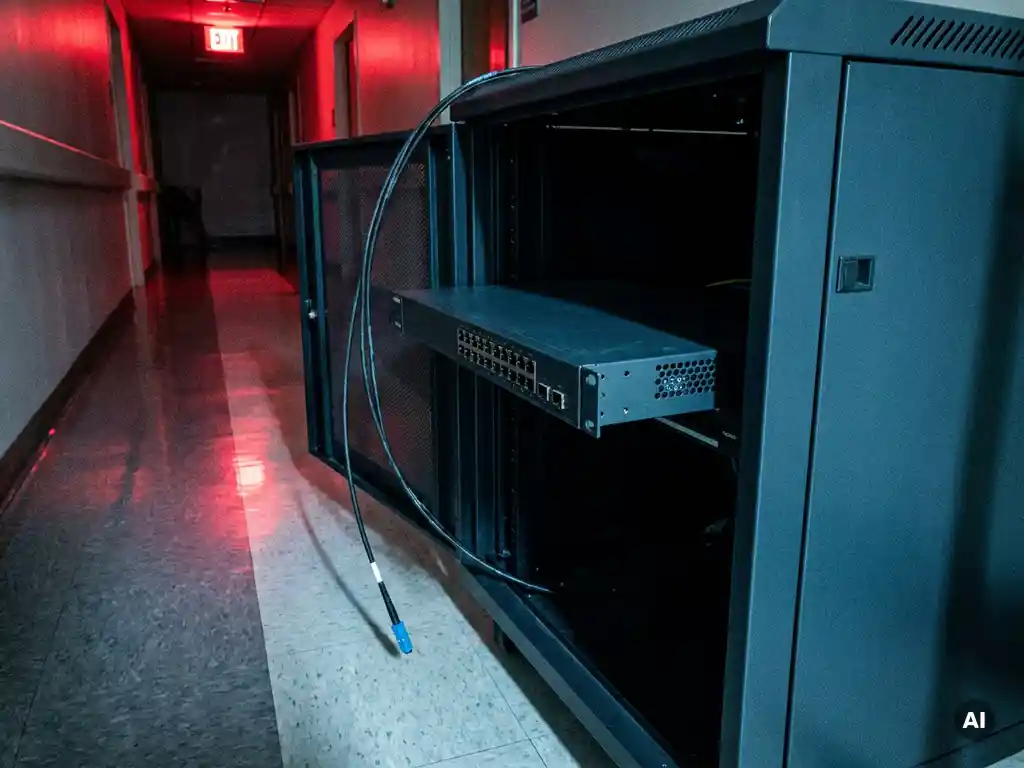
If a critical care connection goes down, you need to act immediately: switch to a pre-configured backup connection, activate your emergency protocol, and notify the departments involved without delay. How quickly you can do that depends entirely on the measures you have put in place beforehand. Network outages in healthcare are not a theoretical risk: they directly affect patient safety, diagnostics, and continuity of care. The questions below help you understand where the vulnerabilities lie and how to address them.
Which systems are immediately at risk during a network outage in healthcare?
During a network outage in healthcare, electronic health records (EHR), medical imaging systems, monitoring equipment, and communication platforms are immediately at risk. These systems depend on a stable network connection for real-time data transport and are barely or not at all usable without alternative connectivity when an outage occurs.
The impact varies by department. In the intensive care unit, patient monitors and infusion pumps are often connected to central systems. In radiology, imaging systems such as MRI and CT equipment are linked to PACS servers. Pharmacies process medication orders digitally. And an increasing number of hospitals use VoIP telephony that is entirely dependent on the IP network.
What many organisations underestimate: supporting systems such as access control, CCTV, and building management also run on the same network. An outage therefore affects not only care delivery, but also the physical security of the facility. That makes real-time monitoring of your fibre infrastructure in healthcare institutions not a luxury, but an operational necessity.
How long does it take for a healthcare network to recover?
Without active redundancy and automatic failover, recovery of a healthcare network can take minutes to hours. With properly configured backup connections and automatic switchover, recovery time can be reduced to seconds or a few minutes. The exact time depends on the architecture, the cause of the outage, and the availability of management tools.
A manual recovery process requires a network administrator to identify the cause, adjust the correct configuration, and restart systems. That takes time, and in healthcare every minute is too many. Automatic detection and switchover, supported by out-of-band management, drastically reduces that time.
Out-of-band management plays a key role here: it enables administrators to reach and manage network equipment even when the primary network is completely unreachable. This allows you to diagnose and resolve issues without being physically present on site — crucial for healthcare institutions with multiple buildings or locations.
What is the difference between redundancy and failover in healthcare networks?
Redundancy means having duplicate components or connections on standby in case a primary connection fails. Failover is the mechanism that automatically switches to that backup component as soon as a disruption is detected. Redundancy is the infrastructure; failover is the process that activates that infrastructure.
Redundancy: double layers as a safety net
In a redundant healthcare infrastructure, critical connections are duplicated. Think of two fibre routes to a data centre via different physical paths, or two internet providers for external connectivity. If one connection fails, an alternative is always available. Redundancy at layer 1 and layer 2 of the OSI model — such as dual fibre cables and redundant switches — forms the foundation of a robust healthcare infrastructure.
Failover: automatic and fast
Failover is the automatic switchover that occurs as soon as a disruption is detected. A properly configured failover mechanism responds within milliseconds, without requiring any administrator intervention. In healthcare, this distinction is essential: a manual switchover takes too long when a monitoring display or EHR connection goes down. Failover without redundancy is meaningless: you need both.
What measures prevent outages of critical healthcare connections?
Outages of critical healthcare connections are prevented through a combination of redundant infrastructure, proactive monitoring, regular testing, and clear emergency procedures. No single measure is sufficient on its own: network resilience in healthcare requires a layered approach that is secured both technically and organisationally.
The most effective technical measures are:
- Dual physical connections via different routes, so that excavation damage or cable breaks do not immediately cause an outage
- Redundant network equipment such as switches and routers with automatic failover
- Proactive network monitoring that flags anomalies before they lead to an outage
- Out-of-band management for access to equipment outside the primary network
- Regular failover tests to verify that backup connections actually work
Organisationally, it is equally important to know who does what during an outage. A clear escalation path, contact lists, and documented emergency procedures prevent valuable time being lost to confusion. We help healthcare institutions design infrastructure that is not only technically sound, but also operationally manageable. View our security and continuity solutions for a complete overview.
When does a private 5G network make sense as a backup in healthcare?
A private 5G network makes sense as a backup in healthcare when a healthcare institution has multiple buildings, fibre outage is a realistic risk, and wireless redundancy is needed for mobile care applications. It provides an independent, wireless alternative that does not depend on the same physical infrastructure as the primary connection.
Traditional backup connections such as a second fibre cable are vulnerable to the same cause of failure as the primary line, especially if both cables run through the same route. A private 5G network is physically completely independent and therefore offers true diversity in transport media.
In healthcare, there are specific situations where private 5G as a backup offers additional value:
- Hospital campuses with multiple pavilions where cabling is vulnerable
- Outpatient care and home care where mobile connectivity is essential
- Temporary emergency locations or expansions where connectivity is needed quickly
- Environments where Wi-Fi provides insufficient capacity or reliability
Private 5G also offers advantages in terms of security: the network is fully under your own management, meaning sensitive patient data does not need to travel over public networks. This directly aligns with the compliance requirements that healthcare institutions handle on a daily basis.
Who is responsible when a healthcare network goes down?
Responsibility for a healthcare network outage is shared: the IT department or network administrator is operationally responsible for recovery, while management bears final responsibility for the continuity of care processes. When management is outsourced, operational responsibility lies with the managed service provider, but the healthcare institution always remains ultimately responsible to patients and regulators.
In practice, ambiguity about responsibilities leads to delays in recovery. It is therefore essential to establish in advance:
- Who detects the outage and how quickly is it flagged?
- Who is notified first: IT administrator, department head, management?
- Who has the authority to activate emergency measures?
- Who communicates externally to patients, suppliers, or regulators?
- Who evaluates afterwards what went wrong and how recurrence is prevented?
From a regulatory perspective — such as the NIS2 directive, which also affects healthcare organisations — healthcare institutions are required to demonstrably have measures in place for the continuity of critical processes. That means not only technical measures, but also documented responsibilities and incident procedures.
We work closely with IT teams in healthcare to not only get the technical infrastructure in order, but also to create clarity around management, monitoring, and escalation. Because a robust network starts with clear agreements: proactive network management is an indispensable link in that chain.
Ready for the next step?
Explore our solutions or get in touch directly with one of our experts.