


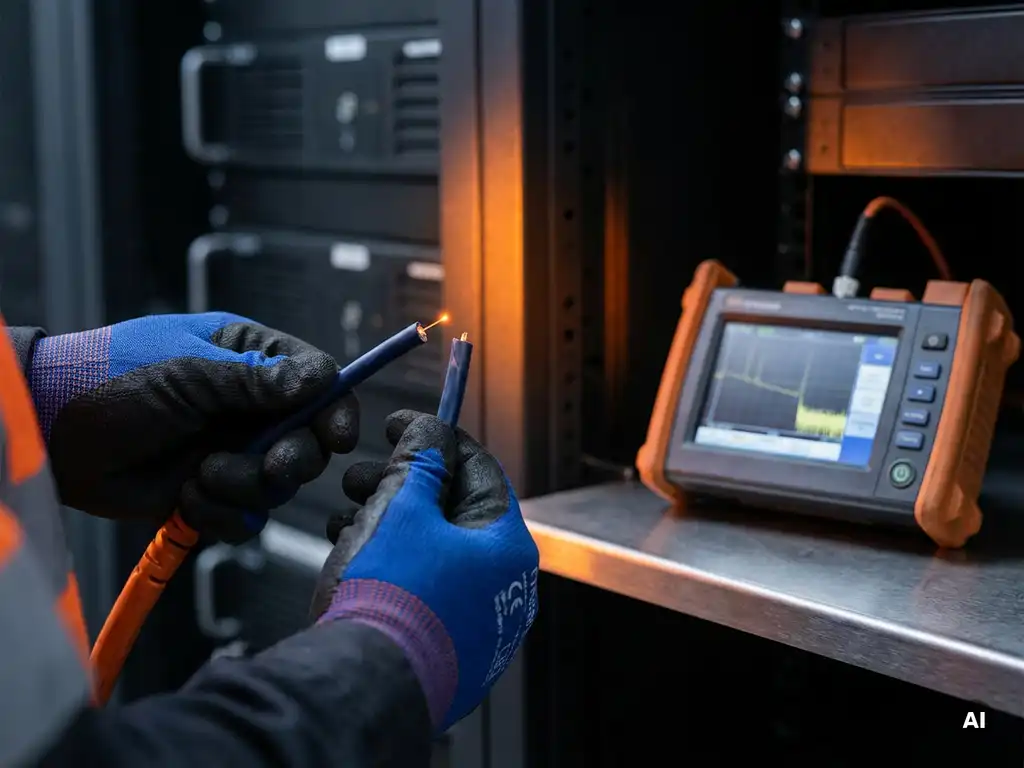
The fastest way to locate a fibre break is with an OTDR (Optical Time Domain Reflectometer). This measuring device sends light pulses through the cable and calculates, based on the reflection, exactly at what distance the break is located. In most cases, you can pinpoint the location within a few minutes, accurate to within a few metres. The articles below address the most frequently asked questions about detecting a fibre break: from causes and measurement methods to engaging a specialised partner.
What are the most common causes of a fibre break?
The most common causes of a fibre break are mechanical damage, excessive bending radius, rodent damage, excavation work, and deterioration due to environmental influences. In practice, unintentional damage during ground work is by far the most common culprit, especially in outdoor networks and underground routes.
Fibre optic cable is a robust medium, but it does have its limits. A fibre optic cable does not break easily, but the following situations regularly cause disruptions in fibre networks:
- Excavation work: Cables struck by excavators or compactors are a classic case. This is the most direct and most impactful cause of a fibre cable break.
- Excessive bending: Every fibre optic cable has a minimum bend radius. If that is exceeded, microscopic cracks form in the core that significantly reduce or completely interrupt signal transmission.
- Rodent damage: Especially in outdoor environments and technical spaces, rats and mice gnaw through cable sheathing. This may sound trivial, but it surprisingly often leads to a fibre outage.
- Thermal stress: Extreme temperature fluctuations, such as in outdoor installations during winter, can cause the cable sheath to shrink or expand, creating internal tension.
- Poor connectorisation: An incorrectly installed connector or a dirty connection does not cause a break in the traditional sense, but it does cause sufficient signal loss to bring the network down.
- Ageing: Cables that have been in the ground for decades can gradually deteriorate due to moisture ingress and material fatigue.
Knowing the cause allows you to search for the location more effectively. With excavation damage, you look along a recently opened route. With thermal stress, you check outdoor connections and transition points. That context makes locating a fibre break considerably more efficient.
How does an OTDR work when tracing a fibre break?
An OTDR sends short light pulses into the fibre optic cable and measures the light that is reflected back. Based on the travel time of that reflected light, the device calculates exactly at what distance an anomaly, break, or loss point is located. The result is a graphical representation of the entire cable route, known as the OTDR trace.
The operating principle is based on a physical concept similar to sonar or radar. Light travels through fibre at a known speed. As soon as something changes in the cable — such as a break, a poor splice, or a connector — part of the light is reflected back to the source. The OTDR measures how long that takes and converts it into a distance.
What can you read from an OTDR trace?
The OTDR trace shows the signal profile over the full cable length. A healthy cable displays a gradually declining line — the normal attenuation profile. Anomalies are immediately visible:
- A sudden dip indicates a splice or connector with elevated loss.
- A reflection peak followed by an abrupt stop is a strong indication of a physical break.
- A gradual increase in attenuation points to wear, moisture ingress, or excessive bending over a longer distance.
How quickly does an OTDR measurement work?
An experienced technician can often get an initial picture of where the fibre fault is located within five to ten minutes. The measurement itself takes only seconds. Interpreting the trace and converting it to a physical location on the route takes a little more time, but with the right documentation it is very manageable. With complex networks containing many splices and branches, the analysis requires more care.
For organisations that want to actively monitor their network, real-time fibre monitoring goes a step further: faults are automatically detected before they lead to downtime.
What other methods exist for locating a fibre break?
In addition to the OTDR, there are several methods for detecting a fibre break, including visual inspection with a light source, optical loss measurements (OLTS), and specialised monitoring systems that continuously monitor the network. The method you choose depends on the situation, the available equipment, and the urgency.
Visual inspection with a light source
For short cables or accessible routes, a visual light test is sometimes the quickest first step. You connect a light source to one end of the cable and check at the other end whether light comes through. No light means a complete interruption. A weak signal indicates high loss. However, this method does not locate the break: you know there is a problem, but not where.
For accessible cable sections — for example in a server room or patch cabinet — a visual fault locator (a red laser pen) can sometimes make the exact location of a break visible. The red light leaks through the cable sheath at the break location.
Optical loss measurements (OLTS)
An Optical Loss Test Set measures the total signal loss across a connection. This is useful for assessing whether a cable meets specifications, but this method also does not tell you where the loss occurs. It is a quantitative measurement, not a localisation method. Combining OLTS with an OTDR measurement gives you both the position and the severity of the problem.
Automated monitoring systems
For critical infrastructure, continuous monitoring is the most proactive approach. Automated systems continuously monitor the signal profile and raise an alarm as soon as an anomaly occurs — even before the connection fails completely. This reduces detection time from hours to seconds. Explore the options for monitoring and network management if your network is business-critical and downtime is not acceptable.
How accurate is an OTDR measurement in practice?
A modern OTDR achieves an accuracy of one to three metres in practice on cables of a few kilometres in length. On longer routes — of tens of kilometres — the margin increases to a few tens of metres. That accuracy is in most cases more than sufficient to dig in the right place or open the correct cable duct.
The final precision depends on a number of factors:
- Quality of the OTDR: Professional measuring equipment performs considerably better than entry-level models.
- Accuracy of cable documentation: An OTDR measures cable length, not geographical distance. If the cable meanders or has extra metres in a cable duct, you need to account for that in the interpretation.
- Measurement settings: The refractive index of the fibre must be set correctly. An incorrect value leads directly to an incorrect distance calculation.
- Number of splices and connectors: Every connection point in the route introduces a small measurement uncertainty. On long cables with many splices, these uncertainties accumulate.
In practice, this means that after an OTDR measurement you know which segment of the route to search in. Combining that information with up-to-date as-built documentation allows you to pinpoint the excavation location to within a few metres in most cases. Good documentation is therefore just as valuable as the measuring equipment itself.
When do you bring in a specialised network partner for fibre diagnostics?
You bring in a specialised network partner when the break is in a critical network segment, when internal knowledge or measuring equipment is lacking, or when the speed of recovery is decisive. The higher the impact of the outage, the sooner external expertise pays off.
There are situations where measuring and locating yourself works perfectly well. But there are also circumstances where it is better to leave it to a partner with the right resources and experience:
- Complex network topologies: In networks with many branches, ring structures, or passive splitters, an OTDR trace is more difficult to interpret. Experience makes the difference here.
- Missing documentation: Without up-to-date as-built data, locating a fibre break is considerably more difficult. An experienced partner can still proceed systematically in that case.
- Business-critical environments: In hospitals, data centres, or transport networks, every minute of downtime is one too many. External specialists have the right equipment and can act immediately.
- Combination of diagnosis and repair: Not just determining the location, but also splicing, testing, and documenting the cable: that requires a fully equipped team.
We have been working on fibre and network infrastructure for over 20 years, from design to repair. All expertise is kept in-house, so we can act quickly without depending on third parties. Whether it’s an acute fibre fault or a structural improvement to your network: view our optical network solutions or contact our engineers directly. We are happy to think along with you, from the first measurement to the final repair.
Ready for the next step?
View our solutions or get in touch directly with one of our experts.