


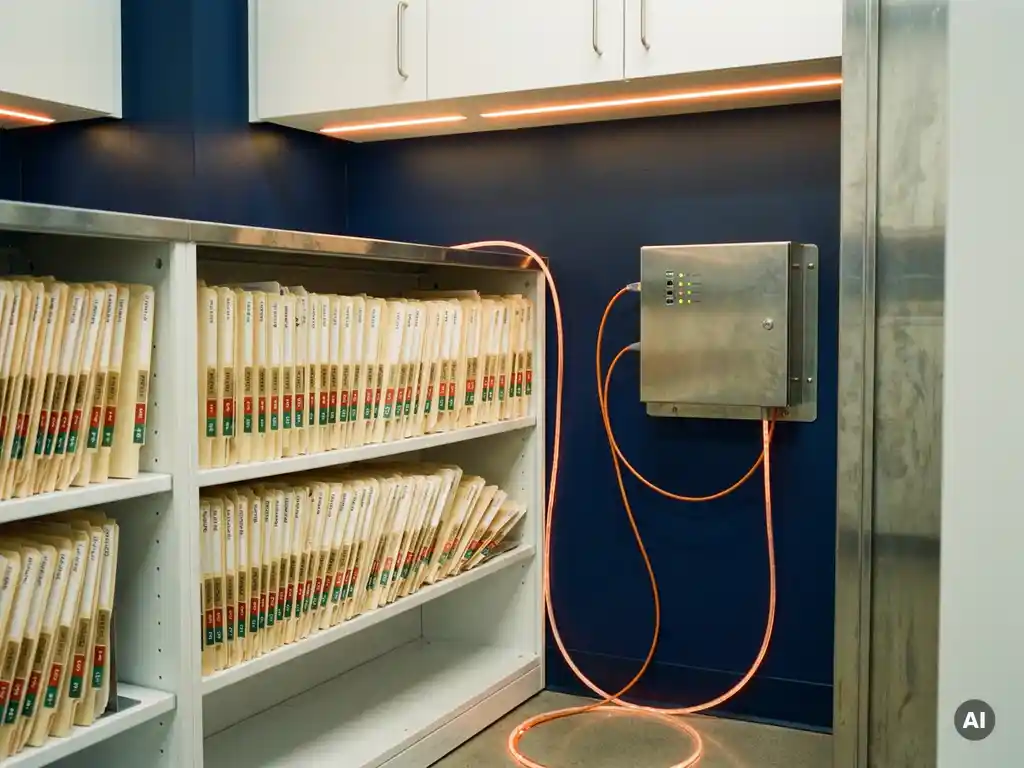
Keeping medical data confidential over the long term requires a combination of strong encryption, multi-layered network security, and attention to future threats such as quantum computing. Patient data sometimes needs to be retained for decades, while the technology used to secure it is constantly evolving. The questions below give you a clear picture of what is needed to ensure that long-term confidentiality.
Why is long-term confidentiality of medical data so difficult to guarantee?
Long-term confidentiality of medical data is challenging because the technology used to secure data today may no longer be adequate in ten or twenty years. Patient records sometimes need to be retained for fifteen to thirty years, while cyber threats and computing power increase enormously during that same period. What is considered secure today may no longer be so in a decade.
On top of that, medical environments are becoming increasingly complex. Hospitals, clinics, and healthcare institutions work with a growing number of connected devices, from medical equipment to cloud platforms and mobile applications. Every connection point is a potential target. Cybercriminals also continuously adapt their attack techniques and are making increasing use of advanced methods, including AI-driven attacks.
Another bottleneck is the so-called “harvest now, decrypt later” scenario. Attackers can intercept and store encrypted data now, in anticipation of being able to decrypt it in the future once the necessary computing power becomes available. This makes securing medical data not just a challenge for today, but also for the years ahead.
What is the difference between short-term and long-term encryption?
Short-term encryption is designed to protect data for as long as current computing power is unable to crack the key, typically for a period of a few years. Long-term encryption goes further: it takes into account future computing power, including quantum computing, and uses cryptographic methods that will remain secure for decades to come.
Short-term encryption uses commonly used standards that work well within current technological boundaries. For medical data that must remain confidential for twenty years, this is insufficient. The key length, algorithm, and implementation must all be resistant to future attack methods.
Long-term encryption also requires a well-considered key management approach. Keys must be periodically renewed, securely stored, and available at all times for authorized access, without being exposed to unauthorized parties. This requires a structured approach to cryptographic lifecycle management, something that is not yet standard practice in the healthcare sector.
How does quantum-resistant encryption work for medical data?
Quantum-resistant encryption, also known as post-quantum cryptography, uses mathematical algorithms that are resistant to attacks by quantum computers. Where classical encryption is based on problems that a quantum computer can solve quickly, post-quantum cryptography relies on mathematical structures for which even quantum computing power offers no fast solution.
For medical data, this means in practice that the encryption standards being implemented now must align with the guidelines established by international standardization organizations for post-quantum algorithms. These algorithms are specifically designed to remain secure even in a future with powerful quantum computers.
The transition to quantum-resistant encryption is not a one-time step. It requires a migration strategy in which existing systems, keys, and protocols are gradually replaced or supplemented. Healthcare organizations are well advised to start inventorying now which systems are vulnerable and which data needs to remain confidential the longest. We help healthcare institutions map those vulnerabilities and implement protection against quantum threats tailored to their specific infrastructure.
What laws and regulations apply to the long-term storage of medical data?
The long-term storage of medical data in the Netherlands and Europe is governed by multiple legal frameworks simultaneously. The General Data Protection Regulation (GDPR) sets requirements for the security and processing of personal data, including medical information. The Medical Treatment Contracts Act (WGBO) stipulates that patient records must be retained for a minimum of twenty years.
In addition to this basic legislation, healthcare institutions are also subject to the NEN 7510 standard, the Dutch standard for information security in healthcare. This standard describes concrete measures for the protection of medical data and aligns with the international ISO 27001 standard. Organizations that demonstrably comply with NEN 7510 show that they take information security seriously.
From 2025, the European NIS2 Directive will also play a greater role. Healthcare institutions designated as essential entities are subject to stricter requirements for cybersecurity, incident reporting, and risk management. Compliance is therefore not only a legal obligation but also an operational necessity. Those who invest now in the right security infrastructure will avoid costly adjustments and potential fines later.
What technical measures protect medical data at the network level?
At the network level, technical measures protect medical data by preventing data from being intercepted, manipulated, or leaked during transmission. The most effective approach combines layer 1 and layer 2 encryption, network segmentation, real-time monitoring, and secure remote management into an integrated security architecture.
Encryption at layer 1 and layer 2
Encryption at the physical level and the data link layer level offers protection that is not always visible higher up in the network stack. Layer 1 encryption encrypts the signal at the fiber optic level, even before data enters the network. Layer 2 encryption operates at the Ethernet level and is particularly suitable for securing connections between locations, such as between hospital buildings or data centers. View our encryption solutions for an overview of what is possible within your infrastructure.
Real-time monitoring and network segmentation
In addition to encryption, continuous monitoring is essential. With real-time fiber optic monitoring, you detect anomalies in the network immediately, allowing you to respond quickly to suspicious activity or a physical attack on the infrastructure. Network segmentation also ensures that medical systems are logically separated from other networks, limiting the impact of a potential incident.
When is a vendor-independent approach the right choice for healthcare networks?
A vendor-independent approach is the right choice for healthcare networks when security requirements are more complex than a single vendor can fulfill, or when an organization wants to avoid becoming dependent on the roadmap and pricing policy of one party. In healthcare, where continuity and compliance are central, vendor independence offers greater flexibility and better future-proofing.
Healthcare networks are rarely homogeneous. They consist of systems from different vendors, with varying lifecycles and security levels. A vendor-independent partner can choose the best solution based on the specific requirements of the organization, not based on what happens to be in one brand’s portfolio. This leads to better integration, lower risks, and an infrastructure that genuinely matches reality.
We work vendor-independently and select solutions from partners such as Nokia, Cisco, Huawei, and HPE Aruba, always tailored to what your organization needs. Whether it concerns encryption, network segmentation, or monitoring: we bring the right technology together into a coherent whole. Want to know which security solutions for sensitive data suit your healthcare environment? Our experts are happy to think along with you, from initial advice to full implementation and management.
Ready for the next step?
Explore our solutions or get in touch directly with one of our experts.