


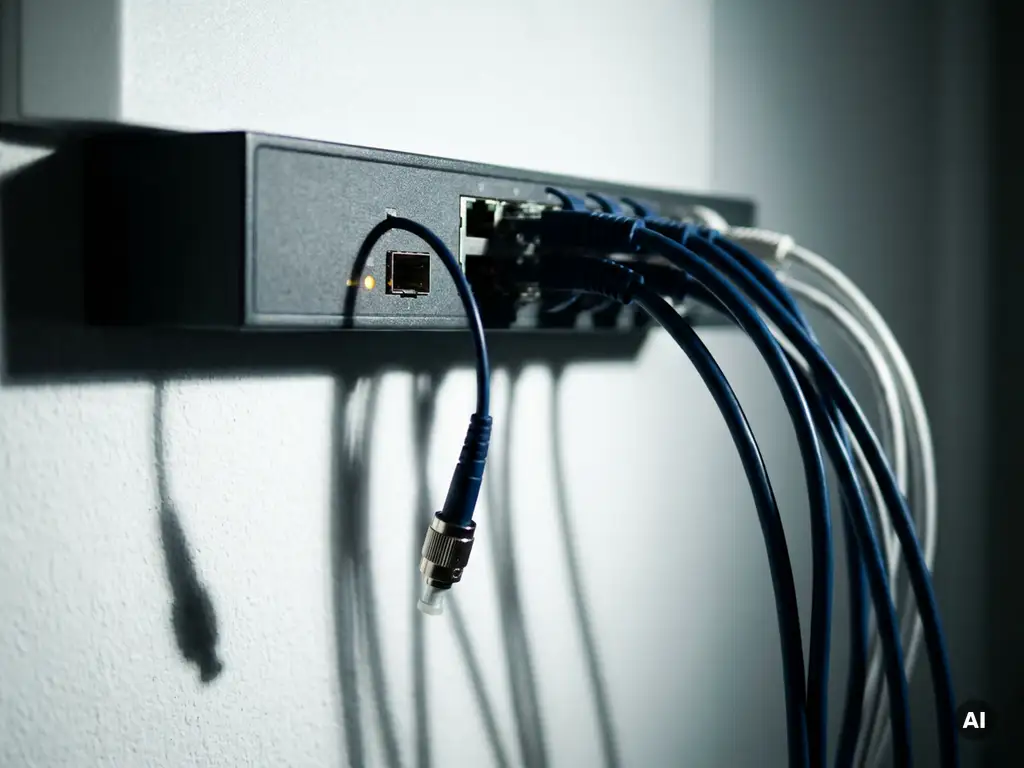
A single point of failure in a healthcare network can be identified by a network component whose failure directly leads to loss of connectivity for systems or users, without an automatic alternative being available. Think of a central switch without redundancy, a single fibre path to a department, or a router serving multiple critical systems. In healthcare environments, this risk is particularly significant, because network outages directly affect patient safety and continuity of care. This article addresses the most frequently asked questions about SPOF identification, consequences, and approaches in healthcare networks.
Which components in a healthcare network are most vulnerable?
The most vulnerable components in a healthcare network are those that serve many systems simultaneously without a backup path: the core switch, the connection to the data centre, the internet uplink, and the link between buildings or departments. If any one of these components fails, multiple critical systems can become unreachable at the same time.
In practice, we see that healthcare networks are often built in layers, but that redundancy is not always consistently implemented. Common weak points include:
- Core switches without failover: A single core switch handling all traffic is a classic example of a SPOF. Failure means all connected systems immediately become unreachable.
- Single fibre connections: Connections between buildings or floors often run via a single fibre path. Damage to or failure of that path completely breaks connectivity.
- Uplinks to the data centre or cloud: If the connection to the central data centre fails, electronic patient records (EPRs) and other business-critical applications become inaccessible.
- Power over Ethernet (PoE) switches for medical equipment: Wireless access points and IP phones for healthcare communication are often connected to a single switch. Failure directly impacts communication on a ward.
- DNS and DHCP servers: Infrastructure services that are rarely monitored, but whose failure can bring down the entire network.
Good network design for healthcare organisations starts with mapping all these dependencies, so you know which components represent a single point of risk.
How do you identify a single point of failure in practice?
A single point of failure in a healthcare network is identified by systematically analysing which components have no redundant alternative. The key question is always: what happens if this component fails? If the answer is that a service or department becomes unreachable, you have found a SPOF.
In practice, there are concrete indicators that point to a SPOF:
- A network topology where all connections converge on a single device or node.
- Connections that physically run via only one route, with no alternative path.
- Systems that have no automatic failover in the event of a component failure.
- Management interfaces that are only accessible via the production path, meaning that during an outage you also lose management access.
- Missing or outdated network topology documentation, making dependencies invisible.
A practical approach is to carry out a network risk analysis: walk through the topology from edge to core and ask at each component whether a redundant path or system is available. Combine this with a review of configurations so you also identify software-based SPOFs, such as a routing protocol configured on only one interface.
What are the consequences of a SPOF in a healthcare environment?
A SPOF in a healthcare environment can have direct consequences for patient safety. Network connectivity failure makes electronic patient records, medical imaging, medication systems, and monitoring equipment inaccessible. In acute situations, this can seriously delay or complicate the delivery of care.
The consequences extend beyond mere technical downtime:
- Continuity of care: Nurses and doctors cannot access patient data, leading to manual emergency procedures that are time-consuming and error-prone.
- Patient safety: Medical equipment that communicates via the network — such as infusion pumps, alarm systems, and patient monitors — can no longer be centrally monitored during network outages.
- Compliance and liability: Healthcare organisations are bound by laws and regulations concerning the availability and security of patient data. A network outage caused by an avoidable SPOF can lead to compliance issues.
- Reputational damage: Prolonged outages undermine the trust of patients, staff, and regulators.
- Recovery costs: Emergency procedures, overtime for IT staff, and any incident investigations entail significant costs.
Network redundancy in hospitals is therefore not a luxury, but a fundamental requirement for responsible healthcare delivery.
How does a SPOF in a healthcare network differ from other sectors?
In a healthcare network, a SPOF has direct consequences for human lives, which makes it fundamentally different from most other sectors. Where a network outage in an office environment leads to productivity loss, the same outage in a hospital can block access to life-saving information and equipment.
There are a number of characteristics that distinguish healthcare networks from networks in other sectors:
- High availability requirements: Healthcare systems must be available 24 hours a day, 7 days a week. There is no acceptable maintenance window during which systems may go offline without risk.
- Diversity of equipment: In addition to standard IT systems, medical devices, monitoring systems, and building management systems are connected to the same network. This increases complexity and the number of potential SPOFs.
- Strict regulations: Healthcare organisations are subject to specific laws and regulations regarding data security and system availability, such as the NEN 7510 standard in the Netherlands.
- Limited tolerance for emergency procedures: In sectors such as retail or logistics, manual emergency procedures are inconvenient but manageable. In acute care, they are time-consuming and can directly affect the quality of care.
This makes network security for healthcare organisations a specialist field, where addressing SPOFs goes beyond standard IT risk management.
Which tools help identify network vulnerabilities?
Identifying network vulnerabilities and SPOFs in a healthcare network requires a combination of network management software, topology mapping, and continuous monitoring. These tools provide insight into the structure of the network, the status of components, and the traffic patterns that make vulnerabilities visible.
Network topology and configuration analysis
Network topology tools automatically map how devices are connected to each other and where single dependencies exist. They show which devices have no redundant path and which connections form a single point of failure. Combine this with a review of network configurations to also identify software-based vulnerabilities, such as missing spanning tree settings or incorrect failover configurations.
Continuous monitoring and real-time alerting
Continuous monitoring of your network infrastructure makes it possible to detect anomalies and failures immediately, before users notice the impact. Good monitoring solutions track the availability of components, link utilisation, and response times of critical systems. Combined with real-time fibre monitoring, you can also detect physical issues in the fibre infrastructure at an early stage.
Out-of-band management
A common mistake is that management tools are accessible via the same network as the production systems. If the production path fails, you also lose management access. Out-of-band management solves this by creating a separate management path, so that even during an outage you retain access to the infrastructure and can diagnose and resolve the issue.
When should you bring in an external network specialist?
Bring in an external network specialist when internal knowledge or capacity is insufficient to fully oversee the complexity of a healthcare network, or when an objective assessment of the network infrastructure is required. An external party identifies vulnerabilities that are overlooked internally, precisely because they approach the architecture without assumptions.
There are specific situations where external expertise demonstrably adds value:
- When carrying out a network risk analysis or audit, where an independent perspective is needed.
- When your network is growing due to new construction, mergers, or the integration of new medical systems and the existing architecture no longer meets requirements.
- When incidents have occurred in which a SPOF led to downtime and you want to prevent a recurrence.
- When preparing for compliance audits, where you need to demonstrate that the network infrastructure meets applicable standards.
- When you want to transition to a redundant architecture but lack the internal expertise to design and implement it correctly.
We work vendor-independently and have extensive experience with critical network infrastructure in the healthcare sector. Our approach is always consultative: we start by understanding your situation and translate that into a concrete, future-proof solution. From mapping vulnerabilities to designing a redundant architecture and guiding the implementation. View our security solutions for healthcare organisations or contact our experts directly if you want to know where the risks in your network lie.
Ready for the next step?
Explore our solutions or get in touch directly with one of our experts.