


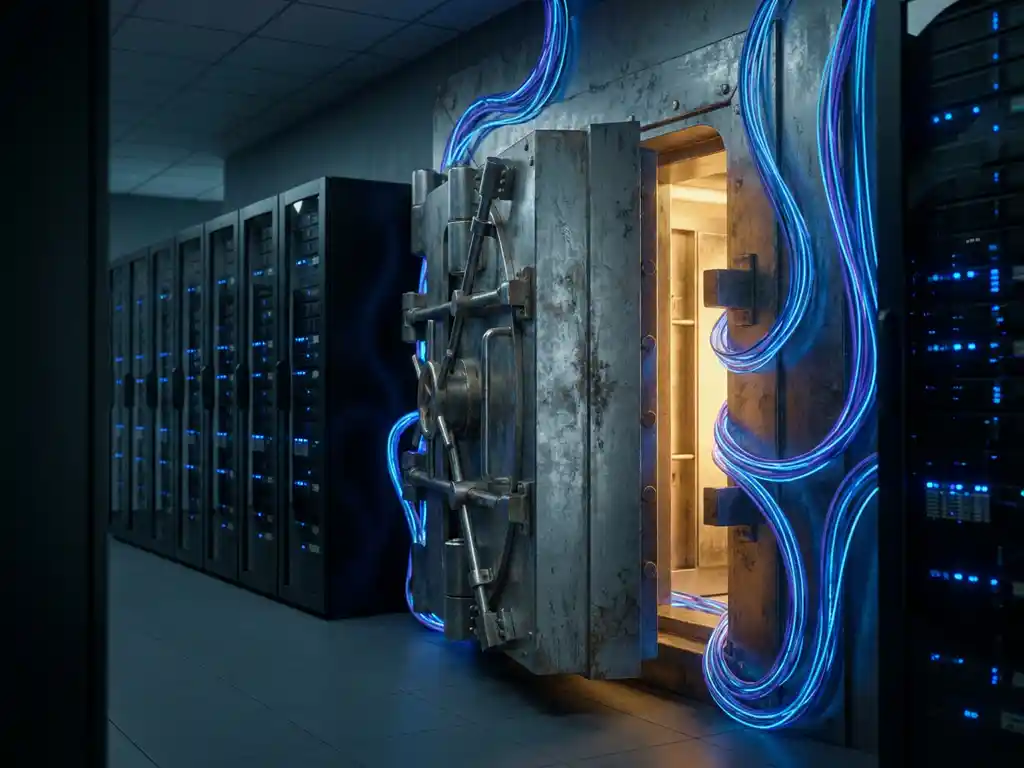
Quantum computers are no longer a distant future. In 2026, governments and technology companies worldwide are investing heavily in quantum technology, and powerful quantum systems are expected to be capable of breaking the encryption that protects business-critical data today within the foreseeable future. For organizations that already handle sensitive information, this represents a serious risk. Attackers are already collecting encrypted traffic today, with the intention of decrypting it later. This principle, commonly known as “harvest now, decrypt later,” makes it urgent to act now. The good news: you don’t have to wait for the quantum era to future-proof your security.
Why classical encryption is vulnerable to quantum computers
Most encryption standards organizations use today such as RSA and elliptic curve cryptography are based on mathematical problems that are practically unsolvable for classical computers. A quantum computer can solve these problems exponentially faster using specific algorithms. This means that encryption currently considered secure could be broken in a short amount of time in the future.
This affects not only the security of future communications. Data that is encrypted and transmitted today can already be intercepted and stored. Once a sufficiently powerful quantum computer becomes available, that stored data can still be decrypted. Organizations working with medical records, financial data, intellectual property, or state secrets are therefore already at risk today.
This is not a matter of waiting and seeing. Protection against quantum threats starts with understanding where your organization is currently vulnerable and what steps you can take to address those vulnerabilities in a structural way. Exploring the full range of available security solutions is a practical first step in that process.
Step 1: Inventory your cryptographic vulnerabilities
The first step toward quantum readiness is knowing what you have. Map out which systems, protocols, and applications within your organization make use of cryptography. Think of VPN connections, digital signatures, certificates, authentication systems, and encrypted databases.
Ask yourself: which of these systems process data that must remain confidential five or ten years from now? Those are precisely the systems that deserve priority. A cryptographic inventory gives you a clear picture of your attack surface and forms the foundation for every subsequent step in your quantum strategy.
When conducting this inventory, involve not only IT but also legal and compliance teams. Regulations around data security are evolving rapidly, and some sectors such as healthcare and critical infrastructure already have specific requirements regarding encryption and data protection.
Step 2: Migrate to post-quantum cryptography (PQC)
Post-quantum cryptography encompasses encryption algorithms that are resistant to attacks from quantum computers, yet run on classical hardware. Standards organizations such as NIST have now approved an initial set of PQC algorithms, paving the way for widespread adoption.
A migration to post-quantum cryptography rarely happens in a single step. Most organizations opt for a hybrid approach: classical and quantum-safe algorithms are used side by side on a temporary basis. This allows you to maintain compatibility with existing systems while gradually migrating to a quantum-safe environment.
Start with the systems that have the longest lifespan or process the most sensitive data. Software updates can be implemented relatively quickly; hardware-bound cryptography requires more planning and time. Make sure the vendors you depend on also have a PQC migration plan in place.
Ready for the next step?
Explore our solutions or get in touch with one of our experts directly.
Step 3: Protect network traffic with Layer 1/2 encryption
Encryption at higher OSI layers such as TLS at Layer 4 and above is vulnerable to attacks that occur before data reaches that layer. Layer 1 and Layer 2 encryption provide protection at the physical and data link level, ensuring that data is already encrypted before it enters the network.
This type of encryption is particularly relevant for organizations that transport sensitive data over fiber optic connections, such as data centers, hospitals, and critical infrastructure. The encryption is transparent to higher layers and adds no noticeable latency to the network.
An additional benefit of Layer 1/2 encryption is that it operates independently of protocols. Regardless of which applications or services communicate over the network, the data is always encrypted. This makes it a robust baseline security measure that complements what higher layers provide. Explore the available networking solutions to find out which approach suits your network architecture.
Step 4: Implement quantum key distribution (QKD)
Quantum key distribution is a technology that leverages the properties of quantum mechanics to exchange encryption keys in a way that is physically impossible to intercept. Any attempt at interception disturbs the quantum channel and is therefore immediately detectable.
QKD theoretically offers the highest level of security for key exchange, but it also has practical limitations. The technology requires specialized hardware and fiber optic connections, and its range is currently limited without intermediate trusted nodes. As such, QKD is currently best suited for organizations with extremely high security requirements on specific connections, such as financial institutions or government agencies.
QKD is expected to become more accessible and scalable in the coming years. It is wise to monitor developments and assess whether and when implementation becomes relevant for your organization.
Step 5: Strengthen key management and key rotation
Even the strongest encryption is vulnerable if keys are poorly managed. Good key management means that encryption keys are regularly renewed, stored securely, and that access is strictly controlled. This applies to both classical and quantum-safe cryptography.
Establish a key rotation policy: how long may a key remain valid? Who has access to which keys? How are keys revoked if a system or employee is compromised? Hardware security modules (HSMs) provide a secure environment for key storage and management, separate from the systems that use the keys.
Automate key rotation wherever possible. Manual processes are error-prone and are often delayed in practice. Automated key management reduces the risk of prolonged use of compromised keys.
Step 6: Segment networks to reduce the attack surface
Network segmentation limits the damage in the event of a breach. By dividing the network into logical zones with strict access controls, you ensure that an attacker who penetrates one segment does not automatically gain access to the rest of the infrastructure.
In a quantum context, segmentation is especially relevant. If an attacker is able to decrypt encrypted traffic, you want the impact to be limited to as small a portion of your data as possible. Segment based on sensitivity: systems that process critical or confidential data deserve stricter separation from the rest of the network.
Combine segmentation with microsegmentation for sensitive environments such as data centers or healthcare networks. The smaller the segments, the more limited the attack surface in the event of a successful attack.
Step 7: Secure out-of-band management channels
Network equipment is often managed over the same network as regular data traffic. This makes management channels an attractive target: anyone who gains access to the management channel can influence the entire infrastructure. Out-of-band management (OoBM) fully separates management traffic from production traffic via a dedicated, physically or logically isolated network.
This is not only relevant from a quantum perspective — it is a broadly recognized best practice in network security. A separate management network ensures that management remains possible at all times, even if the production channel is disrupted, and prevents attackers accessing management functions via the production channel.
For organizations with critical infrastructure, OoBM is an essential component of a robust security architecture. More information about the available options can be found on the managed services page.
Step 8: Adopt quantum-safe authentication
Authentication, which means verifying identities, is one of the most vulnerable links in security. Many authentication methods are based on the same mathematical principles as the encryption that quantum computers can break. Passwords, certificates, and digital signatures all need to be reconsidered in a quantum context.
Switch to authentication methods that are resistant to quantum attacks. This includes the use of PQC-based digital signatures and certificates. Combine this with multi-factor authentication in which the factors themselves are also quantum-safe.
Don’t overlook device authentication either. In networks with many connected devices such as IoT environments or industrial networks, device authentication is a critical point. Make sure these systems are also included in your quantum-safe authentication strategy.
Step 9: Develop a quantum readiness roadmap
Quantum readiness is not a project you complete over a weekend. It is a multi-year journey that requires planning, prioritization, and continuous evaluation. A roadmap helps you bring structure to the process and track progress without losing a sense of urgency.
An effective quantum readiness roadmap includes at least the following elements:
- An up-to-date cryptographic inventory as a starting point
- Prioritization based on data sensitivity and system lifespan
- Concrete milestones for migration to PQC and strengthening of key management
- Defined responsibilities per team or department
- Periodic review moments to update the roadmap based on new developments
Connect the roadmap to your existing security and IT strategy. Quantum readiness is not a standalone initiative, but part of a broader approach to network security and data protection. Also align with vendors and partners on their own migration plans, because your security is only as strong as the weakest link in the chain.
Start your quantum strategy today
The transition to a quantum-safe infrastructure takes time, but the risks of delay are greater than the effort of starting early. Organizations that inventory, prioritize, and take their first steps now will be well-positioned when the time comes. Those who wait run the risk of today’s encrypted data becoming readable tomorrow.
The nine steps in this article are not a theoretical exercise. They are applicable to any organization that takes the protection of sensitive information seriously, regardless of sector or size. Start small if you must — but start.
How we help with quantum-safe security
We understand that the move toward quantum readiness can feel complex for many organizations. With more than 20 years of experience in network infrastructure and in-depth expertise in Layer 1 and Layer 2 security, we help organizations take concrete steps forward. Our security portfolio is specifically designed for organizations with high demands on the protection of their network and data.
What we offer in the area of quantum-safe security:
- Quantum security solutions that provide protection against both current and future threats
- Layer 1 and Layer 2 encryption for maximum protection of network traffic at the physical level
- Out-of-band management solutions for secure separation of management and production traffic
- Vendor-independent advice based on your specific situation, with solutions from partners such as Cisco, Nokia, and HPE/Aruba
- End-to-end support: from advice and design through to implementation and management across the full lifecycle
Whether you work in healthcare, at a data center, in critical infrastructure, or an enterprise environment: we translate complex security challenges into practical, scalable solutions. Get in touch and discuss with us how your organization can take its first step toward a quantum-safe future today.
Ready for the next step?
Explore our solutions or get in touch with one of our experts directly.