
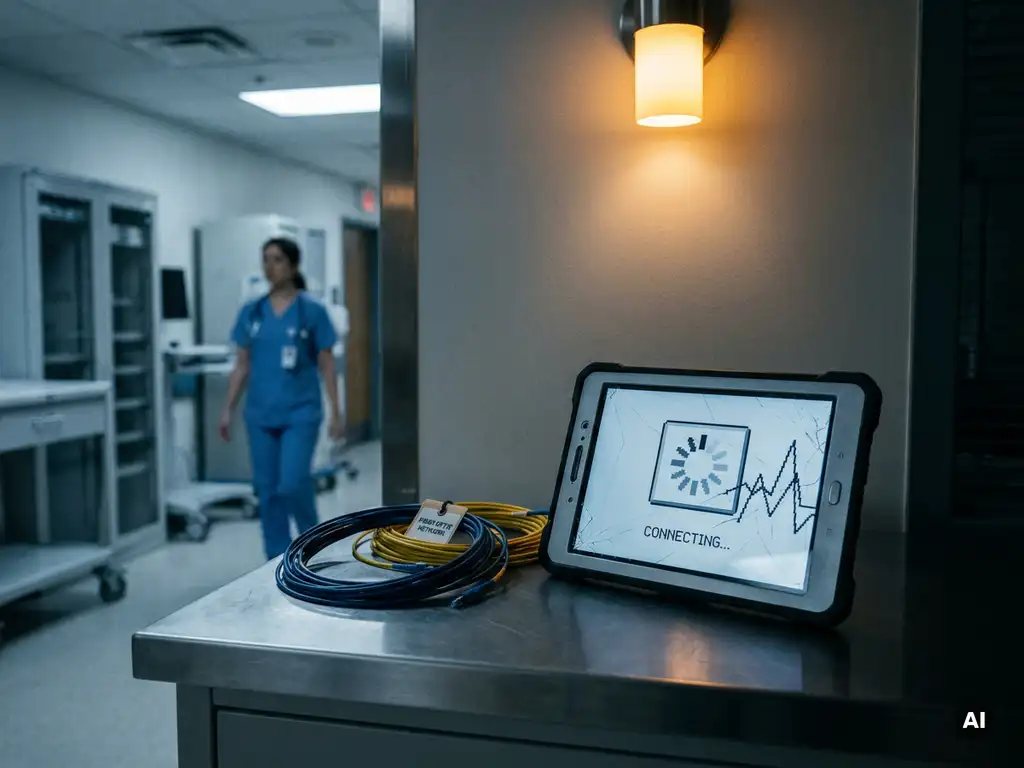
Wi-Fi is no longer sufficient for a healthcare organization once the network load, security requirements, or dependence on business-critical applications exceed the limits of wireless technology. For hospitals, care institutions, and other healthcare organizations, the infrastructure must never be the weak link. In this article, we answer the most frequently asked questions about Wi-Fi limitations in healthcare and when upgrading to a more robust network infrastructure is the right step.
What network requirements do modern healthcare applications demand?
Modern healthcare applications place high demands on the network: constant availability, low latency, high bandwidth, and strict security of patient data. Applications such as electronic patient records, medical imaging, telemonitoring, and connected medical devices require a stable connection that leaves no room for downtime or interference.
In practice, this means that a network infrastructure in healthcare must meet a combination of technical and organizational requirements:
- High availability: systems such as monitoring equipment and infusion pumps must never lose their connection.
- Low latency: real-time applications such as video consultations and remote monitoring require a response time of milliseconds.
- High bandwidth: medical imaging such as MRI and CT scans generates large amounts of data that must be transferred quickly.
- Strict security: patient data is subject to privacy legislation and must be protected at all times.
- Scalability: the network must grow as more devices and applications are added.
As healthcare institutions continue to digitalize and more IoT devices such as wearable sensors and smart infusion pumps are deployed, these demands will only increase. A network that is just sufficient today may already become a bottleneck tomorrow.
What are the biggest limitations of Wi-Fi in a healthcare environment?
The biggest limitations of Wi-Fi in a healthcare environment are susceptibility to interference, limited capacity at high device density, unpredictable latency, and vulnerability to security risks. Wireless networks are designed for flexibility, but that flexibility comes at the expense of the reliability that healthcare processes require.
Interference and coverage
Hospitals and care institutions are complex buildings with thick walls, metal structures, and a large amount of electronic equipment. All these factors disrupt the wireless signal. Wi-Fi signals can also interfere with medical equipment, which in some cases poses a direct risk. Coverage problems in corridors, basement floors, or specific departments are not an inconvenience in a healthcare environment, but a potential hazard.
Capacity at high device density
Modern healthcare institutions connect dozens to hundreds of devices per department: laptops, tablets, mobile workstations, medical monitors, and IoT sensors. Wi-Fi networks have limited capacity per access point. When too many devices connect simultaneously, speed decreases and the likelihood of connection interruptions increases. In an environment where every device is business-critical, that is unacceptable.
Security
Wireless networks are inherently more difficult to secure than wired connections. Signals are detectable outside the building, giving attackers the opportunity to intercept connections or gain unauthorized access. In healthcare, where sensitive patient data is processed, this is a serious risk. Read more about protecting sensitive data in critical environments.
When does Wi-Fi pose a risk to patient safety?
Wi-Fi poses a risk to patient safety when connection interruptions or signal loss lead to the failure of medical equipment, the loss of real-time monitoring data, or delays in the transfer of critical information. In situations where seconds count, an unreliable wireless network is a direct threat to the patient.
Concrete situations in which Wi-Fi poses a risk:
- Connected infusion pumps or medication systems that lose their connection and are therefore unable to transmit alarm signals.
- Monitoring equipment in intensive care units that fails due to interference or network overload.
- Delays in the transfer of medical images causing a treatment to be postponed.
- Mobile nursing workstations that cannot log into the patient record at critical moments.
These are not theoretical risks. In a healthcare environment where 24/7 availability is a requirement, every moment of network loss is one too many. That makes it essential to connect critical systems to an infrastructure that can provide this guarantee.
What is the difference between Wi-Fi and wired fiber optic infrastructure in healthcare?
The key differences between Wi-Fi and a wired fiber optic infrastructure in healthcare are reliability and capacity. Fiber optic offers a stable, interference-free connection with high bandwidth and low latency, while Wi-Fi depends on radio waves that are susceptible to disruptions, overloading, and environmental factors.
Stability and speed
Fiber optic connections are not sensitive to electromagnetic interference, making them ideally suited for hospital environments full of medical equipment. Transfer speed and latency are predictable and consistent, regardless of the number of connected devices or network traffic. That is a fundamental advantage over Wi-Fi, where performance can vary depending on environmental factors. Find out more about the possibilities of fiber optic solutions for critical environments in our overview.
Security at layer 1
A fiber optic cable does not emit signals that are detectable outside the cable. This makes physical eavesdropping virtually impossible without tampering with the cable, which is immediately detectable. For healthcare organizations subject to strict privacy legislation and the protection of patient data, fiber optic therefore offers a fundamentally more secure foundation than Wi-Fi. With additional encryption solutions at the network layer, that security can be further strengthened.
Applicability
Wi-Fi and fiber optic do not necessarily exclude each other. In practice, healthcare institutions often combine a wired fiber optic backbone with Wi-Fi for mobile devices and staff who move flexibly throughout the building. The key is to always route critical systems via a wired connection and reserve Wi-Fi for applications where mobility outweighs absolute reliability.
How do you know if your healthcare network needs replacing?
Your healthcare network needs replacing when you regularly experience connectivity issues, when the infrastructure can no longer keep up with the growth of devices and applications, or when security no longer meets the applicable standards. A network that does not grow with the organization will sooner or later become a risk.
Signs that it is time for a network upgrade:
- Staff regularly experience connection interruptions or slow networks at specific locations.
- New medical equipment or applications cannot be connected without a loss of performance.
- The current infrastructure is older than seven to ten years and lacks support for modern security protocols.
- There have been incidents in which network disruptions affected care processes or patient records.
- A security audit or compliance check has identified vulnerabilities in the network infrastructure.
- The organization is expanding with new locations or departments that require connection to the network.
A periodic evaluation of the network infrastructure is not a luxury for healthcare institutions, but a necessity. Proactive monitoring and adjustment prevents problems from only becoming apparent once they have already caused damage. Monitoring and network management play a central role in this.
What network solutions are suitable when Wi-Fi is no longer sufficient?
When Wi-Fi is no longer sufficient for a healthcare organization, the most suitable alternatives are a fiber optic backbone for critical systems, a hybrid infrastructure combining wired and wireless, or a private LTE or 5G network for environments where mobility is essential. The right choice depends on the specific situation, the building, and the applications that need to be supported.
Fiber optic infrastructure as backbone
A fiber optic network forms the most stable and scalable foundation for a healthcare institution. It supports high data volumes, offers low latency, and is resistant to the electromagnetic environment of a hospital. Critical systems such as monitoring equipment, imaging, and patient records are connected via the fiber optic backbone, virtually eliminating downtime. View our overview of optical networking products for more information about the available options.
Hybrid network: wired and wireless combined
In most healthcare institutions, a complete replacement of Wi-Fi is neither realistic nor desirable. Nurses, doctors, and support staff work on the move and benefit from wireless access. A hybrid approach combines a robust wired backbone for fixed and critical equipment with a well-designed Wi-Fi network for mobile users. The key lies in a thoughtful design in which the right systems run via the right connection.
Private LTE or 5G for mobile healthcare environments
For healthcare institutions with large campuses, multiple buildings, or outdoor spaces, a private LTE or 5G network offers an alternative to traditional Wi-Fi. This type of network provides broader coverage, better performance at high device density, and more control over security and management than a public mobile network. It is particularly interesting for institutions that rely heavily on mobile care delivery or IoT applications.
Want to know which solution best suits your healthcare organization? We are happy to help you make the right choice, from advice and design to implementation and management. Contact our experts for a no-obligation conversation.
Ready for the next step?
View our solutions or get in touch directly with one of our experts.