
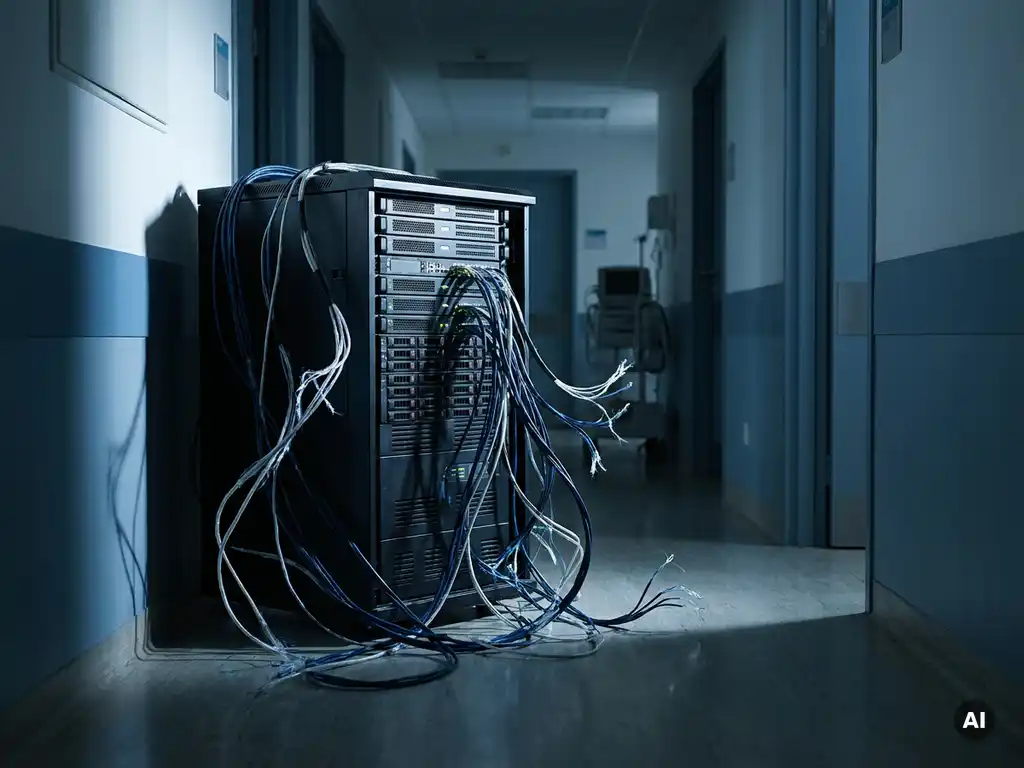
Patient data is already at quantum risk today, even though powerful quantum computers are not yet fully operational. Attackers are collecting encrypted medical data traffic now to decrypt it later, once quantum computers become available. For healthcare organisations working with records that remain sensitive for many years, this is a concrete and urgent security issue. This article answers the most practical questions about quantum encryption in healthcare, from the nature of the risk to the first steps your organisation can take.
When do quantum computers pose a real threat to medical data?
Quantum computers already pose a real threat to medical data today through the so-called “harvest now, decrypt later” attack. Cybercriminals intercept encrypted patient traffic now and store it. Once quantum hardware is powerful enough, they can decrypt that data after all. For medical records, which must remain confidential for decades, this is not a future scenario but a current risk.
The current generation of RSA and ECC encryption, which protects the vast majority of healthcare communications, is mathematically vulnerable to quantum algorithms such as Shor’s algorithm. Estimates of when a sufficiently powerful quantum computer will be available vary, but the security community works with a time horizon of five to fifteen years. That sounds like plenty of time, but the average migration time for critical network infrastructure in healthcare organisations is at least as long.
In 2026 we see that governments and standards bodies worldwide are already publishing new standards for quantum-safe cryptography. That is no coincidence. The urgency is real. If you wait, you will soon be playing catch-up with infrastructure that no longer meets compliance requirements.
Which types of patient data are most vulnerable to quantum attacks?
The most vulnerable patient data is that with a long confidentiality period: electronic patient records, genetic profiles, psychiatric notes, and chronic disease histories. This data retains its value over decades, making it attractive to intercept now and decrypt later when quantum technology matures.
Specifically, the following categories are involved:
- Electronic patient records (EHR): Contain diagnoses, medication histories, and treatment plans that remain relevant for life.
- Genetic and genomic data: Unique to each individual and permanent. Once leaked, always leaked.
- Psychiatric and psychological records: Particularly sensitive due to stigmatisation and legal implications.
- Medical imaging data (MRI, CT, X-ray): Large files transferred across networks that can be intercepted.
- Financial and insurance information: Linked to healthcare claims and personal data.
Beyond the data itself, communication between systems is also vulnerable: connections between hospital sites, links with laboratories, pharmacy systems, and external specialists. All these data streams travel over networks and can be intercepted if the underlying encryption is not quantum-safe. Want to know more about protecting sensitive data in your network? We are happy to explain.
What is the difference between post-quantum cryptography and quantum key distribution?
Post-quantum cryptography (PQC) and quantum key distribution (QKD) are two fundamentally different approaches to quantum-safe security. PQC replaces vulnerable mathematical algorithms with new algorithms that are also difficult for quantum computers to break. QKD uses the laws of quantum physics itself to distribute keys that are physically impossible to intercept without detection.
Post-quantum cryptography: software-based protection
PQC works with new mathematical problems, such as lattice-based cryptography, that neither classical nor quantum computers can solve efficiently. The major advantage: PQC can be implemented as a software update on existing network infrastructure. Standards bodies published the first PQC standards in 2024, enabling healthcare organisations to begin migrating now without replacing hardware.
Quantum key distribution: physics as security
QKD uses quantum particles (photons) to transmit cryptographic keys. Any interception attempt disturbs the quantum state of the particles and is therefore immediately detectable. QKD offers theoretically absolute security, but requires specialised hardware and fibre-optic connections. It is more complex and costly to implement, but provides a higher level of security for the most critical connections.
For most healthcare organisations, PQC is the practical first step. QKD is relevant for extremely sensitive connections, such as links between hospital sites or connections with research institutes working with particularly sensitive data.
How does layer 1 encryption protect patient data against quantum threats?
Layer 1 encryption, also known as physical layer encryption, protects patient data by encrypting all data traffic at the level of the fibre optic cable or physical transmission medium, before the data is assembled into packets. This means that an attacker tapping the connection receives only unreadable noise, with no structure to analyse or decrypt later.
The distinguishing advantage over higher layers of encryption is that layer 1 encryption works independently of protocol. It does not matter which application protocol or security protocol runs on top at a higher level. All data, including metadata and traffic patterns, is concealed. This eliminates an attack vector that remains open with encryption at a higher layer: traffic analysis.
For healthcare organisations working with fibre-optic connections between sites, layer 1 encryption is particularly relevant. The protection against quantum threats we offer combines layer 1 encryption with quantum-safe key exchange, eliminating the “harvest now, decrypt later” risk as well. Also see our encryption solutions for an overview of what is technically possible.
Layer 1 encryption also introduces minimal latency, which is critical in healthcare applications where real-time communication between systems can be life-critical.
Should a healthcare organisation switch to quantum-safe security now?
Yes, healthcare organisations should begin the transition to quantum-safe security now. Not because quantum computers will be operational tomorrow, but because the migration time for critical infrastructure is long, data intercepted today can be decrypted tomorrow, and regulators are already moving towards quantum-safe compliance requirements.
The calculation is straightforward: medical records have a confidentiality period of decades. If your current encryption can be broken in five years, data intercepted today will still be vulnerable then. The GDPR and the NIS2 Directive require you to implement appropriate technical measures. “Appropriate” evolves alongside threats and available technology.
At the same time, you do not need to replace everything at once. A phased approach works best:
- Map which connections and data streams have the highest sensitivity.
- Prioritise quantum-safe encryption for those critical connections first.
- Plan the broader migration to PQC algorithms as part of regular infrastructure renewal.
Waiting is more expensive than acting. Both financially, due to the cost of a data breach, and reputationally, because patients entrust you with their most personal information.
Where do you start with a quantum risk analysis for your healthcare network?
Begin a quantum risk analysis by inventorying all encrypted data streams in your healthcare network and the sensitivity and retention period of the data travelling through them. This immediately reveals where the risk is greatest and where the priority lies. Without that inventory, you do not know what you need to protect.
A practical approach proceeds in four steps:
- Crypto inventory: Map which encryption protocols and algorithms you use across all layers of your network. Identify which RSA- or ECC-based implementations are vulnerable to quantum attacks.
- Data classification: Categorise which data has the longest confidentiality period. Genetic data and psychiatric records deserve a different priority than administrative correspondence.
- Connection criticality: Determine which network connections carry the most sensitive data. Think of connections between sites, links with external laboratories, or cloud connections with EHR systems.
- Migration planning: Develop a roadmap aligned with regular hardware and software replacement cycles, so that quantum-safe migration proceeds cost-efficiently.
We support healthcare organisations at every step of this process. From the initial analysis of your security solutions to the design and implementation of a quantum-safe infrastructure. Our expertise across both the physical network layer and higher security protocols makes it possible to deliver a coherent approach, from fibre optic to application layer. Want to know where your healthcare network stands today? Contact our experts for a no-obligation conversation.
Ready for the next step?
Explore our solutions or get in touch directly with one of our experts.