


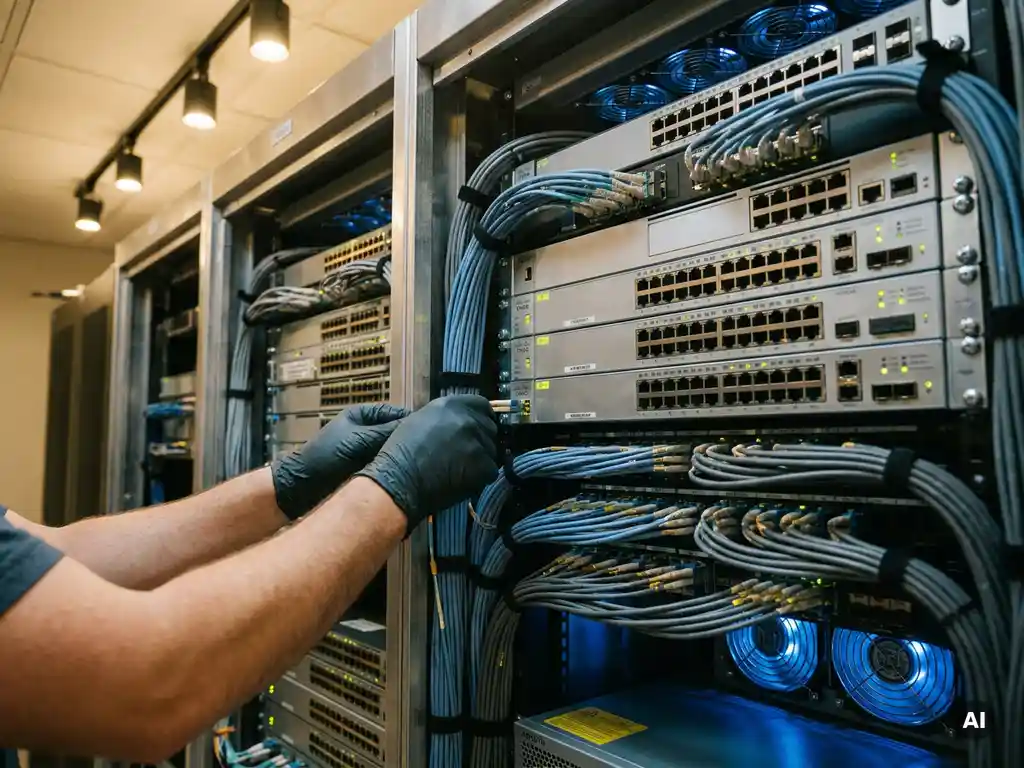
Multi-vendor network management means centrally managing network equipment from multiple vendors within a single infrastructure. You do this by working with vendor-independent management platforms, standardized protocols, and a clear configuration strategy. For organizations with complex network environments, this is not optional, but an operational necessity. In this article, we answer the most frequently asked questions about managing network equipment from multiple vendors.
What challenges does a multi-vendor network bring?
A multi-vendor network brings challenges in the areas of interoperability, management complexity, and security. Equipment from different manufacturers does not always speak the same language, has its own management interfaces, and sometimes follows deviating implementations of standard protocols. This makes it more difficult to maintain a consistent, stable network.
In practice, IT teams working with equipment from multiple brands face a number of recurring bottlenecks:
- Fragmentation in management: Each vendor has its own management interface, CLI syntax, or management platform. Without central oversight, management takes a disproportionate amount of time.
- Compatibility issues: Even with standardized protocols such as BGP or OSPF, implementation differences can lead to unexpected behavior in routing or failover.
- Knowledge fragmentation: Your team must master multiple platforms. This raises the barrier for troubleshooting and increases the risk of configuration errors.
- Inconsistent firmware cycles: Vendors release updates at their own pace. This makes it difficult to maintain a coherent patch strategy.
- Unclear responsibility during outages: When a problem occurs at the interface between two systems from different brands, vendors quickly shift responsibility to each other.
These challenges are manageable, but require a well-thought-out approach. The key lies in standardization, central visibility, and a clear governance structure for your multi-vendor environment.
How do you ensure interoperability between equipment from different brands?
Interoperability in a multi-vendor network is achieved by building on open standards, making the right protocol choices, and avoiding vendor-specific features as much as possible in the core of your infrastructure. Standardization is the foundation for a network that works together reliably, regardless of the brand of the equipment.
Concrete measures that contribute to good interoperability:
- Work with open standards: Protocols such as OSPF, BGP, RSTP, and LACP are widely supported and give you the most flexibility when choosing equipment.
- Avoid vendor lock-in in the core layer: Proprietary features such as vendor-specific stacking protocols or closed routing extensions work excellently within a single brand, but create dependencies that limit interoperability.
- Test integration before deployment: In a lab environment or via pre-staging, you can test equipment from different brands together before they go into production. This prevents surprises in the field.
- Document the dependencies: Record which equipment communicates with which other systems, which protocols are used for this, and where the interfaces lie.
With network solutions that combine multiple brands, a thorough architecture review is essential. A vendor-independent perspective helps you make technical choices that last the entire lifecycle of your infrastructure, not just the initial implementation.
What are the best tools for central network management with multiple vendors?
For central network management in a multi-vendor environment, the most effective tools are those that work based on open APIs, provide support for multiple manufacturers, and offer real-time insight into the status of your entire infrastructure. The choice depends on the scale of your network, the equipment you use, and the degree of automation you are pursuing.
Network monitoring platforms
A good monitoring platform gives you real-time visibility across all equipment, regardless of brand. Platforms that work with SNMP, NETCONF, or streaming telemetry are broadly applicable in multi-vendor environments. They detect anomalies, record performance measurements, and enable you to act proactively before an outage becomes noticeable to users. Monitoring and network management thus forms a foundation for any serious multi-vendor strategy.
Out-of-band management solutions
Out-of-band management (OoBM) gives you access to network equipment via a separate management network, independent of production traffic. This is essential in a multi-vendor environment: if a device becomes unreachable via the regular network, you can still log in, diagnose, and recover via the management network. Out-of-band management significantly reduces the impact of outages and enables remote troubleshooting without being physically on-site.
How do you automate configuration management in a multi-vendor environment?
Configuration management in a multi-vendor environment is automated by using infrastructure-as-code principles, combined with tools that support multiple vendors via standardized interfaces such as NETCONF, YANG data models, or REST APIs. Automation reduces human errors and makes configuration changes repeatable and auditable.
An effective approach to automated configuration management consists of several building blocks:
- Central configuration repository: Store all configurations in a version control system. This gives you a constant overview of the current state of your network and allows you to revert to a previous configuration in case of problems.
- Standardized interfaces: Choose equipment that supports NETCONF or REST APIs. This makes it possible to manage configurations programmatically, regardless of the brand.
- Validation before deployment: Automate not only the deployment of configurations, but also the validation. An automatic check for syntax errors or policy conflicts prevents faulty configurations from reaching production systems.
- Rollback mechanism: Ensure that every automated change can be reversed. This gives your team the confidence to act faster without additional risk.
Automation works best when the underlying architecture is consistent. The more you standardize on protocols and configuration patterns, the more you can automate. Start small, validate thoroughly, and expand step by step.
What security risks arise when combining equipment from multiple vendors?
Combining network equipment from multiple vendors increases the attack surface when there is no consistent security strategy. Risks arise from inconsistent patch cycles, unmanaged interfaces between systems, and the absence of a uniform security policy that applies across all equipment.
The most common security risks in a multi-vendor network are:
- Unpatched vulnerabilities: Vendors release security updates on their own schedule. Without a structured patch process, equipment remains vulnerable longer than necessary.
- Weak points at integration points: Where systems from different brands communicate with each other, configuration errors can occur that inadvertently allow traffic through or bypass authentication.
- Limited visibility: Without central monitoring, you cannot see what is happening on all devices simultaneously. Attackers can move through your network without you noticing in time.
- Inconsistent access control: Each platform has its own capabilities for authentication and authorization. Without standardization, gaps arise in your access policy.
A layered security strategy that also addresses the physical and data link layers is essential. Encryption at layers 1 and 2 protects data flows regardless of which equipment runs above it. In addition, protecting sensitive data at the network level helps prevent a vulnerability in one device from providing access to critical information elsewhere in your infrastructure.
When is a vendor-independent network partner useful?
A vendor-independent network partner is useful as soon as your network consists of equipment from multiple vendors and you do not have the internal capacity or knowledge to manage, secure, and future-proof it consistently. The more complex the environment, the greater the added value of a partner who masters all brands and has no interest in choosing a single specific vendor.
Concrete situations in which a vendor-independent partner clearly adds value:
- Your network has grown through mergers, acquisitions, or expansions and now consists of a mix of brands without a coherent architecture.
- Your IT team lacks the specific knowledge of one or more platforms in your environment, leading to longer resolution times during outages or changes.
- You are facing a replacement or expansion investment and want objective advice on which equipment best suits your situation, without commercial pressure from a single vendor.
- You want to use managed services, but do not want to enter into a separate contract for each vendor.
- You operate in a sector with strict compliance requirements and need demonstrable control over your entire infrastructure.
We have been working vendor-independently for over 20 years and know the products and solutions of brands such as Nokia, Cisco, Huawei, HPE Aruba, and Adtran inside and out. That knowledge is entirely in-house. This means that you always receive objective advice from us, and that we can combine vendors when that is the best solution for your situation. From the initial design to day-to-day management: you have a single point of contact for your complete network infrastructure.
Ready for the next step?
View our solutions or contact one of our experts directly.