


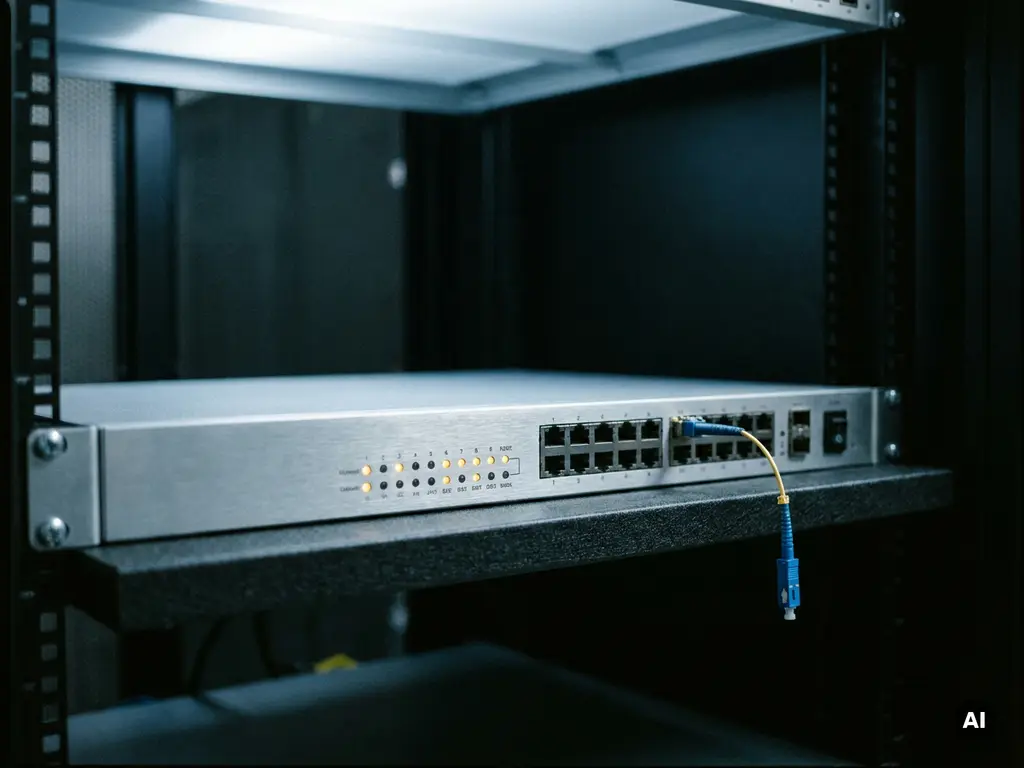
The earliest signs of an upcoming fiber outage are measurable changes in optical power, increased error rates in the data stream, and unexplained latency spikes. These anomalies are visible in your monitoring data before actual downtime occurs. Knowing what to look for allows you to intervene before business-critical processes are affected. The questions below help you recognize, interpret, and act on those signals.
What are the earliest measurable warning signs in a fiber network?
The earliest warning signs in a fiber network are subtle drops in received optical power (Rx power), an increase in bit error rates (BER), and intermittent packet loss without a clear cause. These signals are often visible weeks to months before a connection actually fails.
In practice, signs of a fiber outage manifest in several ways simultaneously. You typically see them in:
- Optical power loss: a gradual drop in the received light level, measured in dBm, outside the manufacturer’s specifications
- Rising BER: more errors per transmitted bit, indicating deterioration of signal integrity
- Higher latency: unexplained delays in throughput, even at low network traffic levels
- Intermittent connection drops: brief outages that recover automatically but occur with increasing frequency
- Alarm history in management platforms: repeated minor alarms that appear harmless individually but form a pattern together
The danger of these early signals is that they attract little attention individually. A single BER spike may be noise. But when you combine that same spike with a slightly declining Rx power and an increase in CRC errors, you are looking at a pattern that warrants attention. Structured monitoring is therefore not a luxury, but a necessity for any organization that depends on stable fiber infrastructure.
How do you distinguish a physical fiber failure from a configuration issue?
A physical fiber failure is identifiable by deviations in optical power and signal integrity at layer 1, while a configuration issue manifests at higher OSI layers without any measurable change in the light signal itself. You make the distinction by systematically working up from layer 1.
Always start by reading the optical values on the transceiver or optical platform. If the received power (Rx) falls within the normal range and no optical alarms are active, the problem is likely configuration-related. Think of incorrect VLAN settings, a mismatch in protocol parameters, or a routing error.
If the Rx power is abnormal, or if you see alarms such as Loss of Signal (LOS) or Loss of Frame (LOF), that points to a physical problem. Possible causes include:
- Contamination or damage to connectors
- A bend or break in the fiber cable
- Wear on splices or fusion joints
- A defective transceiver or SFP module
An OTDR measurement (Optical Time Domain Reflectometer) provides a definitive answer: this instrument sends a light pulse into the fiber and measures reflections at every point along the path. This shows you exactly where in the route an anomaly exists. Configuration issues are not visible with this test, which makes it immediately valuable as a diagnostic tool.
Which environmental factors accelerate wear on fiber connections?
The environmental factors that most rapidly accelerate wear on fiber connections are extreme temperature fluctuations, mechanical stress, moisture, and chemical exposure. Each of these factors affects the structural integrity of the fiber, the jacket, or the connectors — sometimes in ways that only become visible in measurements later on.
Fiber is inherently robust, but the environment in which cables are installed largely determines how quickly degradation occurs. Relevant risk factors include:
- Temperature fluctuations: repeated expansion and contraction of cable jackets and conduits causes mechanical stress on the fiber and splices
- Moisture and condensation: water penetrating cable trays, conduits, or connector enclosures degrades signal transmission properties and accelerates corrosion on metal components
- Mechanical pressure and bend radius: cables that are bent too tightly or placed under pressure due to improper fastening lead to microbends, which weaken the light signal
- UV radiation and chemical environments: the jacket of externally installed cables without adequate protection degrades faster, creating indirect risks
- Vibration: particularly in industrial environments, maritime applications, or transport, sustained vibration can loosen splices and connectors
For organizations active in sectors such as maritime, transport, or critical infrastructure, these are not theoretical risks. Preventive fiber maintenance also means: knowing the environment and designing the infrastructure accordingly.
When does an optical power deviation warrant immediate action?
An optical power deviation warrants immediate action as soon as the received power (Rx) falls outside the operational margin specified by the manufacturer, or when the drop is rapid and sustained rather than incidental. Every transceiver and optical platform has a specified operating range; values outside that range are not noise — they are a signal.
As a rule of thumb: a one-off deviation of 1 to 2 dBm may be noise or a temperature effect. A sustained drop of more than 3 dBm relative to the baseline, or any value approaching the receiver sensitivity of the transceiver, requires action. Do not wait for an outage.
Situations that justify immediate action:
- Rx power drops rapidly over a short period (hours to days)
- The deviation is consistent across multiple measurement intervals, not incidental
- There are simultaneous alarms such as LOS, LOF, or elevated BER
- The connection involves business-critical systems without redundancy
- The drop is asymmetric, which may indicate a specific defect along the route
Early intervention prevents unplanned downtime and makes the difference between a scheduled maintenance window and an emergency repair. Real-time fiber monitoring helps detect deviations immediately, so you always act within the margin.
Which monitoring tools detect fault signals earliest?
The monitoring tools that detect fault signals in fiber networks earliest are platforms that continuously read optical parameters at the transceiver level, combined with network-wide correlation of alarm data. The closer the monitoring is to the physical signal, the sooner you detect a deviation.
Effective monitoring of fiber infrastructure operates on multiple levels simultaneously:
Optical monitoring at the transceiver level
Via Digital Diagnostics Monitoring (DDM) or Digital Optical Monitoring (DOM), transceivers continuously read their own Tx power, Rx power, temperature, and supply voltage. Platforms that aggregate this data and compare it with historical baselines provide insight into trends, not just snapshots. A gradual Rx decline over two weeks is only visible if you track the historical data.
Network management systems with alarm correlation
A network management monitoring platform that correlates alarms from multiple devices and layers detects patterns that are invisible at the device level. A minor alarm on a transceiver combined with elevated BER on the same segment is far more meaningful together than each signal in isolation.
Additionally, out-of-band management provides the ability to retain access to equipment for diagnosis and recovery even during an outage, without depending on the production path. This is valuable in situations where a fiber failure blocks the normal management route.
How do you reduce the risk of unplanned downtime after detecting a signal?
After detecting a warning signal, you reduce the risk of unplanned downtime by documenting the signal, assessing its severity, scheduling a remediation action, and temporarily activating redundancy if available. Responding to an early signal is always more cost-effective than responding to an outage.
Preventive fiber maintenance starts with having a structured process for what happens after a signal is detected. In practice, this means:
- Document the baseline: record what is normal for each connection, so that deviations can be measured objectively
- Classify the urgency: not every signal requires immediate action, but every signal deserves a deliberate assessment
- Plan maintenance proactively: a connector cleaning round or splice inspection at a scheduled time costs a fraction of an emergency repair
- Activate redundancy where possible: if your infrastructure has alternative paths, switch to them temporarily while you restore the primary connection
- Perform a root cause analysis: do not fix the symptom without understanding the cause, or the problem will return
Organizations that want to predict network outages rather than simply react to them build this process in as a standard part of their network management. That requires the right tools, but also the right expertise to interpret signals. If you are looking for support in this area, our engineers are happy to work alongside your team — from setting up monitoring to carrying out preventive maintenance on optical infrastructure. From advice to management: all the expertise is kept entirely in-house.
Ready for the next step?
Explore our solutions or get in touch directly with one of our experts.