


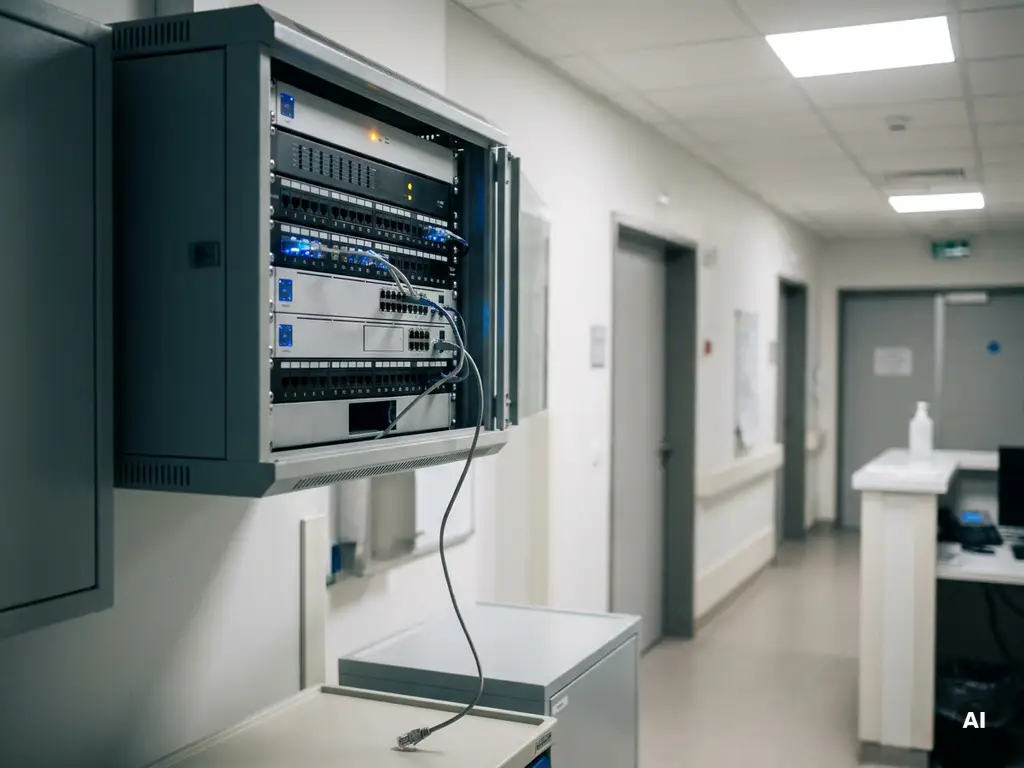
A network assessment in healthcare is needed as soon as your network poses a risk to the continuity of patient care or the security of medical data. For many healthcare organizations, that moment has already arrived: aging infrastructure, growing data flows, and stricter compliance requirements make a periodic network assessment not a luxury, but a necessity. The questions below help you determine whether your organization is due.
What signs indicate an outdated network infrastructure in healthcare?
An outdated IT infrastructure in healthcare can be recognized by recurring disruptions, slow connections, and equipment that is no longer supported by the manufacturer. Concrete signs include: medical devices that do not communicate properly with the network, Wi-Fi outages on nursing wards, and insufficient bandwidth for imaging systems such as MRI or CT scanners.
Other warning signs you should take seriously:
- Network equipment older than seven years without current firmware updates
- No segmentation between medical devices, office networks, and guest networks
- Staff using workarounds because systems are too slow or unreachable
- No up-to-date overview of all connected devices and connections
- Increasing reports of connection errors in electronic patient records (EPR)
In a healthcare environment, these signals are not mere technical inconveniences. They directly affect the quality and safety of care delivery. When a nurse cannot access patient data in time, or when a monitor fails to connect reliably, the consequences can be potentially serious. A network assessment systematically maps these bottlenecks before they escalate.
What are the risks of an unassessed healthcare network?
A healthcare network that is never or rarely audited faces three interrelated risks: security vulnerabilities due to outdated configurations, operational downtime due to unexpected failures, and legal liability due to non-compliance with laws and regulations. In healthcare, these risks can directly affect patient safety.
From a security perspective, the healthcare sector is an attractive target for cyberattacks, precisely because medical data is particularly sensitive and systems are often difficult to shut down quickly. Without current insight into the network architecture, you do not know what vulnerabilities exist, which devices are connected without protection, or where unauthorized access is possible. Protection of sensitive patient data starts with a clear picture of your own network.
Operationally, an unassessed network leads to reactive management: problems are solved after they occur, not prevented. In a hospital or healthcare institution, unplanned system downtime places immediate pressure on care staff and can lead to delays in treatment. Moreover, organizations without periodic network assessments lack the insight to grow: new technologies such as telemonitoring, robotics, and digital care platforms require a stable, well-documented infrastructure as a foundation.
How does a network assessment work in a healthcare environment?
A network assessment in healthcare is a structured analysis of the existing network infrastructure, in which the technical condition, security, performance, and compliance are evaluated. The process typically consists of four phases: inventory, measurement, analysis, and reporting with recommendations.
Inventory and discovery
In the first phase, all network components are mapped: switches, routers, access points, firewalls, medical equipment, and the connections between them. This provides a complete overview of what is connected to the network, including devices that may have been placed outside the IT department’s visibility. In healthcare institutions, this is especially relevant due to the large number of medical IoT devices.
Measurement, analysis, and reporting
Next, performance is measured: bandwidth, latency, stability, and availability per network segment. Security configurations are tested against current standards and sector-specific requirements. The findings are translated into a clear report with a prioritization of risks and concrete recommendations. A good partner not only delivers a list of findings but also provides advice on the most effective next steps. Continuous monitoring and network management can then ensure the network remains structurally up to standard.
When is a network assessment legally required in healthcare?
A network assessment is legally required in healthcare when your organization falls under the NIS2 directive, the GDPR, or sector-specific standards such as NEN 7510. For many healthcare institutions, multiple of these frameworks apply simultaneously, meaning that demonstrable control of the IT infrastructure is not an optional activity.
The NIS2 directive, which is gaining more enforcement teeth in the Netherlands from 2026 onwards, requires organizations in critical sectors, including healthcare, to take appropriate technical and organizational measures. This includes periodically assessing the security status of networks and information systems. NEN 7510, the Dutch standard for information security in healthcare, also requires demonstrable risk management in the areas of networks and access security.
In practical terms, this means that healthcare institutions must be able to demonstrate that they know their network, manage it, and have it assessed periodically. A network audit provides the documentation and insight that regulators expect. If you wait until an incident or an inspection, the damage — financial and reputational — will be considerably greater than the investment in a proactive network assessment.
What does a network assessment concretely deliver for a healthcare organization?
A network assessment delivers three direct results for a healthcare organization: insight into the current state of the infrastructure, a prioritized list of risks and areas for improvement, and a substantiated plan for a future-proof network architecture. This makes the assessment the foundation for all subsequent decisions regarding IT infrastructure in healthcare.
Concretely, after a well-executed assessment you can expect:
- A fully documented overview of all network components and connections
- Insight into vulnerabilities and security gaps, with a risk level per finding
- Recommendations for network segmentation, access security, and capacity expansion
- A basis for compliance reporting to regulators
- A clear picture of which investments are necessary in the short and long term
For IT managers and CISOs in healthcare, this is valuable steering information. It makes discussions about IT budgets concrete and substantiated, and gives management a reliable picture of the risks associated with the current infrastructure. Moreover, an assessment offers the opportunity to plan rather than react, which structurally saves costs and strengthens the continuity of care delivery.
How do you choose the right partner for a network assessment in healthcare?
The right partner for a network assessment in healthcare combines in-depth technical knowledge of network infrastructure with demonstrable experience in the healthcare sector and knowledge of the relevant laws and regulations. Vendor independence is an important criterion: you want advice that fits your situation, not the advisor’s product portfolio.
When making your choice, pay attention to the following points:
- Sector knowledge: Does the partner understand the specific requirements of healthcare environments, such as the presence of medical equipment, strict availability requirements, and privacy legislation?
- Technical breadth: Can the partner assess the full network, from physical fiber connections to wireless networks, security, and cloud connectivity?
- Independence: Does the partner work with multiple vendors and select the best solution for your situation, without bias?
- End-to-end involvement: Does the partner remain involved after the assessment, for implementation, management, and ongoing support?
We have been working with healthcare institutions on questions surrounding network infrastructure, security, and compliance since 2005. Our knowledge is fully in-house, from advice and design to implementation and management. Because we work vendor-independently with partners such as Nokia, Cisco, HPE Aruba, and Huawei, we always advise based on what your organization needs. Whether it concerns an initial optical network assessment, a full security audit, or a multi-year improvement plan: we support you from the first conversation to the last switch.
Ready for the next step?
Explore our solutions or get in touch directly with one of our experts.