


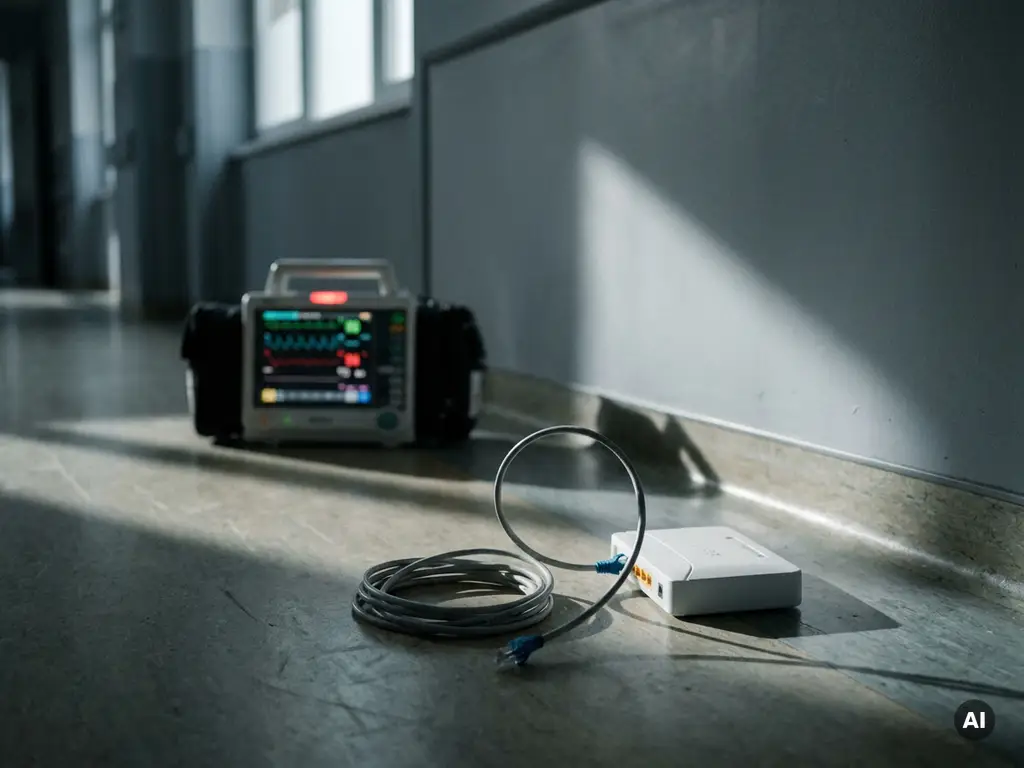
The care processes you must always keep online are those where downtime directly leads to risks for patient safety or continuity of treatment. Think of electronic patient records, medical monitoring systems, communication platforms for emergency care, and medication management systems. For hospitals and care institutions, the rule is: the more a process contributes to direct patient care, the higher the priority for uninterrupted network availability. In this article, we answer the most frequently asked questions about IT continuity in healthcare.
What are the consequences of network loss in healthcare?
Network loss in healthcare directly leads to disruptions in patient care, communication, and administration. When systems go down, healthcare professionals can no longer access patient data, medication processes are interrupted, and monitoring equipment sometimes falls back on local or limited functionality. In acute situations, this can cause life-threatening delays.
Beyond the direct patient risks, there are also operational and legal consequences. Healthcare institutions are legally required to guarantee the availability and integrity of medical data. A network outage that makes patient records inaccessible can lead to compliance violations and liability risks. Moreover, recovery after a serious outage costs significantly more time and resources than a preventive investment in network resilience.
In practice, we see that even brief outages of a few minutes already have noticeable consequences for the workload of healthcare staff. Employees revert to paper-based processes, which increases the risk of errors and delays. The longer an outage lasts, the greater the chance of structural damage to both patient outcomes and the institution’s reputation.
What are the most critical digital healthcare processes?
The most critical digital healthcare processes are those where downtime immediately endangers patient safety or continuity of treatment. These are systems and applications that tolerate no downtime, not even for brief maintenance windows.
- Electronic patient record (EPR): the central source of medical information for diagnosis, treatment, and medication
- Medical monitoring systems: real-time monitoring of vital functions in the intensive care unit and emergency department
- Medication management systems: digital control over the correct dosage and administration of medications
- Imaging systems (PACS/RIS): storage and distribution of X-rays, MRI, and CT scans
- Communication platforms for emergency care: alerting, paging, and internal communication during emergencies
- Laboratory systems (LIS): processing and reporting of diagnostic results
- Operating room equipment with network dependency: planning systems and connected surgical equipment
In addition to these direct care systems, supporting processes are also business-critical, such as access control to secured areas, emergency power registration, and staff communication. They do not always directly affect patient care, but disruption of these processes quickly creates a domino effect on the rest of the organization.
How do you determine which healthcare processes get priority?
You determine the priority of healthcare processes based on the impact that downtime has on patient safety, continuity of treatment, and legal obligations. A structured risk analysis, also known as a Business Impact Analysis (BIA), is the most effective tool for this purpose.
Ask two questions for each digital process: what happens if this system goes down, and how long can the organization function without it? Systems where downtime leads to direct risks within minutes belong to the highest priority category. Systems where downtime only becomes problematic after hours or days fall into a lower category.
In practical terms, you work with two core metrics:
- Recovery Time Objective (RTO): the maximum time a system may be offline before the damage becomes unacceptable
- Recovery Point Objective (RPO): how much data loss is acceptable, expressed in time
For an EPR or monitoring system, the RTO is typically zero to a few minutes. For administrative systems such as billing, this can extend to several hours. By mapping this out per system, you gain a clear picture of where network availability is most critical and where investments in IT continuity deliver the greatest return.
What is the difference between high availability and disaster recovery in healthcare?
High availability focuses on preventing downtime through redundancy and automatic failover, so that systems remain continuously accessible. Disaster recovery focuses on recovery after a serious outage or disaster has occurred. Both are necessary, but they complement each other rather than being interchangeable.
High availability: preventing systems from going down
With high availability, you design your network infrastructure so that no single point of failure exists. Redundant connections, mirrored servers, and automatic switchover ensure that a faulty component does not result in visible downtime for users. In healthcare, this is the foundation for business-critical care processes such as monitoring and EPR access. Real-time fiber optic monitoring plays an important role here: you detect problems before they lead to downtime.
Disaster recovery: recovering after a serious outage
Disaster recovery comes into play when high availability falls short, for example in the event of a cyberattack, fire, or large-scale infrastructure failure. A solid disaster recovery plan describes how you restore systems to operational status, which data you recover, and who bears which responsibility. In the healthcare sector, this is also a compliance requirement: care institutions must be able to demonstrate that they have a functioning recovery plan.
How does network infrastructure ensure uninterrupted care delivery?
A robust network infrastructure ensures uninterrupted care delivery by combining redundancy, segmentation, and continuous monitoring. Each of these elements contributes to a network that absorbs disruptions without interrupting patient care.
Redundancy means that critical connections always have an alternative path. If a fiber optic connection goes down, the network automatically switches to a backup connection without users noticing. This applies to both the physical layer — cabling and switches — and the logical layer — routing and protocols.
Network segmentation protects critical healthcare processes from disruptions elsewhere in the network. By placing medical monitoring systems and EPR access in isolated network segments, you prevent an incident in a less critical part of the network from spreading to the most sensitive systems. This is also essential from the perspective of protecting sensitive data.
Continuous monitoring makes it possible to detect problems before they lead to downtime. With the right monitoring and network management solutions, you have real-time insight into the status of all network components and can intervene proactively. In healthcare, where every moment counts, the difference between detecting and responding is crucial.
When should you bring in a network partner for care continuity?
You bring in a specialized network partner when the complexity of your infrastructure or the demands on availability exceed your internal capacity. For most healthcare institutions, that moment comes sooner than expected, because the combination of medical systems, compliance requirements, and 24/7 availability requires specific expertise that is not always available in-house.
There are concrete signals that indicate it is time to bring in external expertise:
- You do not have a complete picture of all critical dependencies in your network
- Outages are only discovered after users complain rather than being proactively detected
- You lack an up-to-date and tested disaster recovery plan
- Compliance audits point to vulnerabilities in your network availability or data security
- You are considering expanding or renewing critical infrastructure
A good network partner does not start by offering products, but by understanding your specific situation. Which processes are business-critical? Where are the weakest links? What are the legal requirements you must meet? From that analysis, you build together an infrastructure that matches the real needs of your healthcare institution.
We operate vendor-independently and have extensive experience in the healthcare sector. From designing redundant fiber optic connections to integrated security solutions and management throughout the full lifecycle of your infrastructure. This way, you can be sure that your network is never the weak link in the care you deliver.
Ready for the next step?
Explore our solutions or get in touch directly with one of our experts.