


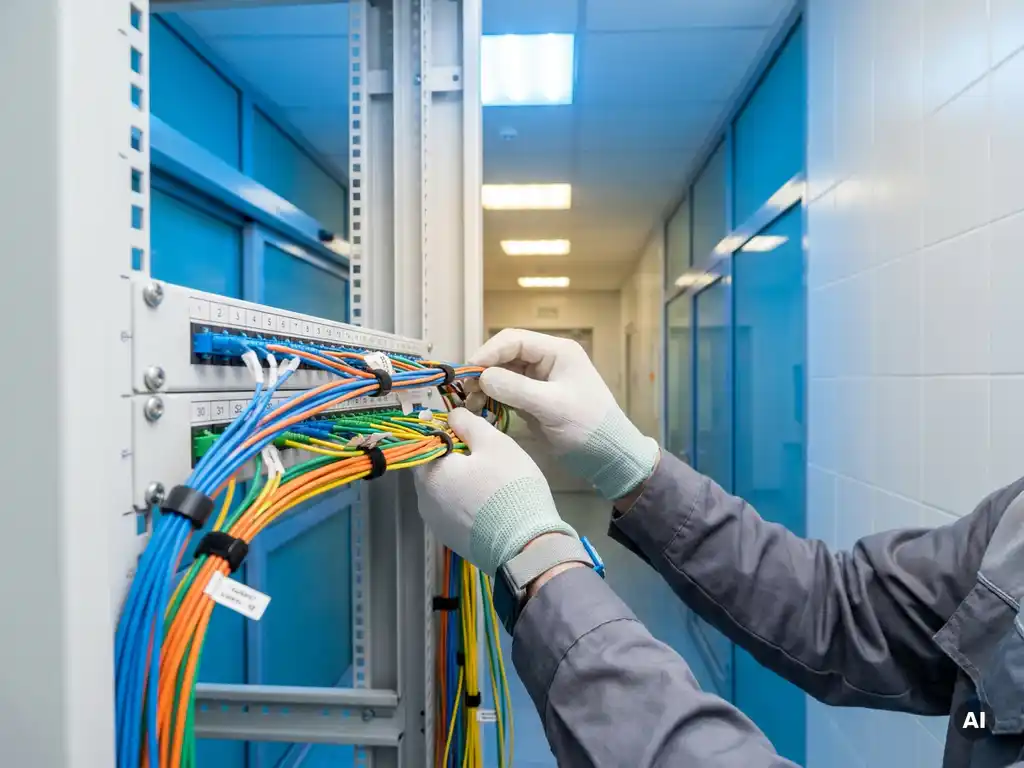
Standardising networks across multiple healthcare locations is done by designing a uniform network architecture that behaves the same at every location, is centrally managed, and complies with applicable healthcare legislation. The key is a layered approach: first establish a common technical foundation, then roll it out step by step. Especially for healthcare organisations with multiple sites, this is not a luxury but an operational necessity. In this article, we answer the most frequently asked questions about network standardisation in healthcare.
Why is network standardisation so challenging in healthcare?
Network standardisation in healthcare is challenging because healthcare locations have historically grown independently, each with their own systems, vendors, and management processes. Combine that with strict privacy legislation, outdated medical equipment, and the 24/7 availability requirements of healthcare networks, and you have a challenge that goes beyond pure technology.
Many healthcare organisations have come about through mergers or acquisitions. Each location brought its own network infrastructure: different switches, different firewalls, different management tooling. The result is a patchwork of systems that are difficult to oversee centrally.
On top of that come healthcare-specific complications. Medical equipment such as infusion pumps, patient monitors, and X-ray machines communicates via legacy protocols that do not simply run on a modern network segment. Downtime is not an option. This makes changes to the existing infrastructure risky and requires a careful approach in which continuity of care always comes first.
Finally, the human factor plays a role. Each location has its own IT team or administrator with their own habits and knowledge. Standardisation therefore affects not only the technology, but also the way of working.
What does a standardised network architecture for healthcare entail?
A standardised network architecture for healthcare organisations is a network setup in which all locations use the same technical building blocks, configurations, and management processes. This includes uniform segmentation, central monitoring, shared security policies, and a consistent connection to healthcare applications and cloud environments.
In practice, this means that the same structure is visible at every location: a standardised core with routers and switches of the same generation and configuration, logical network segmentation per user group (medical staff, guests, medical equipment, management), and a central connection to the data centre or cloud infrastructure of the organisation.
Network segmentation as a foundation
Good segmentation is the backbone of a healthcare network. Medical equipment belongs in a shielded segment that is not reachable from the guest Wi-Fi. Management traffic runs via a separate out-of-band management network. This significantly limits the impact of outages and security incidents.
Central management layer
A standardised architecture only works if you centralise management. That means: one monitoring platform for all locations, automated configuration rollout, and clear escalation procedures. This way, an administrator does not need to log in per location to make a change.
Which network technologies are most suitable for healthcare locations?
For healthcare locations, SD-WAN, fibre as backbone, segmented LAN infrastructure, and layer 1/2 encryption are the most suitable technologies. Together they provide the reliability, security, and manageability that healthcare networks require.
SD-WAN makes it possible to intelligently combine and prioritise multiple WAN connections. Business-critical healthcare traffic such as medical imaging or electronic patient records always gets priority, regardless of network load. At the same time, SD-WAN provides central visibility across all locations from a single management console.
As a physical backbone, fibre is the standard for connections within and between locations. Fibre infrastructure offers high bandwidth, low latency, and is inherently more secure than copper connections because it is much harder to tap. For the LAN layer, managed switches with VLAN support are indispensable for proper segmentation.
Wireless coverage deserves extra attention in healthcare environments. Staff move constantly between departments and expect seamless Wi-Fi connectivity. Good access point placement and roaming support are essential for this.
How do you approach the rollout across multiple healthcare locations step by step?
The rollout of a standardised network across multiple healthcare locations is approached step by step: start with a thorough inventory of the current situation, then design a reference architecture, carry out a pilot at one location, and subsequently roll out in phases to the remaining locations. Haste is the biggest enemy here.
- Inventory and baseline assessment: Map out per location which equipment is present, how the network is set up, and which applications are running. Identify the biggest risks and bottlenecks.
- Design the reference architecture: Based on the inventory, define a standard design that applies to all locations. This includes hardware choices, VLAN structure, security policies, and management processes.
- Pilot location: Implement the new architecture first at one location. Preferably a location that is representative of the rest, but where the impact of a temporary disruption is manageable. Evaluate thoroughly before proceeding.
- Phased rollout: Roll out the standard architecture location by location, preferably outside office hours or during quiet periods in care. Ensure a rollback plan for each location.
- Central management handover: Once the standard architecture has been rolled out at all locations, centralise management fully. Set up monitoring, alerting, and change management according to the new standard.
Communication with the locations is at least as important during this process as the technology itself. Involve local IT managers early and keep healthcare professionals informed of planned work.
How do you ensure network security and compliance during standardisation?
You ensure network security and compliance during standardisation by building security policies into the reference architecture from the outset, not adding them afterwards. Think of mandatory encryption of sensitive data traffic, strict access control, and demonstrable logging for audits in accordance with NEN 7510 and GDPR.
Healthcare organisations process particularly sensitive personal data. The NEN 7510 standard sets specific requirements for information security in healthcare. A standardised network offers an advantage here: because all locations share the same security setup, compliance is demonstrable and repeatable.
Essential security measures that must be included in the standard:
- Network segmentation: Strict separation between medical equipment, patient systems, and office environments
- Encryption: Encryption of data in transit, both internally and to external systems and cloud platforms
- Access control: Role-based access with strong authentication for administrators
- Monitoring and logging: Real-time network monitoring with central logging for incident response and compliance reporting
- Out-of-band management: A separate management network that operates independently of production traffic, so you always retain access to the infrastructure in the event of an incident
Standardisation also makes it easier to consistently apply patches and firmware updates across all locations. This reduces the attack surface and keeps security up to date without having to intervene manually at each location.
When is an external network partner valuable in this approach?
An external network partner is valuable when internal IT capacity is insufficient for the complexity of a rollout across multiple locations, when specialist knowledge is lacking in the area of healthcare compliance or specific network technology, or when you need independent advice without vendor interest.
Many healthcare organisations have a small IT team that is busy day to day with management and incidents. A large-scale standardisation project requires project capacity and in-depth expertise that is simply not available internally. An external partner fills that gap without the need to expand your permanent headcount.
In addition, vendor independence is a serious advantage. An independent partner advises based on your situation, not based on a commercial interest in a specific brand. This leads to better technical choices and prevents lock-in.
We support healthcare organisations throughout the entire process: from inventory and architecture design to implementation and ongoing management. With more than 20 years of experience in complex network infrastructure and knowledge of the specific requirements in the healthcare sector, we help you achieve network standardisation in healthcare in a way that works in practice. Want to know more about how we protect sensitive healthcare data within a standardised infrastructure? Our experts are happy to think along with you.
Ready for the next step?
Explore our solutions or get in touch directly with one of our experts.