


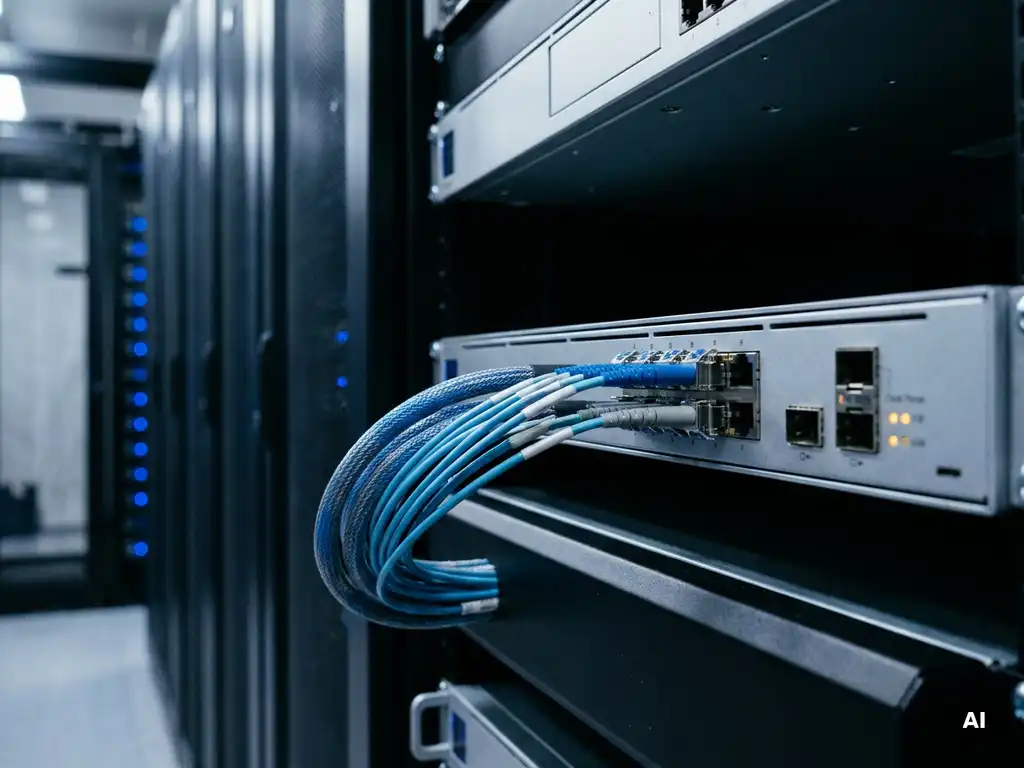
A data center requires network security on multiple layers simultaneously: from physical access control and fiber monitoring to layer 1 and layer 2 encryption, network segmentation, and quantum-safe cryptography. Customer connections in a data center are an attractive target because they transport sensitive business data, often over shared infrastructure. The questions below give you a clear picture of which security measures are relevant and when you need them.
Which attack vectors threaten customer connections in a data center?
Customer connections in a data center are threatened by eavesdropping on physical connections, man-in-the-middle attacks at layer 2, DDoS attacks on the network edge, and unauthorized access via poorly segmented infrastructure. Attackers target the transport of data between the customer and the data center because that is the moment when information is most vulnerable.
The most common threats can be divided into two categories: attacks on the physical layer and attacks on the logical layer. At the physical layer, this involves tapping fiber connections or unauthorized coupling of equipment. At the logical layer, spoofing, session hijacking, and misconfigured VLAN structures are common risks.
What makes this extra complex in a data center environment: multiple customers share the same physical infrastructure. A security issue with one customer connection can therefore pose a risk to others. Good data center security solutions therefore address both the physical and logical attack surfaces.
What is the difference between layer 1 and layer 2 encryption for data center connections?
Layer 1 encryption secures data at the physical transmission level, before any protocol is active. Layer 2 encryption operates at the data link level and encrypts Ethernet frames. The key difference: layer 1 encryption is protocol-independent and introduces virtually no latency, while layer 2 encryption offers more flexibility but has slightly more overhead.
Layer 1 encryption: maximum transparency
With layer 1 encryption, the entire bitstream is encrypted at the moment of transmission. This makes it invisible to higher network layers and provides protection regardless of which protocol runs on top. For data center connections with high bandwidth requirements and strict latency demands, this is often the preferred choice. Think of connections between data centers (DCI) or critical backbone links.
Layer 2 encryption: flexibility at the Ethernet level
Layer 2 encryption is based on standards such as MACsec and encrypts Ethernet frames point-to-point. This makes it suitable for environments where you want to encrypt per segment or per customer. The encryption is configurable per connection, providing more granularity in multi-tenant data centers. The downside is that the encryption stops at every hop, unless you deploy end-to-end MACsec.
The choice between the two depends on your architecture, the distance of the connection, and the latency tolerance of the applications running over it.
How does network segmentation work for customer connections in a data center?
Network segmentation in a data center isolates customer connections from each other by introducing logical or physical separation in the network infrastructure. This prevents traffic from one customer from being visible or reachable to another. The most commonly used techniques are VLAN segmentation, VRF isolation, and software-defined network segmentation via SDN.
In practice, segmentation works as follows: each customer is assigned their own logical network segment. Traffic within that segment remains isolated from other segments, even if it runs over the same physical switches and cables. VLANs are the basic solution for this, but in larger environments, VRF instances (Virtual Routing and Forwarding) are deployed to also separate the routing tables.
Good segmentation is not only a security measure, it is also an operational requirement. Without clear segmentation, it is difficult to isolate problems, manage access, and meet compliance requirements such as those in the healthcare or financial sector. Our network solutions are specifically designed to keep segmentation scalable and manageable.
What role does physical security play in protecting network connections?
Physical security is the foundation of any security architecture for data center connections. Without control over who has access to the physical infrastructure, software-based security measures are insufficient. Fiber connections can be tapped, equipment can be tampered with, and unmonitored access points pose a direct risk.
In a data center, physical security goes beyond locking server rooms. It also includes monitoring cable routes, controlling patch panels, and monitoring the fiber infrastructure itself. Real-time fiber monitoring makes it possible to immediately detect when a connection is being compromised or physically tampered with, before any data is compromised.
Physical and logical security reinforce each other. A fiber connection being tapped produces detectable signal changes. Monitoring systems calibrated for this provide an immediate alert, allowing you to respond quickly. This applies to both connections within the data center and to external connections.
When is quantum-safe encryption necessary for data center connections?
Quantum-safe encryption is necessary for data center connections when you process data that must remain confidential over the long term, or when you operate in sectors with strict compliance requirements. Quantum computers are capable of breaking current asymmetric encryption standards, meaning that data intercepted today can be decrypted in the future.
This risk is known as “harvest now, decrypt later”: attackers collect encrypted traffic now and wait until quantum computers are powerful enough to decipher it. For sectors such as defense, healthcare, and financial services, this is not a theoretical risk but a concrete threat that requires action now.
In 2026, we see a clear acceleration in the adoption of post-quantum cryptography, partly driven by international standardization initiatives. Data center connections transporting sensitive customer data would do well to develop a migration strategy now. Read more about how to protect yourself against this on our page about protection against quantum threats.
How do you choose the right security architecture for your data center environment?
The right security architecture for customer connections in a data center is chosen based on four factors: the sensitivity of the data, the architecture of the connections, the compliance requirements in your sector, and the desired latency. There is no universal solution, but there are clear starting points that guide your choice.
Start with a risk analysis: which connections transport the most critical data? For those connections, layer 1 encryption or end-to-end MACsec is a logical choice. Then segment your network so that customer connections are fully isolated, even in the event of an internal failure or incident. Add physical monitoring so that you detect anomalies immediately.
Also think about manageability. A security architecture that you cannot monitor or maintain offers less protection in practice than a simpler but well-managed solution. Out-of-band management ensures that you can manage your infrastructure even when the primary connection is disrupted or compromised.
Finally: plan for the future. An architecture that meets requirements today but is not scalable or does not allow for quantum-safe upgrades will require a complete overhaul again in a few years. We are happy to help you design a security architecture that works today and grows with you tomorrow.