


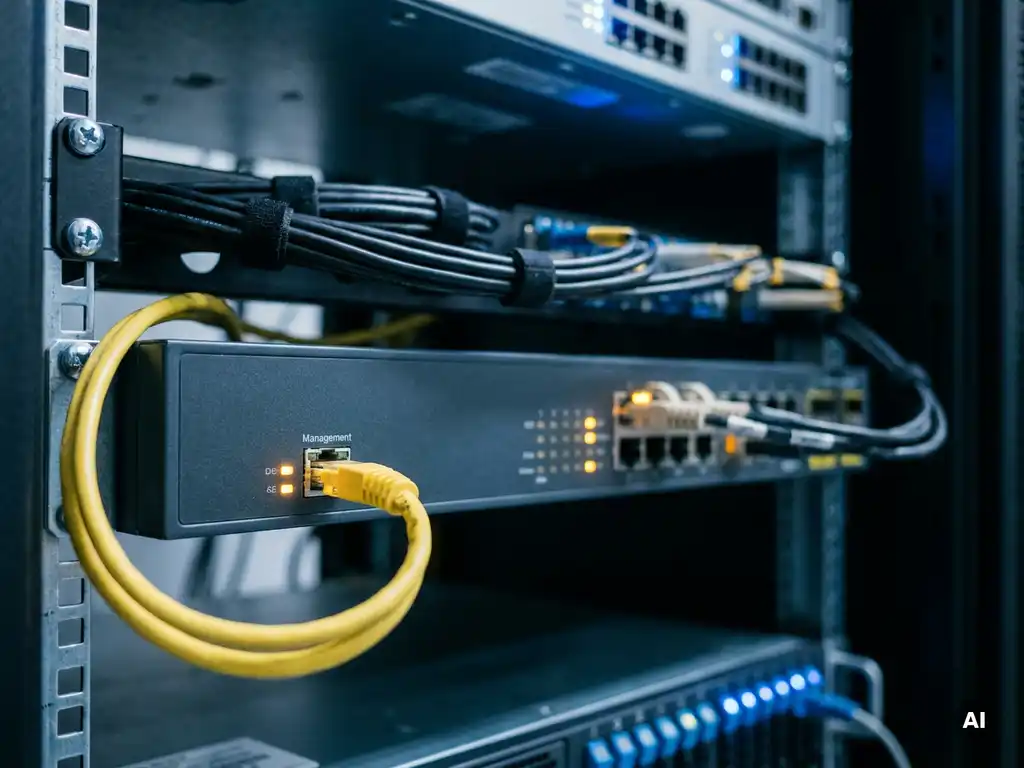
Business-critical network equipment such as core switches, routers, firewalls, and servers should ideally always be managed through a separate management network. This is especially true for equipment in production environments where availability and security are paramount. In this article, we answer the most frequently asked questions about management networks, so you can make an informed decision for your infrastructure.
What is the difference between in-band and out-of-band management?
In-band management means you manage network equipment through the same network that also carries production traffic. Out-of-band management (OoBM) uses a completely separate management network, ensuring access to equipment is always possible, even if the production data network fails or is compromised.
The difference is significant in practice. With in-band management, your management access depends on the availability of the production network. If a switch becomes misconfigured, a link goes down, or an attack disrupts the network, you also lose access to the equipment you need to restore. That is precisely the moment when you need control the most.
With out-of-band management, the management channel is completely decoupled from the production network. You retain access through a dedicated management interface or a separate physical network, regardless of what happens in the production environment. This makes OoBM the standard for professional and critical environments.
Which network equipment needs a separate management network?
Equipment that needs a separate management network includes core switches, distribution switches, routers, firewalls, servers, and power management equipment such as PDUs and UPS systems. These are the components whose availability and integrity directly determine the functioning of your entire infrastructure.
Specifically, this concerns the following categories:
- Core and distribution switches: the backbone of your network. If you lose access here, management of everything connected below it comes to a standstill.
- Routers and WAN equipment: connections to the internet or other locations. In the event of failure or misconfiguration, you always want an alternative management path.
- Firewalls and security equipment: a firewall you can no longer reach after a policy change is a serious operational risk.
- Servers and hypervisors: especially in virtualized environments, out-of-band access through a dedicated management interface is essential.
- Power management equipment: remotely restarting or shutting down PDUs and UPS systems requires a reliable, independent management path.
For organizations in sectors such as healthcare, transportation, or critical infrastructure, a separate management network is not a luxury but a requirement. Loss of management access at the wrong moment can have direct operational or safety consequences.
When is a separate management network not strictly necessary?
A separate management network is less critical for small-scale, non-critical environments with few devices, low availability requirements, and no sensitive data. Think of a small office network with a handful of access switches and a simple router, where downtime is acceptable and security is not a priority requirement.
In such situations, in-band management is often sufficient, provided you take additional measures. Consider using a separate management VLAN, strong authentication, and encrypted traffic via SSH. This provides a basic level of separation without the complexity of a fully separate physical network.
As soon as the environment grows, sensitive data is processed, or availability requirements increase, the balance shifts quickly. A separate management network then rapidly becomes the wisest choice, both from an operational and a security perspective.
How do you technically set up a management network?
You set up a management network by creating a logically or physically separate management path that is exclusively accessible to authorized management systems and administrators. The core consists of a dedicated management VLAN or a separate physical network, combined with strict access control and encryption.
A solid setup follows these steps:
- Choose between logical and physical separation: a separate management VLAN is the most common approach. In highly critical environments, you opt for fully physically separated cabling and switches.
- Configure dedicated management interfaces: most professional network equipment has a separate management port. Use it and connect it to the management network.
- Restrict access strictly: only management systems and administrators may communicate with the management network. Use access control lists (ACLs) and firewall rules to enforce this.
- Encrypt all management communication: SSH for CLI access, HTTPS for web interfaces. Unencrypted management traffic is unacceptable in professional environments. More information about encryption solutions will help you make the right choices here.
- Implement centralized monitoring: use a Network Management System (NMS) that monitors all equipment via the management network. This gives you constant insight into the status of your infrastructure.
For environments with multiple locations, secure remote access is a logical addition. This allows you to reach remote equipment through a reliable and controlled management path, without depending on regular WAN traffic.
What are the risks of managing through the production data network?
The main risks of in-band network management are loss of management access during network outages, an increased attack surface for malicious actors, and the possibility that management traffic is intercepted or manipulated. In production environments with high availability requirements, this makes in-band management a serious vulnerability.
Specifically, these are the risks you face:
- Loss of access during failure: if the production network goes down due to a fault, attack, or misconfiguration, you lose precisely at that moment the access you need to resolve the problem.
- Larger attack surface: management traffic passing through the production network is exposed to all devices and systems on that network. A compromised system can intercept or manipulate management traffic.
- Privilege escalation: if an attacker gains access to the production network, they can also attempt to hijack management sessions or reach management systems in an in-band scenario.
- Limited visibility during incidents: during a security incident, you want to be able to isolate the production network without losing your management access. That is impossible if both run over the same network.
A separate management network largely eliminates these risks. Combined with monitoring and network management at layers 1 and 2, you not only have a secure management path, but also the visibility to detect problems early. Want to know which security solutions suit your infrastructure? We are happy to help you make the right choices.