


Real-time fiber optic monitoring for a business-critical connection typically costs between a few hundred and a few thousand euros per month, depending on the size of the network, the desired service level, and the chosen approach. The biggest cost variable is the choice between a managed monitoring service and self-monitoring with your own hardware and staff. Below we answer the most frequently asked questions about fiber optic monitoring costs, so you can make a well-informed decision.
What factors determine the price of fiber optic monitoring?
The price of fiber optic monitoring is determined by four main factors: the size of the network, the desired service level, the measurement frequency, and the complexity of reporting. The more connections you monitor, the higher the costs. Organizations with a single critical connection pay fundamentally differently than companies with a branched fiber optic network across multiple locations.
Specifically, the following factors play a role in determining the fiber optic monitoring price:
- Number of connections and segments to monitor, each additional segment adds measurement points and data processing
- Service level (SLA), a response time of four hours is cheaper than a guarantee of thirty minutes
- Measurement frequency and granularity, continuous monitoring in milliseconds is more intensive than periodic measurements
- Geographic spread, connections over long distances or hard-to-reach locations require more infrastructure
- Integration with existing systems, linking to network management platforms or ticketing systems increases the initial investment
- Alerting and escalation procedures, automatic notifications with 24/7 follow-up cost more than office-hours monitoring
Organizations in sectors such as healthcare, transport, or critical infrastructure often opt for a higher service level because the consequences of an outage are immediately felt operationally. For them, the higher monitoring costs are a direct investment in business continuity.
What does a managed monitoring service cost versus self-monitoring?
A managed fiber optic monitoring service typically costs more per month than self-monitoring, but has lower total cost of ownership in the long run. Self-monitoring requires a significant one-time investment in hardware and software, plus ongoing staffing costs for management and analysis. A managed service bundles these costs into a predictable monthly rate.
Costs of self-monitoring
With self-monitoring, you invest in measurement equipment, monitoring software, and the expertise to manage everything. The hardware for professional fiber optic monitoring is no small expense, and then there are software licensing costs, staff training costs, and the indirect costs of capacity that your staff cannot spend on other tasks. For smaller organizations without in-house network specialists, this model is rarely efficient.
Costs of a managed service
With a managed monitoring service, you pay a monthly fee that includes hardware, software, management, and reporting. The major advantage is predictability: you know what you pay and you know what you get. In addition, you benefit from specialized expertise that is difficult to build and maintain internally. For business-critical connections, this is often the wisest choice, especially when 24/7 follow-up is required.
What monitoring tools are used for fiber optic connections?
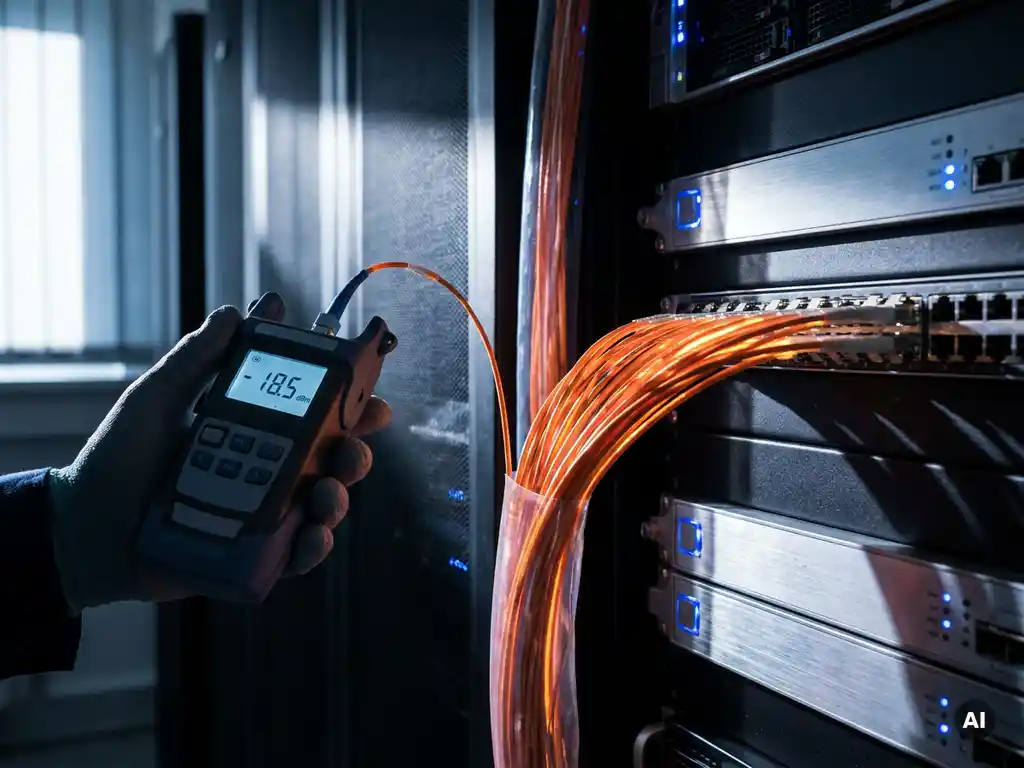
For professional real-time fiber optic monitoring, optical reflectometers (OTDR), optical power meters, and specialized network management platforms are primarily used. These tools measure signal strength, signal quality, fault locations, and latency on the fiber optic path itself, not just at the network level.
The most commonly used techniques and instruments are:
- OTDR (Optical Time Domain Reflectometer), detects break points, connection losses, and degradation along the fiber
- Optical power monitoring, continuously monitors signal power and immediately flags deviations
- Network management platforms, aggregate measurement data from multiple points and generate alarms and reports
- Out-of-band management, makes it possible to retain access to network equipment for diagnosis and recovery even during an outage
Partners such as Adtran, Nokia, and Cisco supply equipment and platforms that integrate these measurement functions into a cohesive monitoring system. The choice of specific tools depends on the network architecture, the desired measurement depth, and integration with existing management infrastructure. Via out-of-band management, access to critical equipment is guaranteed even when the primary connection fails.
What are the costs of an outage without real-time monitoring?
An outage without real-time monitoring typically costs significantly more than the monitoring itself. Without continuous monitoring, it takes longer to discover a problem, longer to find the cause, and longer for recovery to take place. That extra time translates directly into revenue loss, productivity loss, and reputational damage.
The true costs of an unmonitored network outage are made up of multiple layers:
- Direct operational damage, processes that are halted, transactions that do not go through, employees who cannot work
- Detection time, without monitoring you often only discover an outage when users complain, which costs valuable minutes or hours
- Diagnosis costs, without measurement data an engineer must measure on-site, adding time and travel costs
- Recovery costs, emergency interventions outside office hours are significantly more expensive than planned work
- Reputation and contractual obligations, SLA penalties or customer churn are difficult to quantify but very real
For hospitals, data centers, or transport companies, even a brief outage can have critical consequences that far exceed the costs of a comprehensive monitoring package. Real-time monitoring reduces detection time from hours to seconds and recovery time by a factor that quickly recoups the monthly monitoring costs.
When is more extensive fiber optic monitoring worth the investment?
More extensive fiber optic monitoring is worth the investment as soon as the cost of one hour of downtime exceeds the monthly monitoring costs. For most organizations with a business-critical connection, this is quickly the case. The more dependent your processes are on network availability, the faster the payback period.
More extensive monitoring is certainly justified in the following situations:
- Your business processes are directly dependent on network access, with no fallback
- You have contractual uptime obligations to customers or partners
- Your network connects multiple locations or critical systems that are interdependent
- You operate in a sector with strict availability requirements, such as healthcare, finance, or transport
- Your current team lacks the capacity or expertise to quickly diagnose outages themselves
For organizations that also want to secure the safety of their fiber optic connection, monitoring offers a logical complement to encryption solutions at layer 1 and layer 2. Together, monitoring and encryption form a complete approach for business-critical connections. Want to know which monitoring level suits your situation? We are happy to help you determine the right approach, without recommending more than you need.
Ready for the next step?
Explore our solutions or get in touch directly with one of our experts.