



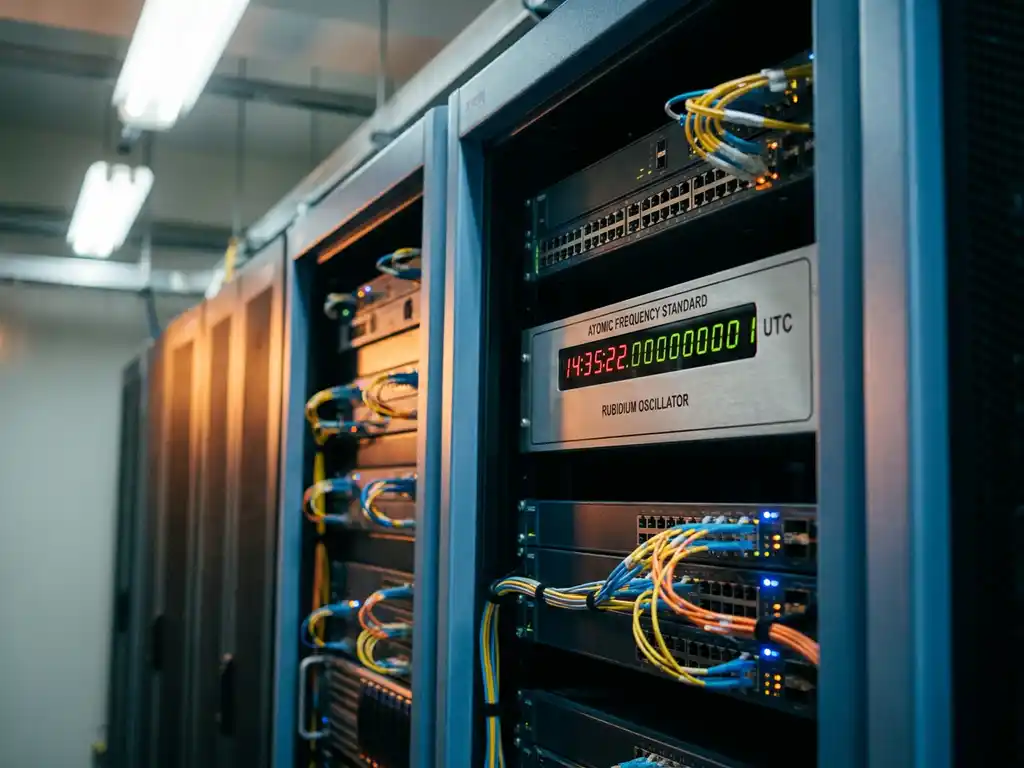
Time synchronization is required in networks because virtually every digital system depends on a shared, accurate time reference to coordinate processes, validate transactions, and order communications. Without a common clock, errors arise in logging, data transfer, and security protocols. This article answers the most frequently asked questions about clock synchronization in networks, from the technical workings to choosing the right solution.
Which networks and systems depend on time synchronization?
Virtually every professional network and system that coordinates multiple devices or processes depends on time synchronization. This applies to financial trading platforms, power grids, telecom infrastructure, hospital systems, data centers, and industrial control systems. Wherever the order, speed, or security of data matters, a shared time reference is indispensable.
Specifically, this covers the following categories:
- Financial networks: Stock exchange transactions and payment systems require accurate timestamps for auditing and fraud detection.
- Telecom networks: Mobile networks such as 4G and 5G use precision time for frequency allocation and handoffs between base stations.
- Power grids: Smart electricity grids synchronize switching operations and measurements across large distances.
- Data centers: Distributed databases and applications depend on time synchronization for consistency and replication.
- Healthcare institutions: Medical equipment, patient records, and alarm systems require a reliable time reference.
- Transportation and logistics: GPS navigation, railway systems, and air traffic control rely on synchronized clocks.
- Critical infrastructure: Water management, industrial automation, and security systems depend on a stable time base.
What all these systems have in common is that a time difference of even a few milliseconds can lead to errors, conflicts, or security issues. The more devices that work together in a network, the greater the impact of an unsynchronized clock.
How does time synchronization work technically in a network?
Time synchronization in a network works by having all devices reference a common, accurate time source. A primary time source, such as a GNSS receiver or an atomic clock, distributes the reference time. Through a hierarchical protocol, this time is propagated to servers and then to end devices, which continuously adjust their own clocks. Implementing the right networking solutions is key to ensuring this process runs reliably across your entire infrastructure.
The process takes place in a number of steps:
- Primary time source: A GNSS receiver (such as GPS or Galileo) or an atomic clock provides a UTC traceable time reference with high precision.
- Stratum hierarchy: Time servers are organized into layers, known as strata. A stratum 1 server is directly connected to the primary time source. Stratum 2 servers synchronize with stratum 1, and so on.
- Time protocol: Using protocols such as NTP or PTP, time messages are exchanged between servers and clients. The client calculates the network delay and adjusts its clock accordingly.
- Continuous correction: Devices continuously compare their local clock with the received time reference and correct small deviations, also known as drift.
The accuracy of synchronization depends on the protocol used, the quality of the time source, and the stability of the network. For time synchronization in critical processes, the redundancy of the time source also plays an important role: if the primary source fails, a backup must be able to take over immediately.
What is the difference between NTP and PTP?
NTP (Network Time Protocol) and PTP (Precision Time Protocol) are both protocols for network time synchronization, but they differ significantly in accuracy and area of application. NTP synchronizes clocks to within a few milliseconds and is suitable for most IT networks. PTP achieves accuracies in the microsecond to nanosecond range and is designed for time critical applications.
NTP: robust and broadly applicable
NTP has existed for decades and is the most widely used time protocol in the world. It operates over UDP on standard IP networks and is straightforward to implement on virtually any device. Typical accuracy ranges from 1 to 50 milliseconds, depending on network latency. For office networks, servers, and most business applications, this is more than sufficient.
PTP: precision for demanding environments
PTP, defined in the IEEE 1588 standard, was developed for environments where millisecond precision is not enough. The protocol accounts for exact delays in network equipment and, when supported by hardware timestamping in switches and routers, can achieve accuracies of less than 100 nanoseconds. PTP is used in 5G networks, financial trading platforms, power grids, and industrial automation.
The choice between NTP and PTP depends on the precision requirements of your application. For standard IT infrastructure, NTP is sufficient. As soon as you are dealing with applications that require sub millisecond synchronization, PTP is the appropriate choice.
Ready for the next step?
Explore our solutions or get in touch with one of our experts directly.
What happens when time synchronization in a network fails?
When time synchronization in a network fails, devices and systems can begin using conflicting time information. This leads to errors in log files, failed authentication, conflicts in distributed databases, and in serious cases, the failure of business critical processes. The consequences range from minor inconsistencies to complete system outages.
Specific risks associated with failed clock synchronization include:
- Security issues: Certificates and authentication protocols such as Kerberos are sensitive to time discrepancies. A deviation of more than five minutes can result in rejected connections.
- Data inconsistency: Distributed databases can encounter conflicts when transactions are not correctly ordered in time.
- Faulty logging: Troubleshooting and audit trails become unreliable when timestamps are incorrect, complicating forensic investigations.
- Network disruptions: In telecom networks, loss of time synchronization can cause synchronization issues between base stations, resulting in connection failures.
- Financial errors: In trading systems, incorrect timestamps can lead to transaction errors or compliance violations.
A particular risk is the dependency on external time sources such as GNSS signals. Jamming or spoofing of satellite signals can disrupt the time reference of an entire network. Robust backup solutions, such as time synchronization via fiber optic infrastructure, are therefore essential for networks that require high availability. Addressing these vulnerabilities is an integral part of a well designed network security strategy.
When is nanosecond precision required in time synchronization?
Nanosecond precision in time synchronization is required when systems collaborate in real time over large distances or at high speeds, where even microsecond deviations cause measurable errors. This applies in particular to 5G networks, financial trading infrastructure, power grids, and scientific measurement systems.
The most common applications requiring nanosecond precision:
- 5G and mobile networks: Coordination between base stations in 5G requires time synchronization accurate to within hundreds of nanoseconds for correct frequency allocation and interference management.
- Financial trading systems: Regulations such as MiFID II require timestamps accurate to the microsecond for transaction reporting.
- Power grids: Synchrophasor measurement in smart electricity grids requires precision time to detect and prevent network disruptions.
- Scientific instruments: Radio telescopes and seismic measurement networks combine data from multiple locations and depend on nanosecond precision for meaningful results.
For these applications, PTP with hardware timestamping is the standard. The time reference is typically provided by GNSS receivers with multi band support, which can accurately distribute phase, frequency, and time of day to all connected devices. You can explore the range of compatible networking products suited to these demanding environments.
How do you choose the right time synchronization solution for your network?
The right time synchronization solution is chosen based on three factors: the required accuracy, the size of your network, and the level of availability you must guarantee. Start by mapping the precision requirements of your most critical applications, then determine which time sources and protocols are appropriate, and ensure redundancy is in place.
A practical step by step approach:
- Map your precision requirements: Do your applications need millisecond, microsecond, or nanosecond precision? This determines whether NTP or PTP is the right choice.
- Choose a reliable time source: For high precision, a directly connected GNSS receiver is recommended. Consider multi band receivers that support multiple satellite constellations for greater reliability.
- Ensure redundancy: Avoid a single point of failure by combining multiple time sources. Fiber based synchronization can serve as a backup when satellite signals are unavailable.
- Check your network hardware: PTP requires hardware timestamping in switches and routers. Verify whether your existing infrastructure supports this or needs to be expanded.
- Implement monitoring: Set up continuous monitoring of your time synchronization infrastructure so that deviations are detected and corrected immediately.
- Protect against attacks: Validate time signals and implement protection against GNSS spoofing and jamming, especially in environments with critical processes.
For networks in sectors such as telecom, energy, or finance, it is advisable to treat time synchronization as part of your broader security strategy. An unreliable time reference is not only a technical problem, but also a security risk. Our managed services can help you maintain continuous oversight and control of your synchronization infrastructure.
How we help with time synchronization in your network
Time synchronization may be invisible, but it forms the backbone of every reliable digital infrastructure. We deliver end to end synchronization solutions for organizations that cannot afford to compromise on high availability and precision.
What we specifically offer:
- GNSS based synchronization via multi band receivers that combine GPS and Galileo for maximum reliability and UTC traceability.
- PTP and NTP implementations tailored to the precision requirements of your network, from standard IT environments to 5G infrastructure.
- Redundant backup solutions via fiber optic infrastructure, ensuring time synchronization remains guaranteed when satellite signals are unavailable.
- Protection against GNSS attacks through signal validation, anomaly detection, and the use of multiple synchronization sources.
- Monitoring and management of your time synchronization infrastructure for continuous visibility and rapid intervention in the event of deviations.
- Vendor independent advice backed by more than 20 years of experience in network infrastructure, from design to implementation and management.
Want to find out which time synchronization solution is right for your network and requirements? Get in touch and we will be happy to help.
Ready for the next step?
Explore our solutions or get in touch with one of our experts directly.