


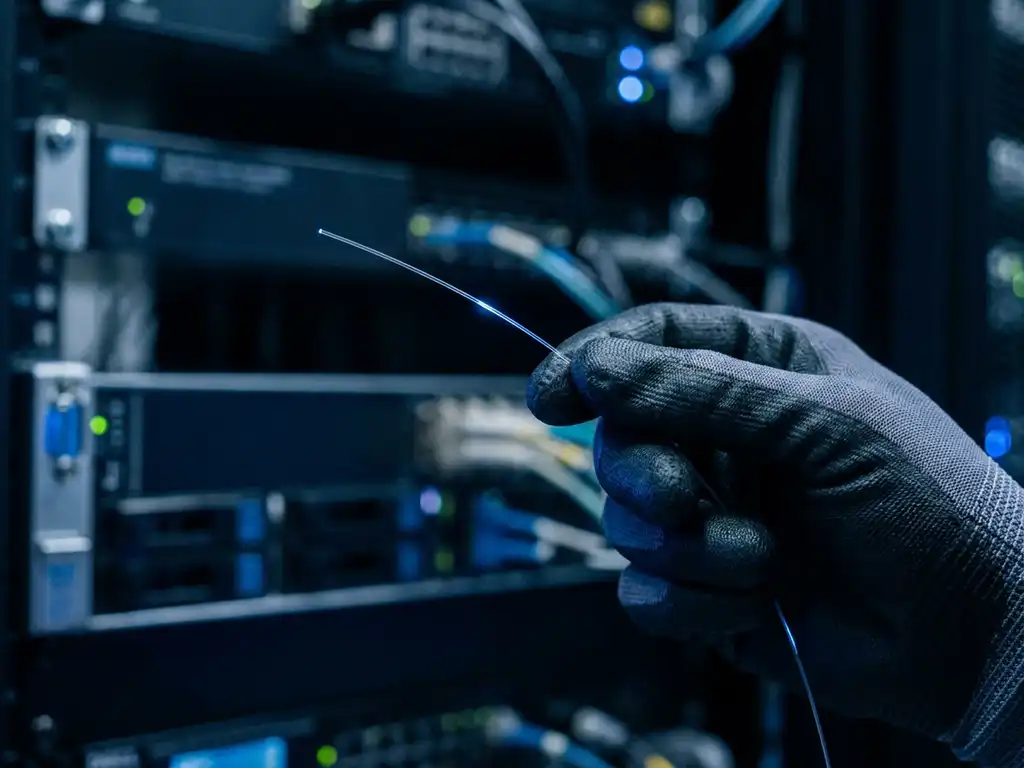
Fiber optic eavesdropping is technically far more difficult than tapping copper cables or wireless connections, but it is not entirely impossible. Light travels through a fiber optic cable without emitting electromagnetic radiation, which makes passive interception extremely challenging. Nevertheless, there are known methods that malicious actors can use to intercept the signal, and for organizations working with sensitive data it is wise to understand how significant that risk truly is and what protective layers are available.
How difficult is it to tap a fiber optic cable?
Tapping a fiber optic cable is considerably more difficult than intercepting copper connections or Wi-Fi signals. Fiber optic cables transmit data as pulses of light through a glass core, and because no electromagnetic field is generated around the cable, passive remote interception is not possible. An attacker must have physical access to the cable itself in order to intercept the signal.
That physical requirement makes fiber optic eavesdropping far more complex than higher-level digital attacks. Even so, the risk should not be dismissed entirely. Physical access to a cable route is achievable in certain situations, particularly with long outdoor runs, distribution cabinets, or unsecured cable ducts. The level of difficulty depends heavily on how well the physical infrastructure is secured.
What methods are used to intercept fiber optic signals?
The most well-known method for intercepting fiber optic signals is the so-called bend attack, also referred to as a bend tap or optical tap. This involves slightly bending the fiber optic cable, causing a small portion of the light signal to leak through the cladding. A sensitive photodetector can then capture that leaked light and convert it into readable data, without breaking the connection. Organizations looking to understand the full scope of available countermeasures can explore the range of security solutions designed to address threats at every layer of the network.
In addition to the bend attack, other techniques are in use:
- Splitter attack: An optical splitter is inserted into the cable to copy the signal. This requires cutting the cable and reconnecting it, which leaves traces.
- Evanescent field tapping: A more advanced method that exploits the weak light field just outside the fiber optic core. This requires specialized equipment.
- Attacks on active components: Rather than targeting the cable itself, attackers sometimes focus on connection points, amplifiers, or splitters within the network where signals are temporarily converted or amplified.
All of these methods require physical proximity and technical expertise. They are not something that can simply be carried out remotely, but for targeted espionage or sabotage they are very much relevant.
Ready for the next step?
Explore our solutions or get in touch with one of our experts directly.
Can a fiber optic interception attempt be detected?
Yes, a fiber optic interception attempt can in many cases be detected, provided the right monitoring tools are in place. Any physical interference with a fiber optic cable such as bending or splitting causes a measurable change in the signal. Signal loss, reflections, or changes in light intensity are indicators that specialized equipment can identify.
Technologies such as OTDR (Optical Time Domain Reflectometry) and real-time fiber optic monitoring make it possible to continuously monitor the condition of a fiber optic connection. As soon as an anomaly occurs, an alert is generated. This gives administrators the ability to respond quickly before an attacker has prolonged access.
The effectiveness of detection depends on how precisely the monitoring is configured and how sophisticated the attack is. A very careful bend attack can cause minor signal changes that only get noticed if the monitoring uses fine-grained threshold values. Detection is therefore possible, but requires an active and well-configured monitoring infrastructure.
How secure is fiber optic compared to copper and wireless?
Fiber optic is considerably more secure than both copper cables and wireless connections when it comes to the risk of interception. Copper cables emit electromagnetic signals that can be picked up remotely without physical contact. Wireless connections are in principle accessible to anyone within range if encryption is not properly in place. Fiber optic always requires direct physical access.
A comparison across three dimensions:
- Copper: Vulnerable to inductive tapping and electromagnetic interception. Relatively easy to intercept without leaving a trace.
- Wireless: Signals are present in the air and therefore inherently exposed. Security depends entirely on encryption protocols and proper management.
- Fiber optic: No electromagnetic emissions, physical access required, and interception attempts are measurable. The most secure option at the transmission level.
Fiber optic is therefore the most robust choice for organizations working with sensitive or business-critical communications. However, even fiber optic offers no absolute guarantee without additional security measures. A broader overview of how networking and security solutions work together can be found on the solutions overview.
How do organizations protect their fiber optic network against interception?
Organizations protect their fiber optic networks against interception through a combination of physical security, active monitoring, and encryption. None of these layers is sufficient on its own; together they form a defense-in-depth strategy that works both preventively and as a means of detection.
The most important protective measures are:
- Physical access security: Cable routes, distribution cabinets, and connection points are secured with locks, access control, and surveillance. The fewer people who can physically reach the cable, the lower the risk.
- Real-time signal monitoring: Continuous monitoring of signal strength and reflections makes it possible to quickly detect any interference with the cable.
- Encryption at Layer 1 and Layer 2: By encrypting data at the physical layer and the data link layer of the network, any intercepted traffic is unreadable to the attacker. This is the most robust form of protection, even if the cable is physically compromised.
- Route diversity: Critical connections are routed through multiple physically separate paths, ensuring that intercepting a single cable does not provide a complete picture of the data traffic.
- Regular audits: Periodic inspection of the physical infrastructure helps identify unauthorized modifications in a timely manner.
For organizations handling confidential data, protecting sensitive data at the network level is not optional — it is a requirement. The combination of encryption and monitoring provides the strongest foundation for achieving this. Organizations that prefer to outsource this responsibility can benefit from managed services that handle ongoing monitoring and security management on their behalf.
When is additional fiber optic security necessary?
Additional fiber optic security becomes necessary as soon as the consequences of a data breach or interception are serious for the organization or for society at large. The baseline security of fiber optic is sufficient for many standard applications, but once data is confidential, legally protected, or operationally critical, that baseline is no longer enough.
Situations in which additional security is required:
- Critical infrastructure: Energy, water, transportation, and communications networks where disruption or espionage has societal consequences.
- Healthcare institutions: Hospitals and other healthcare organizations process patient data that is subject to strict privacy legislation.
- Government and defense: Confidential communications involving state secrets or national security interests.
- Financial sector: Transaction data and customer information that are targets of targeted attacks.
- Data centers and DCI connections: Connections between data centers carry large volumes of sensitive data, sometimes over long distances.
- Long outdoor cable runs: Cable routes that pass through public or poorly monitored areas are physically more accessible and therefore require greater attention.
The rise of quantum computing is also making future-proof security increasingly relevant. Encryption that appears secure today may be broken in the future by quantum computers. For organizations that require long-term confidentiality, it is wise to start exploring protection against quantum threats now.
How we help with fiber optic security
Fiber optic is inherently a secure transmission medium, but it does not offer complete protection without additional measures. We help organizations secure their fiber optic networks at the layers where it truly matters.
Our approach includes:
- Physical encryption at OSI Layer 1 and Layer 2: Data traffic is encrypted before it reaches the network. Intercepted traffic is therefore unreadable, regardless of the protocol or application running above it. The encryption operates transparently, with minimal latency and without modifications to existing architectures.
- Real-time fiber optic monitoring: Continuous monitoring of signal integrity so that anomalies are detected immediately and administrators can act quickly.
- Quantum-safe solutions: Encryption that not only protects today, but is also resilient against future threats from quantum computing.
- Vendor-independent advice: We select solutions based on your infrastructure and industry, not on preferred suppliers.
- End-to-end support: From consulting and design to implementation and management, backed by more than 20 years of experience in fiber optic communications and physical network infrastructure.
Would you like to know how vulnerable your current fiber optic network is and which security layers are appropriate for your situation? Contact us for a no-obligation conversation with one of our engineers.
Ready for the next step?
Explore our solutions or get in touch with one of our experts directly.