


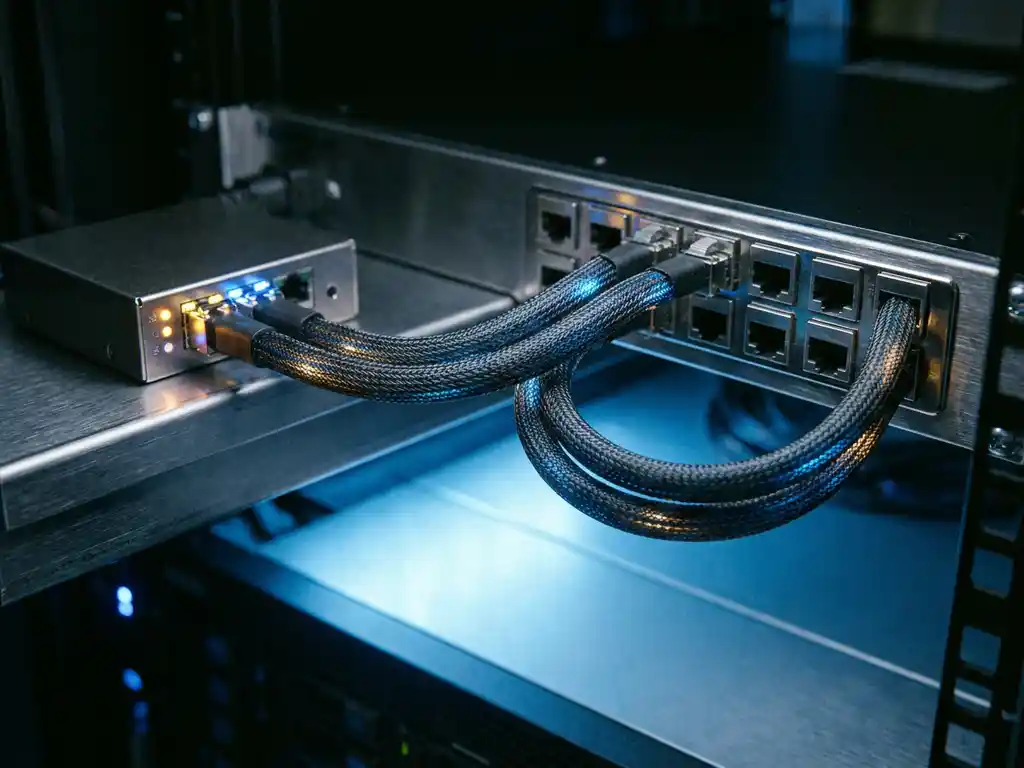
Active fiber optic monitoring sends its own test signals through the fiber to detect problems, while passive monitoring only analyzes existing signals in the network without injecting anything itself. The difference lies in how information is collected: active monitoring is proactive and measurement driven, while passive monitoring is observational and non-invasive. Which approach you choose depends on your network environment, the required level of accuracy, and the available infrastructure. Below, we answer the most frequently asked questions about both methods.
How does active fiber optic monitoring work technically?
Active fiber optic monitoring works by sending optical test signals through the fiber optic cable and measuring the returning reflections. The most widely used technique for this is OTDR (Optical Time Domain Reflectometry). An OTDR device sends light pulses through the fiber and analyzes how and when the light reflects back. This allows the location and severity of faults, break points, or signal degradation to be mapped with precision. Learn more about our optical products that support these measurement techniques.
What makes active monitoring powerful is its ability to pinpoint problems to within a meter. If something goes wrong somewhere in a cable spanning dozens of kilometers, you know almost immediately exactly where it is. Modern active monitoring systems can do this continuously and automatically, so you don’t need to take manual measurements.
Active systems do require measurement equipment to be connected to the network. In some cases, a dedicated test port or splitter is used for this purpose, so that production traffic is not disrupted. The infrastructure for real-time fiber optic monitoring is therefore somewhat more complex than with passive methods, but it delivers far more detailed information.
How does passive fiber optic monitoring work technically?
Passive fiber optic monitoring analyzes the light already flowing through the network without introducing any signals of its own. The system listens in on existing data transmissions and measures parameters such as optical power, signal noise, and wavelength shifts. No test signals are generated, meaning the network is neither loaded nor affected.
Passive monitoring makes use of optical taps or splitters that divert a small portion of the light signal to a measurement module. That module continuously analyzes signal quality. Changes in power or wavelength can indicate wear, bending losses, or an impending fault.
A key advantage of passive monitoring is that it operates completely transparently to the network. There is no risk of interference with live traffic. The drawback is that passive systems are less precise when it comes to locating exactly where a problem exists. They excel at detecting that something has changed, but are less effective at pinpointing the exact cause.
Ready for the next step?
Explore our solutions or get in touch with one of our experts directly.
What are the main differences between active and passive monitoring?
The core difference between active and passive fiber optic monitoring lies in the measurement method: active monitoring generates its own test signals, while passive monitoring only observes existing signals. This results in fundamentally different characteristics in terms of accuracy, complexity, and applicability.
- Measurement method: Active injects light pulses; passive analyzes existing signals
- Localization precision: Active can pinpoint faults to within a meter; passive provides a more general picture
- Impact on the network: Passive is completely non-invasive; active requires a measurement interface
- Required hardware: Active requires OTDR equipment or integrated measurement modules; passive works with simple optical taps
- Cost: Active systems are generally more expensive to purchase and install
- Response speed: Both methods can operate in real time, but active provides greater diagnostic depth
For monitoring and network management, active monitoring offers deeper insight into the physical condition of the cable, while passive monitoring is better suited to continuous signal monitoring without disrupting the network.
When should you choose active monitoring for a fiber optic network?
Active fiber optic monitoring is the right choice when you need precise diagnostic information about the physical condition of your fiber optic infrastructure. This is especially true for long connections, complex cable routes, or networks where downtime has immediate operational consequences.
Situations where active monitoring is the preferred option:
- You manage long fiber optic connections, such as in transportation, energy, or telecommunications
- Your network is business critical and you want to locate faults before they lead to outages
- There is regular excavation work or physical risk near the cable route
- You need detailed reports for maintenance purposes or SLA accountability
- You work with dark fiber or unmanaged fiber optic connections that carry no active traffic signal
For organizations in sectors such as critical infrastructure, data centers, or transportation, active monitoring is almost always the standard. The investment in measurement equipment is more than offset by the cost of unplanned downtime or lengthy searches for a fault location.
When is passive fiber optic monitoring sufficient?
Passive fiber optic monitoring is sufficient when your primary goal is to monitor signal quality on an active network without placing a burden on the infrastructure or deploying complex measurement equipment. It is a good choice for networks where continuous availability of the monitoring process itself is critical.
Passive monitoring is well suited to the following situations:
- You want to continuously monitor optical power levels on a live network
- The cable routes are relatively short and straightforward
- You already have an active monitoring system and want to supplement it with a lightweight layer
- The environment requires minimal interference with the network, such as in sensitive production environments
- Budget constraints make a fully active system less feasible
Passive monitoring is also well suited as an early warning system. If optical power gradually decreases, a passive system will raise an alert before an actual fault occurs. This allows you to schedule preventive maintenance rather than reacting after the fact.
Can active and passive monitoring be used together?
Yes, active and passive fiber optic monitoring can work together very effectively and complement each other well. Passive monitoring provides a continuous, non-invasive layer of signal monitoring, while active monitoring delivers in-depth diagnostics as soon as an anomaly is detected.
In practice, a combined approach works as follows: the passive system continuously monitors signal quality and triggers an alert when anomalies occur. At that point, an active OTDR system can be activated to determine the exact location and nature of the problem. This limits the use of the more expensive active measurement equipment to moments when it is truly needed.
For networks where both availability and security are important, a combined approach also offers advantages in the area of protecting sensitive data. Unauthorized physical access to a fiber optic cable such as a tapping attempt can be detected through changes in the optical signal that a passive system picks up.
The combination of both methods is therefore increasingly becoming the standard in professional fiber optic networks that place high demands on uptime, security, and maintenance efficiency.
How we help with fiber optic monitoring
A well-monitored fiber optic network starts with the right choice between active and passive monitoring or a combination of both. We help organizations make that choice and handle the full implementation. Our approach is always practical and tailored to your specific network environment and operational requirements.
What we offer in the area of fiber optic monitoring and network surveillance:
- Consulting and design: We analyze your current infrastructure and determine which monitoring method best fits your situation
- Active monitoring solutions: Including OTDR based systems for accurate fault localization and continuous cable monitoring
- Passive monitoring systems: For non-invasive, continuous signal monitoring on live networks
- Combined approaches: We integrate active and passive monitoring into a single, coherent management platform
- End-to-end support: From installation and configuration to management and troubleshooting throughout the entire lifecycle
Want to find out which monitoring approach best suits your fiber optic network? Explore our managed services or contact us for a no-obligation conversation with one of our engineers.
Ready for the next step?
Explore our solutions or get in touch with one of our experts directly.