


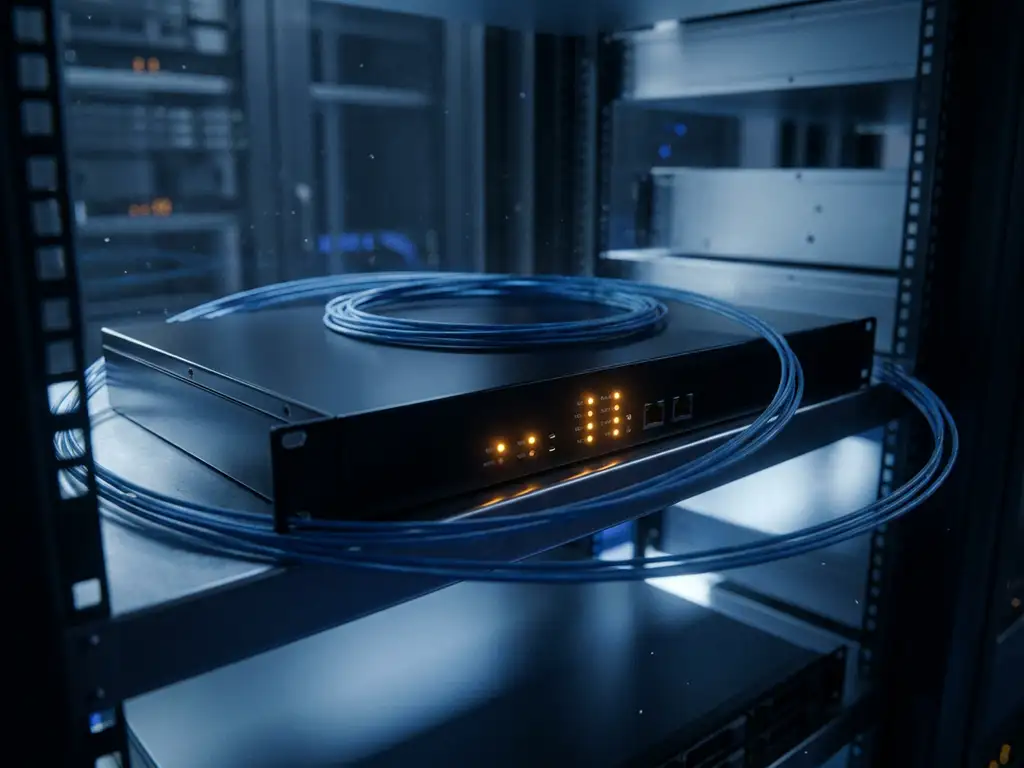
A network encryptor is a device or system that encrypts data traffic as it travels through a network, preventing unauthorized parties from reading or intercepting the information. Encryption takes place at the network level, transparently for applications and end users. In this article, we answer the most frequently asked questions about network encryption: from how it works to which organizations need it and what to look for when choosing a solution.
How does a network encryptor protect your data traffic?
A network encryptor protects your data traffic by encrypting all data passing through the network before it is transmitted, and decrypting it upon arrival. Only parties with the correct cryptographic keys can read the information. For attackers who intercept the traffic, the data is rendered unreadable.
The protection works independently of the protocol or application sending the data. Whether it involves database traffic, video conferencing, or file transfers, everything is encrypted at the network level. This makes network-level data encryption particularly powerful, as you do not need to secure each application individually.
Network encryptors typically operate inline with your existing infrastructure. They are placed at strategic points in the network, for example between locations or at the edge of a data center. Encryption occurs with minimal latency, meaning your network performance is barely affected.
What is the difference between layer 1 and layer 2 encryption?
Layer 1 encryption encrypts data at the physical layer of the network, directly on the transmission medium such as fiber optic cable. Layer 2 encryption operates at the data link layer and encrypts Ethernet frames, including all higher-level protocols. The core difference lies in the level at which security is applied and the degree of transparency to higher network layers.
Layer 1: encryption at the physical layer
With layer 1 encryption, the signal itself is encrypted before any structured data packets exist. This offers the highest degree of transparency: the network does not “see” the encryption, and all higher layers function entirely unchanged. This type of encryption is particularly well suited for fiber optic connections where you want to secure the transmission itself.
Layer 2: encryption at the data link layer
Layer 2 encryption encrypts Ethernet frames, operating at a level where the encryptor is aware of the network structure. This provides greater flexibility in configuration and management, and makes it possible to selectively secure specific connections or segments. Layer 2 encryption solutions are widely applicable in enterprise and carrier environments.
Both methods offer a high level of security with low latency. The choice depends on your network architecture, the nature of your connections, and the requirements of your sector.
Ready for the next step?
Explore our solutions or get in touch with one of our experts directly.
Which organizations need a network encryptor?
Organizations that handle sensitive, business-critical, or legally protected information benefit most from a network encryptor. Think of sectors where data breaches have major operational, financial, or legal consequences. In 2026, network security encryption has become a baseline requirement for a growing number of sectors, not merely an option.
Concrete examples of organizations that deploy a network encryptor:
- Hospitals and healthcare institutions that exchange patient data between locations
- Government agencies with confidential communications and statutory security obligations
- Data centers and cloud providers securing data center interconnects (DCI)
- Financial institutions protecting transaction data and customer information
- Critical infrastructure such as energy companies, transportation, and ports
- Educational institutions processing research data and personal information
Organizations with connections between multiple locations, such as branch offices or campuses, also benefit from protection of sensitive data at the network level. As soon as data leaves an internal network and travels over shared infrastructure, encryption is essential.
How does a network encryptor compare to a VPN?
A network encryptor and a VPN both secure data traffic, but do so in fundamentally different ways. A VPN operates at higher OSI layers (layer 3 or above) using software and tunneling protocols. A network encryptor operates at layer 1 or 2 using hardware, resulting in lower latency, higher throughput, and transparency for all protocols above it.
The practical differences are significant:
- Latency: Hardware-based network encryptors add microseconds of delay. VPN connections typically add tens of milliseconds due to software-based processing.
- Scalability: Network encryptors can handle high bandwidths without performance loss. VPN concentrators become a bottleneck under heavy load.
- Transparency: A network encryptor is fully transparent to applications and higher network layers. A VPN requires configuration on both sides and is visible to the network.
- Use case: VPNs are suitable for individual users or small branch offices. Network encryptors are designed for site-to-site connections with high demands on reliability and performance.
For organizations with business-critical connections, a network encryptor is therefore a better choice than a VPN, especially when latency and availability are decisive factors.
What are quantum-safe network encryptors?
Quantum-safe network encryptors are encryption devices that use cryptographic algorithms resistant to attacks by quantum computers. Classical encryption algorithms can theoretically be broken by powerful quantum computers. Quantum-safe encryption addresses this problem by relying on mathematical problems that are unsolvable even for quantum computers.
This is relevant because quantum computers are becoming increasingly powerful. The threat is not purely future-facing: attackers can already store encrypted traffic today and decrypt it later once quantum computers become available. This is known as the “harvest now, decrypt later” attack strategy.
Quantum-safe network encryptors typically combine classical encryption with post-quantum cryptography (PQC), the new standards being established by international standards bodies. This ensures you are protected both today and in the future.
What should you look for when choosing a network encryptor?
When selecting a network encryptor, performance, compatibility, certifications, and manageability are the most important criteria. The right choice depends on your specific network architecture, the sensitivity of your data, and the requirements of your sector or applicable regulations.
Pay attention to the following points when making your selection:
- Encryption layer: Choose layer 1 or layer 2 based on your infrastructure and transparency requirements.
- Throughput and latency: Ensure the encryptor can handle your current and future bandwidth needs without noticeable delay.
- Quantum safety: Ask whether the solution supports post-quantum cryptography, especially for long-term connections.
- Certifications: Verify that the device meets the relevant standards for your sector, such as Common Criteria or sector-specific requirements.
- Management and monitoring: Good encryptors offer centralized management capabilities and integrate with existing monitoring and network management tools.
- Scalability: Choose a solution that grows with your organization and easily supports new connections.
- Vendor independence: Vendor-neutral advice helps you select the solution that truly fits your situation, not the preference of a single manufacturer.
How we help with network encryption
We help organizations secure their data traffic at the deepest layers of the network, with encryption solutions tailored to your infrastructure, sector, and security requirements. Our approach is vendor-independent: we select the solution that genuinely matches your situation, not a standard product list.
What we offer:
- Advice on the right encryption layer (layer 1 or layer 2) based on your network architecture
- Implementation of quantum-safe encryption for future-proof security
- Integration with existing infrastructure, without modifications to higher network layers
- End-to-end support: from design and implementation to management and monitoring
- Sector-specific expertise for healthcare, government, data centers, critical infrastructure, and more
Want to find out which network encryptor is right for your situation? Get in touch with us and we will be happy to think it through with you.
Ready for the next step?
Explore our solutions or get in touch with one of our experts directly.