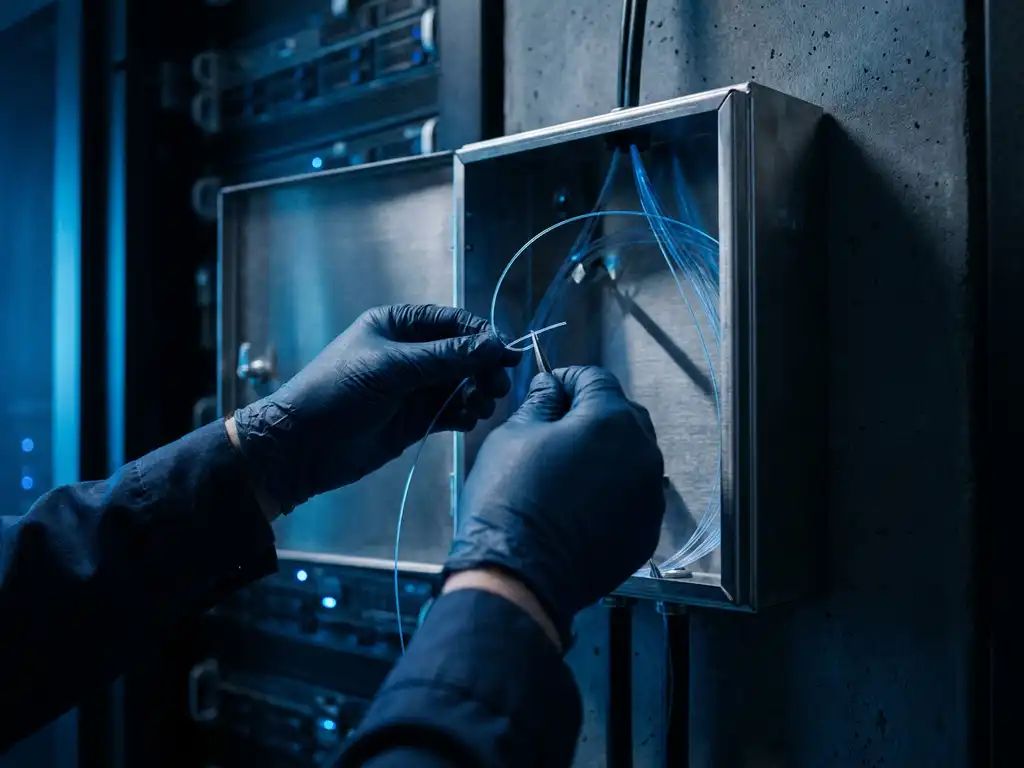
Yes, a fiber optic network can be tapped, but it requires targeted physical access to the cable. Fiber optic technology transmits data as pulses of light, which makes eavesdropping more difficult than with copper cables but certainly not impossible. For organizations that handle sensitive or business-critical information, it is therefore essential to take active protective measures. In this article, we answer the most frequently asked questions about fiber optic eavesdropping and how to effectively secure a fiber optic network.
Can a fiber optic network be tapped?
Yes, a fiber optic network can be tapped. Although fiber optic cables are inherently more secure than copper, they are not immune. By physically bending or coupling a fiber optic cable, light leaks from the core. With the right equipment, an attacker can capture this light and reconstruct the data stream without noticeably interrupting the connection.
This type of attack is known as a fiber tap or optical tap. What makes it particularly dangerous is that it can be carried out passively: the attacker reads the data without actively injecting traffic or disrupting the connection. Network management systems that only monitor traffic flows often fail to detect this type of attack. For sectors such as healthcare, government, and critical infrastructure, this is a serious risk that should not be underestimated and one that calls for robust network security solutions tailored to the physical layer.
What attack methods are used in fiber optic eavesdropping?
Fiber optic eavesdropping primarily involves three methods: the bend tap, the splitter attack, and the connector attack. Each of these techniques exploits a vulnerability in the physical infrastructure to extract and read light from the cable.
- Bend tap: The cable is bent sharply, causing light to leak from the core. A photodetector captures this light. This method is relatively simple and leaves no visible damage.
- Splitter attack: An optical splitter is inserted into the cable to create a copy of the signal. This requires direct access to the cable or a patch panel.
- Connector attack: At an unsecured patch cabinet or connector, an attacker can insert an intermediate device to copy the signal.
All of these methods require physical access to the cable or a distribution point. This makes physical access security a first line of defense. However, physical security alone is not enough: even with strict access controls, an insider or compromised vendor can gain access to critical cable routes.
Ready for the next step?
Explore our solutions or get in touch with one of our experts directly.
How does layer 1 encryption protect against eavesdropping?
Layer 1 encryption, also known as physical encryption, encrypts data traffic directly at the physical transmission layer of the network. This means that the light pulses traveling through the fiber optic cable are already encrypted before they enter the network. Even if an attacker manages to tap the optical signal, they receive only unreadable, encrypted data.
The strength of layer 1 encryption lies in its transparency and speed. Because encryption takes place at the lowest level of the network, higher-level protocols and applications do not need to be modified. The encryption is invisible to end users and introduces minimal latency. This makes it particularly well suited to environments where both speed and security are critical, such as data centers, hospitals, and industrial networks. Organizations looking to implement this kind of protection can explore dedicated optical networking products designed for exactly these use cases.
Another advantage is that layer 1 encryption operates in a protocol-agnostic manner: it secures all data traffic regardless of which protocol or application runs on top of the network. This provides broader and more consistent protection than encryption applied higher in the network stack.
What is the difference between layer 1 and layer 2 encryption for fiber optics?
The key difference between layer 1 and layer 2 encryption is the level at which encryption takes place and what exactly is protected. Layer 1 encryption operates at the physical transmission layer and encrypts the raw optical signal. Layer 2 encryption operates at the data link layer and encrypts Ethernet frames, including their associated metadata.
Layer 1 encryption: maximum transparency
Layer 1 encryption is completely transparent to the network and all higher layers. It encrypts everything transmitted over the fiber optic connection, without distinguishing between protocol or frame structure. This offers the broadest protection and the lowest latency, but requires specialized hardware placed directly in the transmission paths.
Layer 2 encryption: flexible and widely deployable
Layer 2 encryption, such as MACsec, operates at the Ethernet frame level and can be configured per network segment or VLAN. This makes it more flexible within existing network architectures and suitable for environments where granular control is desired. The encryption protects the data content of frames, but metadata such as MAC addresses may remain visible in some implementations.
In practice, both layers are sometimes combined for a layered security approach. The best choice depends on the infrastructure, the sensitivity of the data, and the specific threats you want to protect against. A comprehensive overview of available networking solutions can help identify the right fit for your environment.
What other measures physically protect a fiber optic network?
In addition to encryption, there are several physical measures that protect a fiber optic network against eavesdropping and sabotage. Effective security combines technical and organizational measures to minimize the risk of unauthorized physical access.
- Real-time fiber optic monitoring: Optical monitoring systems detect anomalies in the signal immediately. An unexpected signal loss or reflection may indicate a tap attempt or physical damage.
- Secured cable routes: Ensure that fiber optic cables run through protected channels or conduits, preferably in areas with access control and camera surveillance.
- Locked patch cabinets and distribution points: Distribution points are attractive targets for attackers. Use locked cabinets and keep a record of who has access and when.
- Cable break alarm systems: Some systems detect even minor changes in cable integrity, such as bending or pressure on the cable, and trigger an immediate alert.
- Out-of-band management: Manage your network via a separate management network so that a compromise of production traffic does not automatically grant access to the management infrastructure.
Physical security and encryption reinforce each other. Even if an attacker gains physical access, encryption renders the tapped data useless. And effective monitoring ensures that any such attempt is detected quickly.
When is quantum encryption relevant for fiber optic security?
Quantum encryption becomes relevant when the sensitivity of data is so high that you also want to guard against future threats. Classical encryption is robust today, but quantum computers may eventually be capable of breaking certain encryption algorithms. For organizations that handle long-term confidential information, this is a real risk.
One specific threat scenario is the so-called harvest now, decrypt later attack: an adversary intercepts encrypted traffic today and stores it until quantum computers are powerful enough to break the encryption. For sectors such as defense, government, and critical infrastructure, this scenario is no longer a distant concern. It is a current risk that demands attention now.
Quantum-safe encryption, also known as post-quantum cryptography, uses algorithms that are resistant to attacks by quantum computers. In addition, Quantum Key Distribution (QKD) offers a method by which keys are exchanged using quantum mechanical principles, making eavesdropping physically detectable.
Quantum encryption is not immediately necessary for every organization, but for those who are thinking today about the lifespan of confidential data, it is wise to build a future-proof infrastructure now.
How we help secure your fiber optic network
Effectively securing a fiber optic network requires more than a single measure. It calls for a coherent approach that combines physical security, encryption, and monitoring tailored to your specific infrastructure and industry.
We help organizations design and implement a comprehensive security strategy for fiber optic networks. Specifically, we offer:
- Physical encryption at layer 1 and layer 2, protecting all data traffic transparently and with minimal latency, regardless of protocol or application
- Real-time optical monitoring, so that anomalies in the network are detected immediately and you can respond quickly
- Quantum-safe encryption solutions, for organizations that want to ensure their security over the long term
- Vendor-independent advice, with solutions from partners such as Adtran, Nokia, and Cisco, fully tailored to your infrastructure
- End-to-end guidance, from design and implementation to management and support throughout the entire lifecycle, backed by our managed services
Want to find out which security measures are right for your network and organization? Contact us for a no-obligation consultation. We are happy to think along with you.
Ready for the next step?
Explore our solutions or get in touch with one of our experts directly.