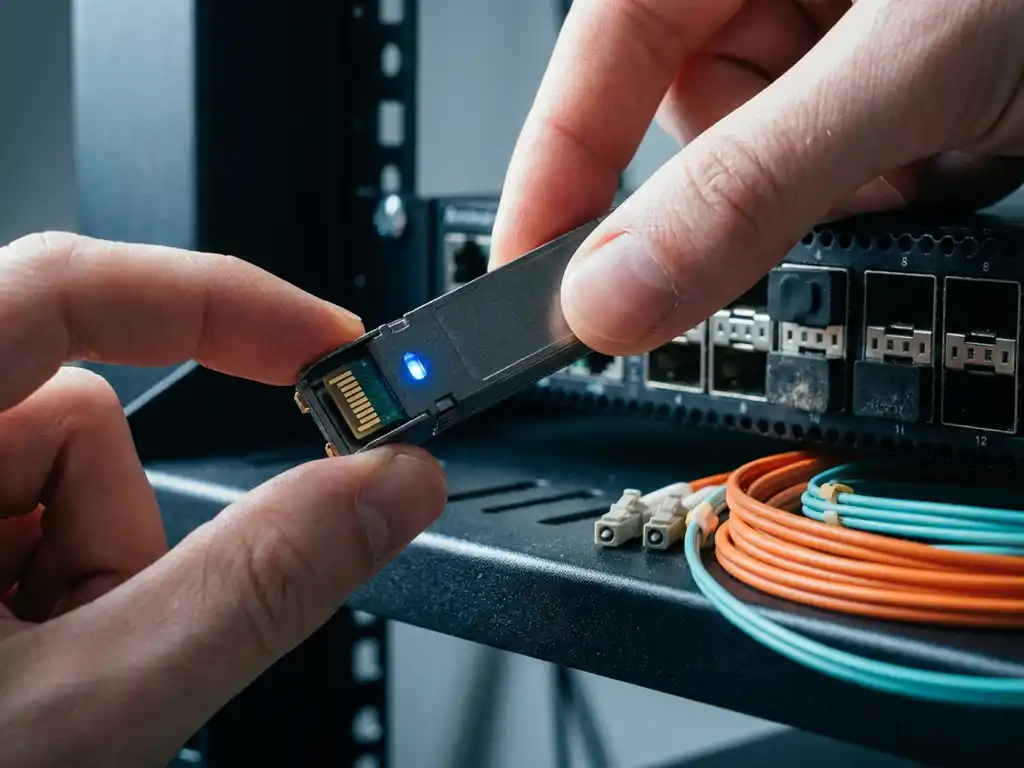
Choosing the right SFP module determines the performance and reliability of your network connection. A wrong choice leads to connectivity issues, data loss, and unnecessary costs. The right SFP module depends on your network infrastructure, distance requirements, speed needs, and compatibility with existing equipment. This guide answers the most important questions about selecting the optimal fiber optic SFP for your specific network environment.
What is an SFP module and why does choosing the right one matter so much?
An SFP module (Small Form-factor Pluggable) is a hot-pluggable transceiver that connects network equipment via fiber optic cables. These compact modules convert electrical signals into optical signals and vice versa, enabling data to be transmitted over fiber optic connections.
SFP modules form the backbone of modern fiber optic communication. They make it possible to support different speeds, distances, and cable types within the same network equipment. This provides flexibility when designing and upgrading network infrastructure.
A wrong choice has direct consequences for your network performance. Incompatible modules can lead to connection failures, reduced throughput speeds, or even damage to equipment. In addition, incorrect specifications often result in unnecessary replacement costs and downtime.
The right SFP module ensures stable, reliable network connections that perform optimally within the desired parameters. This prevents costly problems and guarantees that your optical networking investment retains its value.
What different types of SFP modules are there and what are their applications?
SFP modules are available in various form factors and speeds. Standard SFP supports speeds up to 1 Gbps, SFP+ up to 10 Gbps, and SFP28 up to 25 Gbps. Each variant has specific application areas within the network infrastructure.
Standard SFP modules (1G) are commonly used for access networks, smaller office connections, and edge connectivity. They offer a cost-effective solution for basic fiber optic communication where higher speeds are not required.
SFP+ modules (10G) are popular in enterprise environments, data centers, and aggregation networks. They offer a good balance between performance and cost for many business applications. These modules support both short- and long-distance connections.
SFP28 modules (25G) are primarily used in high-performance computing, large data centers, and carrier-grade networks. They deliver the highest performance for critical applications where bandwidth is essential.
Each type comes in various variants for multimode and single-mode fiber, with a range of reach specifications from a few hundred meters to tens of kilometers. Browse our full product range to find the right module for your environment.
Ready for the next step?
Explore our solutions or get in touch directly with one of our experts.
How do you determine whether you need a multimode or single-mode SFP module?
The choice between multimode and single-mode depends on the distance you need to cover and your budget. Multimode fiber works well for short distances up to approximately 500 meters, while single-mode is suitable for long distances of up to 80 kilometers or more.
Multimode SFP modules use LEDs or VCSEL lasers and are more cost-effective for short-distance connections. They are ideal for connections within buildings, between floors, or for short campus links. The fiber optic cables are also less expensive than single-mode variants.
Single-mode SFP modules use laser technology and can bridge much greater distances without significant signal loss. They are essential for connections between buildings, across cities, or for long WAN links. Although the initial cost is higher, they offer superior performance over long distances.
Consider your future expansion plans as well. If you expect distances to increase, investing in single-mode from the outset can result in cost savings down the line. For stable, short-distance connections, multimode remains a practical choice.
Always verify the specifications of your existing fiber optic infrastructure. Multimode and single-mode cables are not interchangeable, so your SFP choice must align with your current cabling.
What should you look for when checking SFP compatibility with your network equipment?
SFP compatibility requires attention to vendor specifications, MSA compliance, and DOM functionality. Not all SFP modules work with every brand of network equipment, despite identical technical specifications.
MSA compliance (Multi-Source Agreement) guarantees that modules meet industry standards. MSA-compliant modules typically work with equipment from multiple vendors, reducing vendor lock-in and increasing flexibility.
Many network manufacturers, such as Cisco, HPE Aruba, and Nokia, enforce their own firmware requirements for SFP modules. These vendor-specific modules are often more expensive, but guarantee full compatibility and support.
DOM functionality (Digital Optical Monitoring) provides real-time monitoring of temperature, voltage, current, and optical power. This information is valuable for proactive network management and troubleshooting.
Always test new SFP modules in a controlled environment before deploying them. Verify that all features work correctly, including link detection, speed negotiation, and monitoring capabilities.
Consider third-party SFP modules that offer vendor compatibility at a lower cost. These can deliver significant savings without sacrificing functionality, provided you choose reliable suppliers.
What SFP solutions does Netways Europe offer for your network infrastructure?
We offer a comprehensive portfolio of SFP modules with vendor-independent advice for optimal network performance. Our expertise in optical networking solutions helps you make the right choice for your specific network needs, from 1G to 25G applications.
Our SFP range includes modules from well-known brands such as Nokia, Cisco, and HPE Aruba, as well as high-quality third-party alternatives. We ensure full compatibility with your existing network infrastructure while pursuing cost optimization.
For complex optical networking projects, we provide consultation from the design phase onward. We analyze your current infrastructure, future growth plans, and budget requirements to develop the most suitable SFP strategy.
Our optical networking products include not only SFP modules, but also QSFP modules, media converters, and complete WDM systems. This integrated approach ensures optimal performance and compatibility.
We support you throughout the entire product lifecycle, from selection and implementation to maintenance and upgrades. Our optical solutions are designed for maximum reliability and future-readiness, ensuring your investment delivers lasting value for your fiber optic communication infrastructure.
Frequently Asked Questions
How do I test whether a new SFP module is working correctly before I deploy it?
First test the SFP module in a controlled test environment using the same type of equipment as in production. Check the link status, measure optical power levels with a power meter, test data transfer with traffic generators, and monitor DOM values for at least 24 hours. Document all test results before putting the module into production.
What are the most common mistakes when selecting SFP modules?
The biggest mistakes are mixing up multimode and single-mode types, ignoring distance limits, choosing incompatible wavelengths, and failing to check vendor-specific firmware requirements. It is also easy to overlook future expansion when planning, which can lead to costly replacements later on.
Can third-party SFP modules cause problems with warranties and support?
Some network manufacturers may reject warranty claims when third-party modules are used, even though this is often technically unjustified. For this reason, choose reputable third-party suppliers that guarantee vendor compatibility and offer their own warranty. Always document that any issues are not related to the SFP module itself.
How can I extend the lifespan of my SFP modules?
Ensure adequate cooling in your network cabinets, avoid repeatedly inserting and removing modules, use dust caps on unused modules, and monitor DOM values regularly for early warnings. Store spare modules in anti-static packaging in a dry, cool location, and perform regular optical connector cleaning.
Which DOM parameters should I monitor for proactive network management?
Pay particular attention to temperature (must remain within specifications), optical transmit/receive power (signal degradation can indicate cable issues), laser bias current, and supply voltage. Set alarms at 80% of the threshold values to catch problems before they occur.
How do I calculate the optical power budget for my fiber optic connection?
Add up the total loss of all components: cable attenuation (0.5 dB/km for single-mode, 3.5 dB/km for multimode), connector losses (0.3–0.5 dB per connection), splice losses, and any splitter losses. Make sure this total loss stays within the power budget of your SFP module, with a minimum margin of 3 dB to account for aging and temperature variations.
Ready for the next step?
Explore our solutions or get in touch directly with one of our experts.