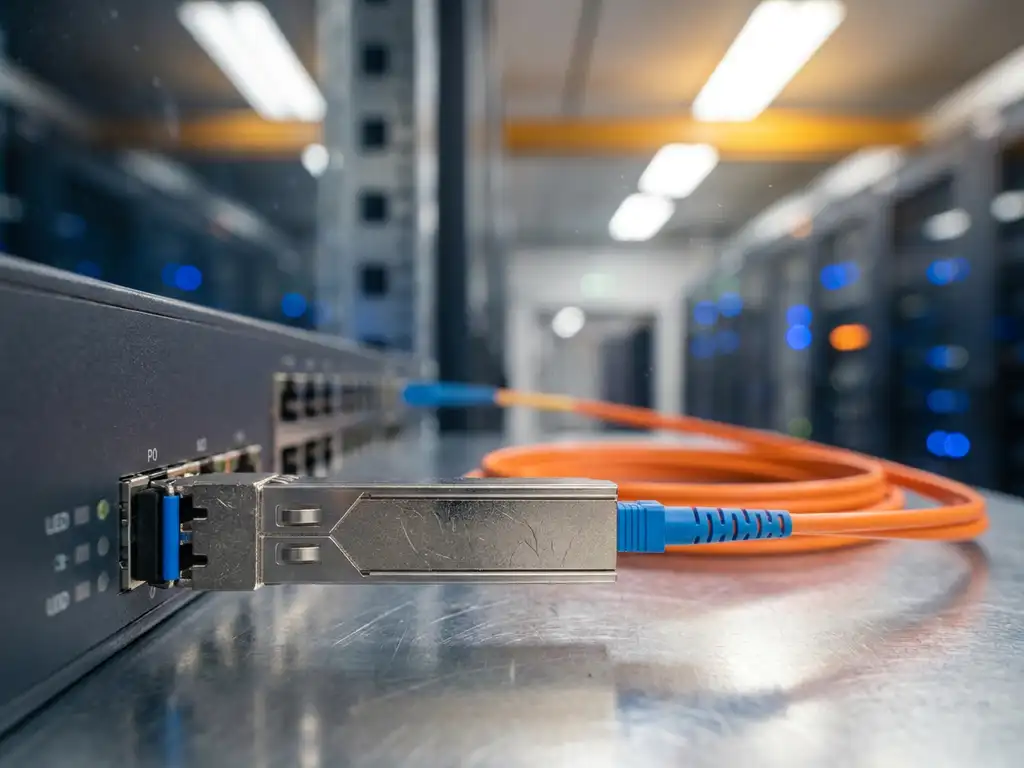
A standard SFP module has a range of 500 meters to 120 kilometers, depending on the type of fiber and the SFP variant. Multimode SFP modules reach a maximum of 2 kilometers, while singlemode versions can bridge distances of up to 120 kilometers. The exact distance depends on factors such as fiber quality, connectors, and environmental conditions.
What is the maximum range of a standard SFP module?
The maximum range of an SFP module varies significantly between multimode and singlemode variants. Multimode SFP modules cover distances of 500 meters to 2 kilometers, while singlemode SFP modules reach much farther: from 10 kilometers to 120 kilometers.
The most common multimode SFP modules operate at a wavelength of 850 nm and are suited for short distances within buildings or campus networks. These modules are cost-effective for local fiber connections but have a limited range due to the characteristics of multimode fiber.
Singlemode SFP modules use wavelengths of 1310 nm or 1550 nm and are designed for long distances. The 1310 nm variants typically reach 10 to 40 kilometers, while 1550 nm modules can bridge distances of up to 120 kilometers. These modules are ideal for connections between different sites or data centers.
For optical networking applications, it is important to choose the right SFP transceiver based on the required fiber distance. The performance of the network connection is directly tied to the compatibility between the SFP module and the fiber infrastructure.
What factors affect the range of fiber connections?
The actual range of a fiber connection is affected by multiple external factors that attenuate the optical signal. Optical losses caused by connectors, splices, and cable quality can significantly reduce the effective range compared to the theoretical specifications.
Fiber quality plays a crucial role in overall performance. Older or damaged cables introduce additional losses, while high-quality fiber performs closer to its theoretical limits. Each connector adds approximately 0.3 to 0.5 dB of loss, and splices can cause 0.1 to 0.3 dB of loss.
Ambient temperature affects the performance of both the SFP module and the fiber itself. Extreme temperatures can lead to increased optical losses and reduced reliability of the network connection. This is especially relevant for outdoor installations.
The bend radius of the fiber is an often-underestimated factor. Excessively tight bends in the cable routing can cause microscopic cracks that weaken the optical signal. For singlemode fiber, the bend radius must be at least 15 times the cable diameter.
Ready for the next step?
Explore our solutions or get in touch directly with one of our experts.
How do you choose the right SFP module for your network distance?
Selecting the optimal SFP module starts with determining the exact distance and the type of fiber in your network infrastructure. Start by measuring the actual cable length, including all bends and slack lengths, and add a 20 to 30% margin for future adjustments.
For distances up to 2 kilometers, multimode SFP modules are usually the most cost-effective choice, provided you have multimode fiber available. For longer distances or when planning future expansion, singlemode modules are the better investment, despite the higher upfront cost.
Compatibility with the existing network infrastructure is essential. Check the specifications of your switches and routers to ensure that the chosen SFP modules are fully supported. Some devices have specific requirements for certain brands or types.
Budget considerations also play a role in the decision. Multimode modules and fiber are less expensive for short distances, but singlemode offers greater future-proofing. Consider the total cost of ownership over the lifetime of your fiber technology investment.
What are the alternatives when standard SFP modules fall short?
When standard SFP modules do not provide sufficient range, several advanced solutions are available. SFP+ modules support higher speeds and often longer distances as well, while optical amplifiers can boost the signal for additional reach.
DWDM (Dense Wavelength Division Multiplexing) technology makes it possible to transmit multiple signals over a single fiber and achieves distances of up to 200 kilometers or more. This solution is ideal for metropolitan networks and long-distance connections between data centers.
For more complex network needs, specialized optical networking products are available that go beyond standard SFP modules. These include advanced transceivers, optical switches, and WDM systems for professional applications.
Professional optical solutions can also include optical regenerators and inline amplifiers. These devices amplify or regenerate the optical signal along the way, enabling much longer distances without any loss of signal integrity.
The choice of advanced optical range extensions depends on your specific requirements, budget, and future growth plans. A thorough analysis of your network architecture will help determine the most suitable solution for your fiber connectivity challenges. If you need expert guidance, managed services can provide ongoing support and optimization for your fiber infrastructure.
Frequently Asked Questions
How do I calculate the exact optical loss in my fiber connection?
Calculate the total loss by adding up all components: fiber cable (0.2–0.4 dB/km), connectors (0.3–0.5 dB each), and splices (0.1–0.3 dB per splice). Add a 3–6 dB safety margin to the total. Use an optical power meter for accurate measurements of actual signal loss.
Can I use a singlemode SFP module on multimode fiber?
No, this is not recommended. Singlemode SFP modules are designed for the smaller core diameter (9 μm) of singlemode fiber, whereas multimode fiber has a much larger core (50 or 62.5 μm). The incompatibility leads to significant optical losses and unreliable connections.
What should I do if my SFP module does not reach the expected distance?
First, check all connectors for contamination and clean them if necessary. Verify the fiber quality and look for damage or excessively tight bends. Measure the optical power with a power meter and compare it to the SFP specifications. Consider replacing old connectors or upgrading to a more powerful SFP variant.
How often should fiber connectors be cleaned for optimal performance?
Always clean connectors before every new connection, including with new equipment. For existing connections, cleaning is needed when performance issues arise, or at least annually for critical connections. Use specialized fiber cleaning kits and inspect connectors with a microscope for best results.
Is it possible to extend the range of existing SFP modules without new hardware?
Yes, by optimizing existing components. Replace old connectors with high-quality alternatives, eliminate unnecessary splices, and ensure optimal cable routing without tight bends. A thorough cleaning of all optical components can also recover 1–3 dB of loss, increasing the effective range.
What temperature ranges are critical for SFP module performance?
Standard SFP modules operate optimally between 0°C and 70°C. At temperatures above 85°C or below -10°C, performance can decrease significantly. For outdoor applications, specialized industrial-grade SFP modules are available that can handle temperatures from -40°C to +85°C without performance degradation.
Ready for the next step?
Explore our solutions or get in touch directly with one of our experts.